. 2023 Jan 31;13(1):1803.
doi: 10.1038/s41598-023-28355-z.

CENPF knockdown inhibits adriamycin chemoresistance in triple-negative breast cancer via the Rb-E2F1 axis

Affiliations

CENPF knockdown inhibits adriamycin chemoresistance in triple-negative breast cancer via the Rb-E2F1 axis

Depeng Wang et al. Sci Rep. .

Abstract

Drug resistance occurs frequently in triple-negative breast cancer (TNBC) and leads to early relapse and short survival. Targeting the DNA damage response (DDR) has become an effective strategy for overcoming TNBC chemoresistance. CENPF (centromere protein) is a key regulator of cell cycle progression, but its role in TNBC chemotherapy resistance remains unclear. Here, we found that CENPF, which is highly expressed in TNBC, is associated with a poor prognosis in patients receiving chemotherapy. In addition, in vitro CENPF knockdown significantly increased adriamycin (ADR)-induced cytotoxicity in MDA-MB-231 cells and ADR-resistant cells (MDA-MB-231/ADR). Then, we demonstrated that CENPF targets Chk1-mediated G2/M phase arrest and binds to Rb to compete with E2F1 in TNBC. Considering the crucial role of E2F1 in the DNA damage response and DNA repair, a novel mechanism by which CENPF regulates the Rb-E2F1 axis will provide new horizons to overcome chemotherapy resistance in TNBC.


Conflict of interest statement

The authors declare no competing interests.

Figures
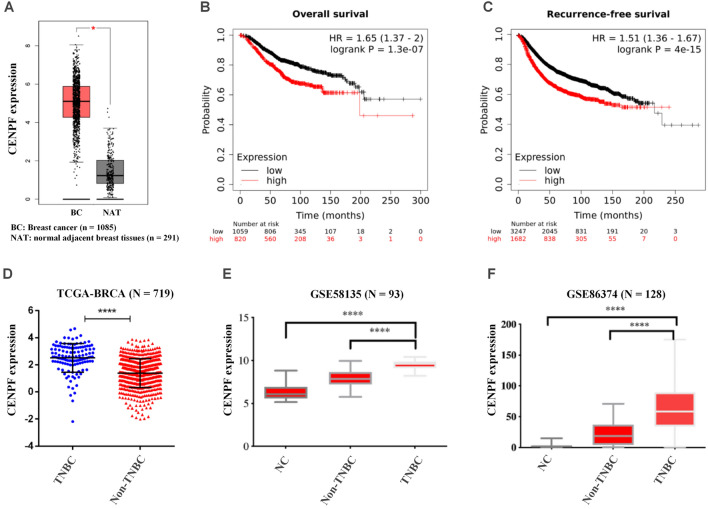
Figure 1
Figure 1
CENPF is highly expressed in triple-negative breast cancer. (A) CENPF expression in breast cancer tissues (n = 1,085) and adjacent peritumoral tissues (n = 291) from the TCGA and GTEx databases using GEPIA (http://gepia.cancer-pku.cn/index.html). (B,C) Overall survival (B, n = 1 879, log-rank P = 1.3e−07) and recurrence-free survival (C, n = 4929, log-rank P < 1e−15) of breast cancer patients. Data were obtained from Kaplan‒Meier Plotter (http://kmplot.com/analysis/). (DF) Based on data from the TCGA (D), GSE58135 (E) and GSE86374 (F), CENPF expression in TNBC and non-TNBC samples. Data shown represent the means (± standard deviation [SD]); *P < 0.05, ****P < 0.0001; log-rank test (B,C), Student’s t test (D) or one-way ANOVA (E,F).
Figure 2
Figure 2
CENPF increases the ADR chemosensitivity of TNBC. (A,B) Recurrence-free survival in breast cancer patients receiving NACT (A, n = 403, log-rank P = 0.035) or TNBC treatment with NACT (B, n = 200, log-rank P = 0.031), using Kaplan‒Meier Plotter. (C) Overall survival in TNBC patients receiving NACT (C, n = 112, P = 0.02). Data were obtained from GSE25066. (D) Quantification of IHC staining for CENPF chemo-resistant and chemotherapy-sensitive TNBC. (E) CENPF mRNA quantification in MDA-MB-231, MDA-MB-468, MCF-7 and T47D cells performed by RT‒qPCR. F IC50 of adriamycin in MDA-MB-231 and MDA-MB-231/ADR cells. (GJ) We used a drug sensitivity assay to assess the effects of CENPF knockdown on ADR chemosensitivity in MDA-MB-231 (G) and MDA-MB-231/ADR (I) cells. We performed an Annexin V-FITC/PI apoptosis assay to investigate the role of CENPF in cell apoptosis with or without adriamycin in MDA-MB-231 (H) and MDA-MB-231/ADR (J) cells. Data shown represent the means (± SD) of three independent experiments; **P < 0.01, ***P < 0.001, ****P < 0.0001; NS, not significant; log-rank test (AC), nonlinear regression (F) or one-way ANOVA (GJ).
Figure 3
Figure 3
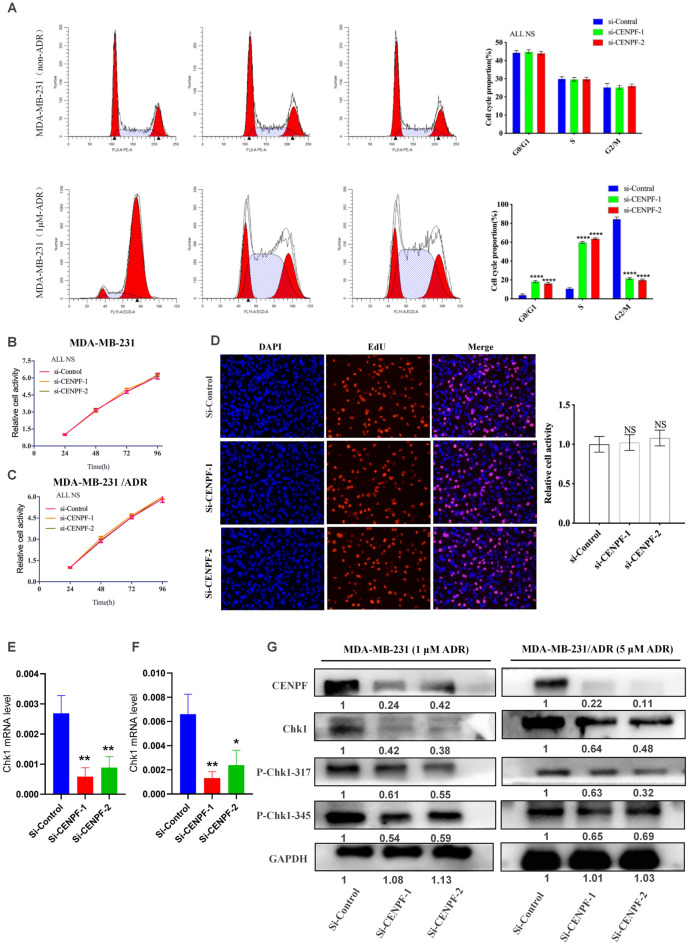
CENPF regulates ADR-induced G2/M phase arrest through Chk1. (A) Flow cytometry was performed to determine the effects of CENPF inhibition on cell cycle distribution with or without adriamycin in MDA-MB-231 cells. (B,C) The effect of CENPF inhibition on cell proliferation in MDA-MB-231 (B) or MDA-MB-231/ADR (C) cells. (D) Cell proliferation was determined by EdU assay. (E,F) Using RT‒qPCR, the mRNA level of CHK1 was detected in MDA-MB-231 (E) or MDA-MB-231/ADR (F) cells with CENPF knockdown. (G) Western blot analysis of the effect of CENPF knockdown on Chk1 expression and phosphorylation in MDA-MB-231 and MDA-MB-231/ADR cells exposed to adriamycin. Data shown represent the means (± SD) of three independent experiments; **P < 0.01, ****P < 0.0001; NS not significant; one-way ANOVA (AF).
Figure 4
Figure 4
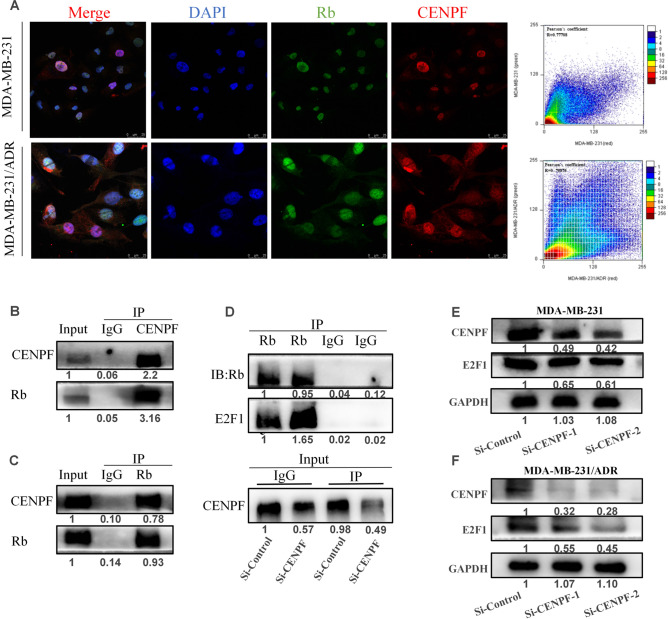
The Rb-E2F1 axis mediates the regulation of Chk1 expression by CENPF. (A) Colocalization of CENPF and Rb in MDA-MB-231 and MDA-MB-231/ADR cells. (B,C) Western blotting detected the binding protein of immunoprecipitated endogenous CENPF (B) or Rb (Rb). (D) Co-IP and western blotting demonstrated that CENPF and E2F1 compete for Rb binding. (E,F) Western blot analysis of the effect of CENPF knockdown on E2F1 expression.

References

    1. Siegel RL, Miller KD, Fuchs HE, Jemal A. Cancer statistics, 2022. CA Cancer J. Clin. 2022;72:1. doi: 10.3322/caac.21708. - DOI - PubMed
    1. Giovannelli P, Di Donato M, Auricchio F, Castoria G, Migliaccio A. Androgens induce invasiveness of triple negative breast cancer cells through AR/Src/PI3-K complex assembly. Sci. Rep. 2019;9:4490–4490. doi: 10.1038/s41598-019-41016-4. - DOI - PMC - PubMed
    1. Nedeljković M, Damjanović A. Mechanisms of chemotherapy resistance in triple-negative breast cancer-how we can rise to the challenge. Cells. 2019;8:957. doi: 10.3390/cells8090957. - DOI - PMC - PubMed
    1. Jabłońska-Trypuć A, Świderski G, Krętowski R, Lewandowski W. Newly synthesized doxorubicin complexes with selected metals-synthesis. Struct. Anti-Breast Cancer Act. Mol. 2017;22:1106. - PMC - PubMed
    1. Huang R-X, Zhou P-K. DNA damage response signaling pathways and targets for radiotherapy sensitization in cancer. Signal Transduct Target Ther. 2020;5:60–60. doi: 10.1038/s41392-020-0150-x. - DOI - PMC - PubMed

Publication types

MeSH terms