Review
. 2023 Feb 1;18(1):9.
doi: 10.1186/s13024-023-00595-7.

The gut microbiome in Alzheimer's disease: what we know and what remains to be explored

Affiliations
Review

The gut microbiome in Alzheimer's disease: what we know and what remains to be explored

Sidhanth Chandra et al. Mol Neurodegener. .

Abstract

Alzheimer's disease (AD), the most common cause of dementia, results in a sustained decline in cognition. There are currently few effective disease modifying therapies for AD, but insights into the mechanisms that mediate the onset and progression of disease may lead to new, effective therapeutic strategies. Amyloid beta oligomers and plaques, tau aggregates, and neuroinflammation play a critical role in neurodegeneration and impact clinical AD progression. The upstream modulators of these pathological features have not been fully clarified, but recent evidence indicates that the gut microbiome (GMB) may have an influence on these features and therefore may influence AD progression in human patients. In this review, we summarize studies that have identified alterations in the GMB that correlate with pathophysiology in AD patients and AD mouse models. Additionally, we discuss findings with GMB manipulations in AD models and potential GMB-targeted therapeutics for AD. Lastly, we discuss diet, sleep, and exercise as potential modifiers of the relationship between the GMB and AD and conclude with future directions and recommendations for further studies of this topic.

Keywords: Amyloid; Diet; Exercise; Gut microbiome; Human; Mouse; Neuroinflammation; Peripheral immunity; Sleep; Tau; Therapeutics.


Conflict of interest statement

The authors declare that they have no competing interests.

Figures

Fig. 1
Fig. 1
Theory of GMB involvement in AD. Environmental factors, such as diet, sleep, and exercise and the development of AD due to genetics contribute to an inflammatory environment in the gut microbiota, which leads to changes in composition and diversity over time. Changes in the gut microbiota influence gut microbiome-derived metabolites and peripheral immunity by altering peripheral immune cell gene expression and cytokine release. Changes in peripheral immunity, possibly gut-derived metabolites directly, and vagus nerve trafficked gut-derived hormones can then alter phenotype of the blood brain barrier and central nervous system cell types (microglia, astrocytes, neurons), which can then modulate amyloidosis, tauopathy, and neurodegeneration and contribute to disease pathogenesis
Fig. 2
Fig. 2
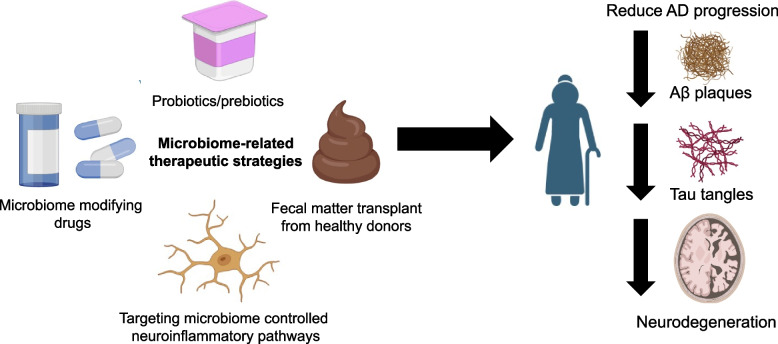
Microbiome-related therapeutic strategies for AD. Preliminary evidence from mouse and human studies suggests that probiotics/prebiotics, fecal matter transplant from healthy donors into AD patients, microbiome modifying drugs, and direct targeting of gut microbiome controlled neuroinflammatory pathways may potentially be disease modifying therapeutic strategies and may reduce amyloid, tau, and neurodegeneration

References

    1. Long JM, Holtzman DM. Alzheimer Disease: an update on pathobiology and treatment strategies. Cell. 2019;179(2):312–339. - PMC - PubMed
    1. Berer K, Mues M, Koutrolos M, Rasbi ZA, Boziki M, Johner C, et al. Commensal microbiota and myelin autoantigen cooperate to trigger autoimmune demyelination. Nature. 2011;479(7374):538–541. - PubMed
    1. Sampson TR, Debelius JW, Thron T, Janssen S, Shastri GG, Ilhan ZE, et al. Gut microbiota regulate motor deficits and neuroinflammation in a model of parkinson's disease. Cell. 2016;167(6):1469–80.e12. - PMC - PubMed
    1. Aho VTE, Houser MC, Pereira PAB, Chang J, Rudi K, Paulin L, et al. Relationships of gut microbiota, short-chain fatty acids, inflammation, and the gut barrier in Parkinson’s disease. Mol Neurodegener. 2021;16(1):6. - PMC - PubMed
    1. Minter MR, Zhang C, Leone V, Ringus DL, Zhang X, Oyler-Castrillo P, et al. Antibiotic-induced perturbations in gut microbial diversity influences neuro-inflammation and amyloidosis in a murine model of Alzheimer's disease. Sci Rep. 2016;6:30028. - PMC - PubMed

Publication types

Substances