


Ovarian volume partially explains associations of phthalate biomarkers with anti-Müllerian hormone and estradiol in midlife women
- PMID: 36724714
- PMCID: PMC10012419
- DOI: 10.1016/j.envint.2023.107771
Ovarian volume partially explains associations of phthalate biomarkers with anti-Müllerian hormone and estradiol in midlife women
Abstract
Background/objectives: Women are ubiquitously exposed to endocrine disruptors, including phthalates. Ovarian follicles undergoing folliculogenesis (indirectly measured by ovarian volume) produce anti-Müllerian hormone (AMH) and estradiol (E2). We evaluated associations of phthalates with ovarian volume to assess whether this explained prior positive associations of phthalates with AMH and E2.
Methods: Women ages 45-54 years (n = 614) had transvaginal ultrasounds of right/left ovaries to calculate mean ovarian volume. Women provided up-to-four urine and blood samples for quantifying AMH (first serum sample), E2 (all serum samples), and nine phthalate metabolites (from pooled urine, representing six parent phthalates). Multivariable linear or logistic regression models (for individual phthalate biomarkers), as well as weighted quantile sum (WQS) regression (for mixture analyses) evaluated associations of phthalate biomarkers with ovarian volume. Using cross-sectional mediation analysis, we assessed whether associations of phthalates with ovarian volume partially explained those of phthalates with AMH or E2.
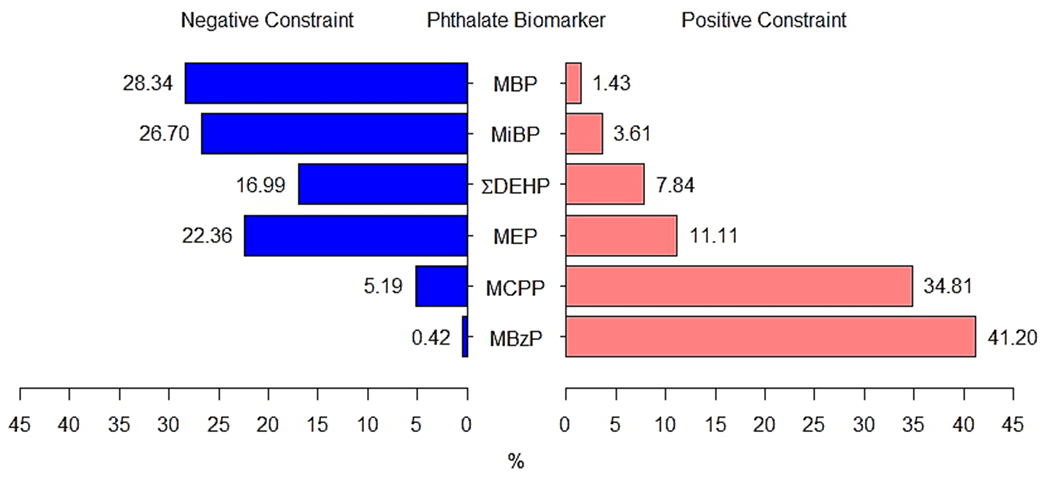
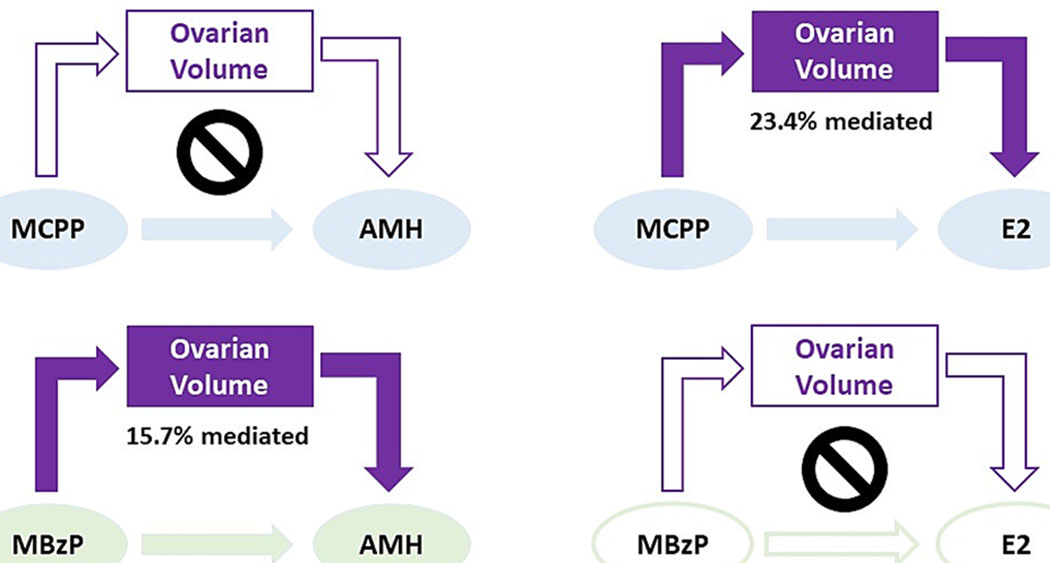
Results: Most women were non-Hispanic White (68%) and pre-menopausal (67%) with higher urinary phthalate metabolite concentrations than U.S. women. In single-pollutant models, 10% increases in mono(3-carboxypropyl) phthalate (MCPP) and monobenzyl phthalate (MBzP) were associated with 0.44% (95% CI: -0.02%, 0.91%) and 0.62% (95% CI: 0.02%, 1.23%) larger ovarian volumes, respectively. As a cumulative mixture, 10% increases in the phthalate mixture were associated with 2.89% larger ovarian volume (95%CI: 0.27, 5.59) with MCPP (35%) and MBzP (41%) identified as major contributors. Higher ovarian volume due to a 10% increase in MBzP (indirect effect OR: 1.004; 95% CI: 1.00, 1.01) explained 16% of the positive association between MBzP and higher AMH, whereas higher ovarian volume due to a 10% increase in MCPP (indirect effect %Δ: 0.11; 95% CI: -0.01, 0.22) explained 23% of the positive association between MCPP and E2.
Conclusion: In this cross-sectional study, phthalates were associated with increased ovarian volume, with implications for midlife hormone production.
Keywords: Anti-Müllerian hormone; Estradiol; Midlife; Ovarian volume; Phthalates.
Copyright © 2023 The Author(s). Published by Elsevier Ltd.. All rights reserved.
Conflict of interest statement
Declaration of Competing Interest The authors declare that they have no known competing financial interests or personal relationships that could have appeared to influence the work reported in this paper.
Figures
References
-
- Abrao MS, et al. 2013. Anatomical causes of female infertility and their management. Int. J. Gynaecol. Obstet 123 (Suppl 2), S18–S24. - PubMed
-
- Al-Saleh I, et al. 2019. Couples exposure to phthalates and its influence on in vitro fertilization outcomes. Chemosphere 226, 597–606. - PubMed
-
- Al-Saleh I, Elkhatib R, 2016. Screening of phthalate esters in 47 branded perfumes. Environ. Sci. Pollut. Res. Int 23, 455–468. - PubMed
-
- Bao AM, et al. 2003. Diurnal rhythm of free estradiol during the menstrual cycle. Eur. J. Endocrinol 148, 227–232. - PubMed
-
- Baumgarten a S C, C S., 2018. Granulosa Cells. In: Skinner MK (Ed.), Encyclopedia of Reproduction, (Second Edition). Academic Press, pp. 8–13.
Publication types
MeSH terms
Substances
Grants and funding
LinkOut - more resources
Full Text Sources
Research Materials
