


The Impact of Human Immunodeficiency Virus and Menopause on Bone Mineral Density: A Longitudinal Study of Urban-Dwelling South African Women
- PMID: 36726211
- PMCID: PMC10946789
- DOI: 10.1002/jbmr.4765
The Impact of Human Immunodeficiency Virus and Menopause on Bone Mineral Density: A Longitudinal Study of Urban-Dwelling South African Women
Abstract
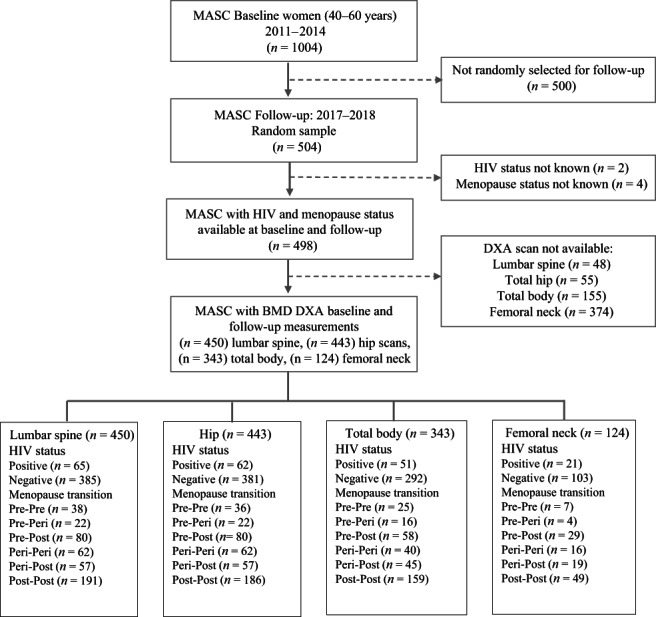
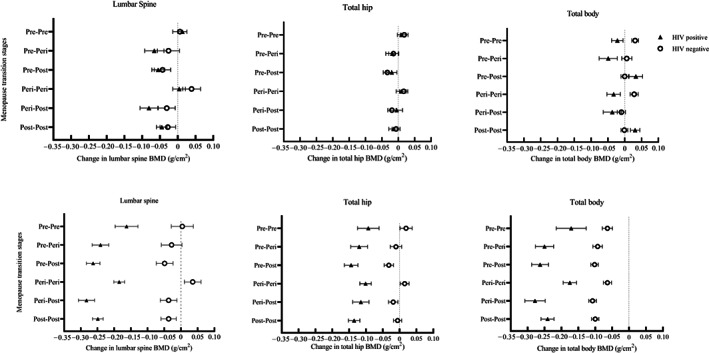
An estimated 25% of South African women live with human immunodeficiency virus (HIV). Antiretroviral therapy roll-out has improved life expectancy, so many more women now reach menopause. We aimed to quantify changes in bone mineral density (BMD) during the menopausal transition in urban-dwelling South African women with and without HIV and determine whether HIV infection modified the effect of menopause on BMD changes. A 5-year population-based longitudinal study recruited women aged 40-60 years residing in Soweto and collected demographic and clinical data, including HIV status, anthropometry, and BMD, at baseline and at 5-year follow-up. All women were staged as pre-, peri-, or postmenopausal at both time points. Multivariable linear regression assessed relationships and interactions between HIV infection, menopause, and change in BMD. At baseline, 450 women had mean age 49.5 (SD 5.7) years, 65 (14.4%) had HIV, and 140 (31.1%), 119 (26.4%), and 191 (42.4%) were pre-, peri-, and postmenopausal, respectively; 34/205 (13.6%) women ≥50 years had a total hip (TH) or lumbar spine (LS) T-score ≤ -2.5. At follow-up 38 (8.4%), 84 (18.7%), and 328 (72.9%) were pre-, peri-, and postmenopausal. Those with HIV at baseline lost more total body (TB) BMD (mean difference -0.013 [95% confidence interval -0.026, -0.001] g/cm2 , p = 0.040) and gained more weight 1.96 [0.32, 3.60] kg; p = 0.019 than HIV-uninfected women. After adjusting for age, baseline weight, weight change, and follow-up time, the transition from pre- to postmenopause was associated with greater TB BMD losses in women with HIV (-0.092 [-0.042, -0.142] g/cm2 ; p = 0.001) than without HIV (-0.038 [-0.016, -0.060] g/cm2 , p = 0.001; interaction p = 0.034). Similarly, in women who were postmenopausal at both time points, those with HIV lost more TB BMD (-0.070 [-0.031, -0.108], p = 0.001) than women without HIV (-0.036 [-0.015, -0.057], p = 0.001, interaction p = 0.049). Findings were consistent but weaker at the LS and TH. Menopause-related bone loss is greater in women with HIV, suggesting women with HIV may be at greater risk of osteoporotic fractures. HIV services should consider routine bone health assessment in midlife women as part of long-term HIV care delivery. © 2023 The Authors. Journal of Bone and Mineral Research published by Wiley Periodicals LLC on behalf of American Society for Bone and Mineral Research (ASBMR).
Keywords: BONE MINERAL DENSITY; DUAL-ENERGY X-RAY ABSORPTIOMETRY; HUMAN IMMUNODEFICIENCY VIRUS; MENOPAUSE; SOUTH AFRICA.
© 2023 The Authors. Journal of Bone and Mineral Research published by Wiley Periodicals LLC on behalf of American Society for Bone and Mineral Research (ASBMR).
Figures
Comment in
-
HIV and Bone Health: Considerations for Menopausal Women Living with HIV in Sub-Saharan Africa.J Bone Miner Res. 2023 May;38(5):617-618. doi: 10.1002/jbmr.4812. Epub 2023 Apr 17. J Bone Miner Res. 2023. PMID: 37068495 No abstract available.
References
-
- United Nations Children's Fund . World AIDS Day Report 2020. New York. USA: United Nations Children's Fund (UNICEF); 2020.
-
- Velkoff VA, Kowal PR. Aging in sub‐Saharan Africa: The changing demography of the region. In Cohen B, Menken J, eds. National Research Council (US) Committee on Population. Washington (DC): National Academies Press (US); 2006. - PubMed
Publication types
MeSH terms
Grants and funding
LinkOut - more resources
Full Text Sources
Medical
