


Development of energy plants from hybrids between Miscanthus sacchariflorus and M. lutarioriparius grown on reclaimed mine land in the Loess Plateau of China
- PMID: 36726684
- PMCID: PMC9885154
- DOI: 10.3389/fpls.2022.1017712
Development of energy plants from hybrids between Miscanthus sacchariflorus and M. lutarioriparius grown on reclaimed mine land in the Loess Plateau of China
Abstract
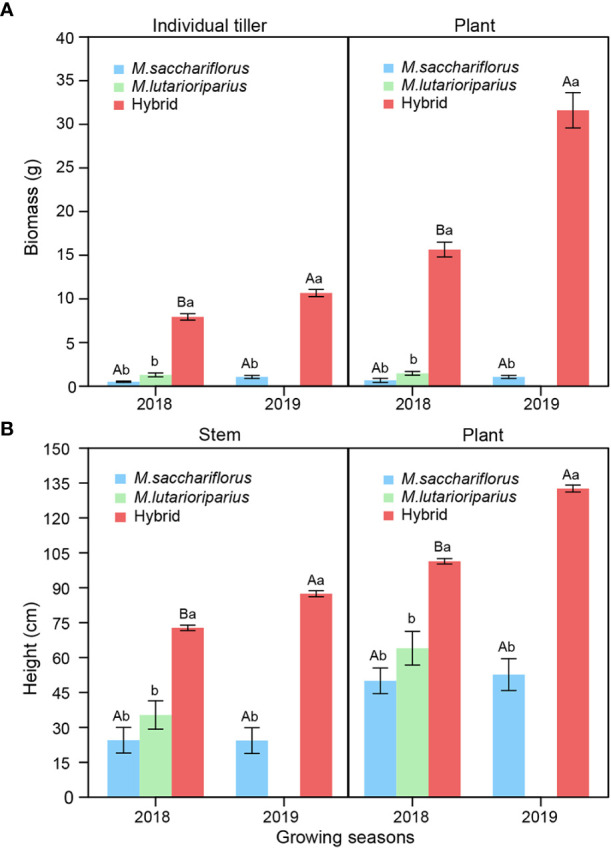
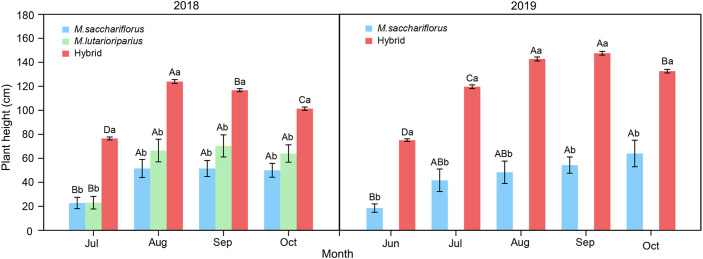
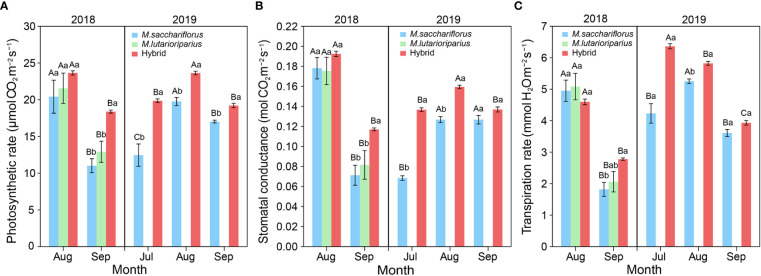
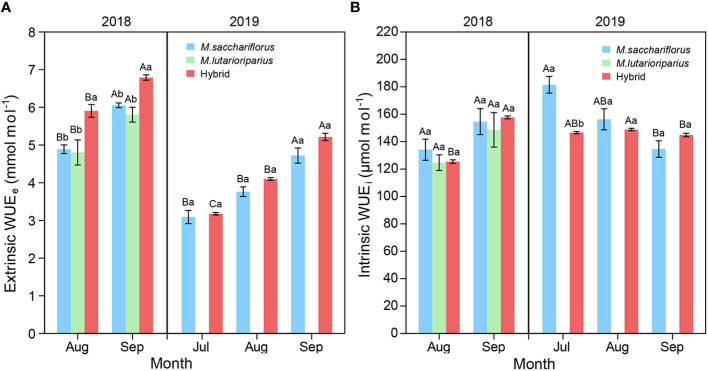
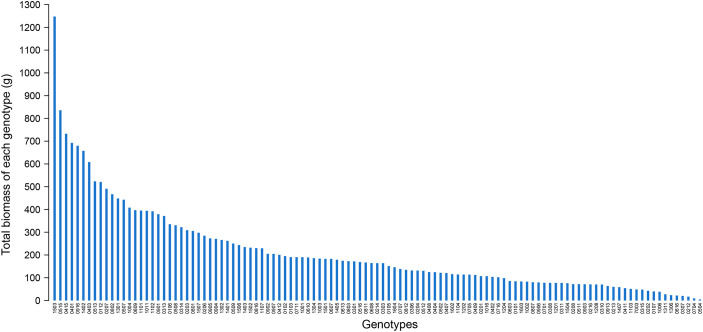
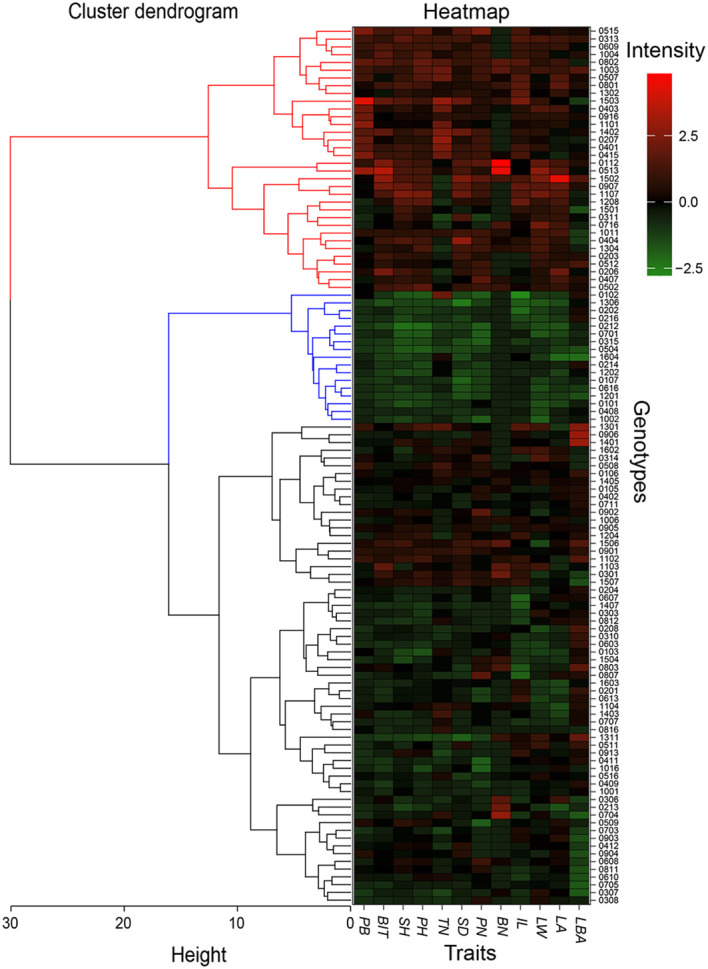
Miscanthus, a promising bioenergy plant, has a high biomass yield with high cellulose content suitable for biofuel production. However, harsh climatic and poor soil conditions, such as barren lands or abandoned mines, pose a challenge to the survival and yield of Miscanthus feedstock on the marginal land. The selection from the interspecific hybrids of Miscanthus might combine high survival rates and high yield, which benefits energy crop development in multi-stressful environments. A total of 113 F1 hybrids between Miscanthus sacchariflorus and M. lutarioriparius together with the parents were planted and evaluated for multiple morphological and physiological traits on the mine land of the Loess Plateau of China. The majority of hybrids had higher establishment rates than M. sacchariflorus while M. lutarioriparius failed to survive for the first winter. Nearly all hybrid genotypes outperformed M. lutarioriparius for yield-related traits including plant height, tiller number, tiller diameter, and leaf area. The average biomass of the hybrids was 20 times higher than that of surviving parent, M. sacchariflorus. Furthermore, the photosynthetic rates and water use efficiency of the hybrids were both significantly higher than those of the parents, which might be partly responsible for their higher yield. A total of 29 hybrids with outstanding traits related to yield and stress tolerance were identified as candidates. The study investigated for the first time the hybrids between local individuals of M. sacchariflorus and high-biomass M. lutarioriparius, suggesting that this could be an effective approach for high-yield energy crop development on vast of marginal lands.
Keywords: Miscanthus lutarioriparius; Miscanthus sacchariflorus; biomass; hybrids; photosynthetic rate; reclaimed mine land; water use efficiency.
Copyright © 2023 Zhao, Xiao, Mi, Kang, Lin, Chen, Huang, Yan, Yi, Sang and Liu.
Conflict of interest statement
The authors declare that the research was conducted in the absence of any commercial or financial relationships that could be construed as a potential conflict of interest.
Figures
References
-
- Ai X., Jiang J., Chen Z., Qin J., Yi Z. (2017). Heterosis, genetic and correlation analysis. of main agronomic traits in F1 population derived from crossing between Miscanthus sacchariflorus and M.lutarioriparius . Acta Pratac. Sin. 26, 111–122. doi: 10.11686/cyxb2016370 - DOI
-
- Beer C., Ciais P., Reichstein M., Baldocchi D., Law B. E., Papale D., et al. (2009). Temporal and among-site variability of inherent water use efficiency at the ecosystem level. Glob. Biogeochem. Cycle 23, 13. doi: 10.1029/2008gb003233 - DOI
-
- Chen X., Min D., Yasir T. A., Hu Y. G. (2012). Evaluation of 14 morphological, yield-related and physiological traits as indicators of drought tolerance in Chinese winter bread wheat revealed by analysis of the membership function value of drought tolerance (MFVD). Field Crop Res. 137, 195–201. doi: 10.1016/j.fcr.2012.09.008 - DOI
-
- Clifton-Brown J. C., Lewandowski I. (2000). Overwintering problems of newly established Miscanthus plantations can be overcome by identifying genotypes with improved rhizome cold tolerance. New Phytol. 148, 287–294. doi: 10.1046/j.1469-8137.2000.00764.x - DOI
-
- Clifton-Brown J. C., Lewandowski I. (2002). Screening Miscanthus genotypes in field trials to optimise biomass yield and quality in southern Germany. Eur. J. Agron. 16, 97–110. doi: 10.1016/s1161-0301(01)00120-4 - DOI
LinkOut - more resources
Full Text Sources
