


COVID-19 Mortality and Progress Toward Vaccinating Older Adults - World Health Organization, Worldwide, 2020-2022
- PMID: 36730046
- PMCID: PMC9927068
- DOI: 10.15585/mmwr.mm7205a1
COVID-19 Mortality and Progress Toward Vaccinating Older Adults - World Health Organization, Worldwide, 2020-2022
Abstract
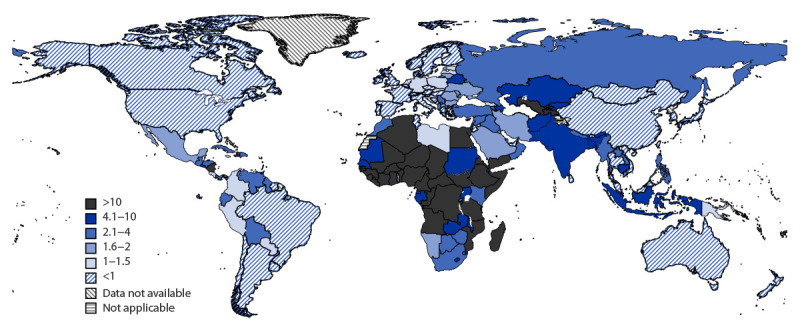
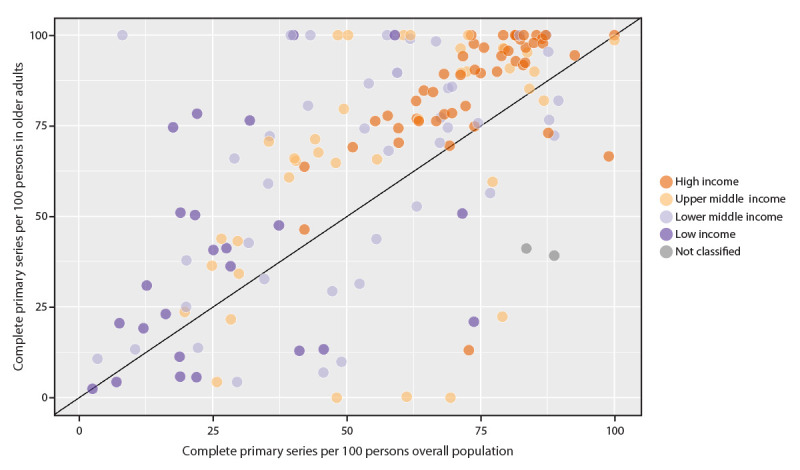
After the emergence of SARS-CoV-2 in late 2019, transmission expanded globally, and on January 30, 2020, COVID-19 was declared a public health emergency of international concern.* Analysis of the early Wuhan, China outbreak (1), subsequently confirmed by multiple other studies (2,3), found that 80% of deaths occurred among persons aged ≥60 years. In anticipation of the time needed for the global vaccine supply to meet all needs, the World Health Organization (WHO) published the Strategic Advisory Group of Experts on Immunization (SAGE) Values Framework and a roadmap for prioritizing use of COVID-19 vaccines in late 2020 (4,5), followed by a strategy brief to outline urgent actions in October 2021.† WHO described the general principles, objectives, and priorities needed to support country planning of vaccine rollout to minimize severe disease and death. A July 2022 update to the strategy brief§ prioritized vaccination of populations at increased risk, including older adults,¶ with the goal of 100% coverage with a complete COVID-19 vaccination series** for at-risk populations. Using available public data on COVID-19 mortality (reported deaths and model estimates) for 2020 and 2021 and the most recent reported COVID-19 vaccination coverage data from WHO, investigators performed descriptive analyses to examine age-specific mortality and global vaccination rollout among older adults (as defined by each country), stratified by country World Bank income status. Data quality and COVID-19 death reporting frequency varied by data source; however, persons aged ≥60 years accounted for >80% of the overall COVID-19 mortality across all income groups, with upper- and lower-middle-income countries accounting for 80% of the overall estimated excess mortality. Effective COVID-19 vaccines were authorized for use in December 2020, with global supply scaled up sufficiently to meet country needs by late 2021 (6). COVID-19 vaccines are safe and highly effective in reducing severe COVID-19, hospitalizations, and mortality (7,8); nevertheless, country-reported median completed primary series coverage among adults aged ≥60 years only reached 76% by the end of 2022, substantially below the WHO goal, especially in middle- and low-income countries. Increased efforts are needed to increase primary series and booster dose coverage among all older adults as recommended by WHO and national health authorities.
Conflict of interest statement
All authors have completed and submitted the International Committee of Medical Journal Editors form for disclosure of potential conflicts of interest. No potential conflicts of interest were disclosed.
Figures
References
-
- World Health Organization. WHO SAGE values framework for the allocation and prioritization of COVID-19 vaccination. Geneva, Switzerland: World Health Organization; 2020. Accessed November 8, 2022. https://www.who.int/publications/i/item/who-sage-values-framework-for-th...
-
- World Health Organization. WHO SAGE roadmap for prioritizing uses of COVID-19 vaccines in the context of limited supply: an approach to inform planning and subsequent recommendations based upon epidemiologic setting and vaccine supply scenarios, 20 October 2020, version 1. Geneva, Switzerland: World Health Organization; 2020. Accessed November 7, 2022. https://apps.who.int/iris/handle/10665/341445
MeSH terms
Substances
LinkOut - more resources
Full Text Sources
Medical
Miscellaneous
