. 2023 Feb 2;13(1):1890.
doi: 10.1038/s41598-023-28830-7.

Extra-viral DNA in adeno-associated viral vector preparations induces TLR9-dependent innate immune responses in human plasmacytoid dendritic cells

Affiliations

Extra-viral DNA in adeno-associated viral vector preparations induces TLR9-dependent innate immune responses in human plasmacytoid dendritic cells

Kirsten Bucher et al. Sci Rep. .

Abstract

Adeno-associated viral (AAV) vector suspensions produced in either human derived HEK cells or in Spodoptera frugiperda (Sf9) insect cells differ in terms of residual host cell components as well as species-specific post-translational modifications displayed on the AAV capsid proteins. Here we analysed the impact of these differences on the immunogenic properties of the vector. We stimulated human plasmacytoid dendritic cells with various lots of HEK cell-produced and Sf9 cell-produced AAV-CMV-eGFP vectors derived from different manufacturers. We found that AAV8-CMV-eGFP as well as AAV2-CMV-eGFP vectors induced lot-specific but not production platform-specific or manufacturer-specific inflammatory cytokine responses. These could be reduced or abolished by blocking toll-like receptor 9 signalling or by enzymatically reducing DNA in the vector lots using DNase. Successful HEK cell transduction by DNase-treated AAV lots and DNA analyses demonstrated that DNase did not affect the integrity of the vector but degraded extra-viral DNA. We conclude that both HEK- and Sf9-cell derived AAV preparations can contain immunogenic extra-viral DNA components which can trigger lot-specific inflammatory immune responses. This suggests that improved strategies to remove extra-viral DNA impurities may be instrumental in reducing the immunogenic properties of AAV vector preparations.


Conflict of interest statement

M.D.F. is on the advisory board of and/or consulting and/or receiving honoraria/grant money/travel support from following companies: Adelphi Values, Advent France Biotechnology, Alphasights, Arctos, Atheneum, Axiom Healthcare Strategies, Biogen, Decision Resources, Dialectica, Frontera Therapeutics, Janssen Research & Development, Navigant, Novartis, Roche, RegenxBio, Sirion, STZeyetrial. He is director of Fischer Consulting Limited and holds a patent (50%) on a gene therapy product for X-linked Retinitis Pigmentosa. S.J.C. is an inventor on patents describing the use of complement inhibitors for inflammatory disease, and is a co-founder and scientific consultant of Complement Therapeutics, which is developing complement inhibitors for therapeutic purposes including ocular disease. K.B., E.R.B, B.W., T.S., A.L.B. and D.S.-A. declare no potential conflict of interest.

Figures
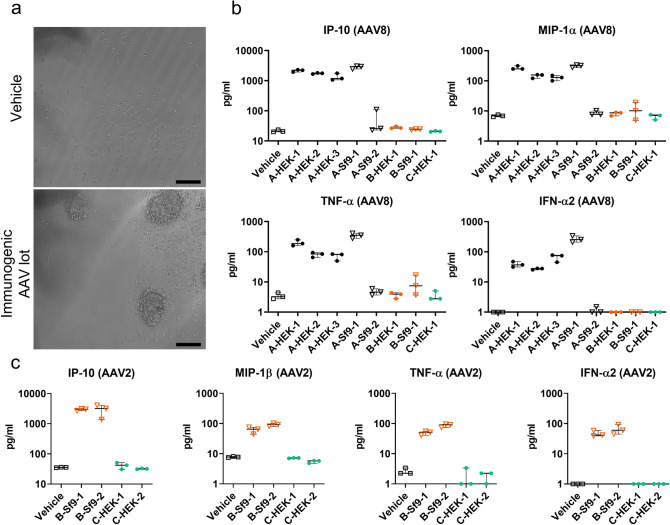
Figure 1
Figure 1
Induction of AAV vector lot-specific immune responses in human pDCs. Human pDCs were stimulated with different lots of AAV8-CMV-eGFP and AAV2-CMV-eGFP (MOI: 1:1 × 106 vg) for 18 h (a) Representative bright field images of pDCs stimulated with vehicle control (upper image) or an immunogenic AAV vector lot (lower image). Scale bar is 100 μm. (b) Cytokine release of IP-10, MIP-1β, TNF-α and IFN-α2 by AAV8-stimulated pDCs. (C) Cytokine release by AAV2-stimulated pDCs. Representative plots of one of three to four independent experiments. Since in the IFN-α2 measurements (b,c) and TNF-α measurement (c) some values fell below the assay range, the constant 1 was added to all measured IFN-α2 and TNF-α values for presentation in a semi-logarithmic plot. Shown are medians and interquartile ranges. In the labels of the individual vector lots the three manufacturers are represented by the letters A, B, C; HEK-cell derived and Sf9-cell derived vectors are indicated by "HEK and "Sf9" and corresponding lots of the same manufacturer and the same production system are numbered “1, 2, 3”. Circle: HEK-derived vector lot; triangle: Sf9-derived vector lot; black: vector lot from manufacturer A; orange: vector lot from manufacturer B; green: vector lot from manufacturer C.
Figure 2
Figure 2
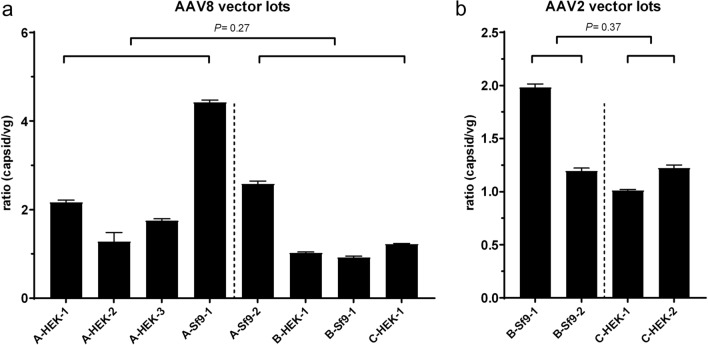
Comparison of capsid/vg ratios between different AAV8-CMV-eGFP and AAV2-CMV-eGFP vector lots. The capsid/vg ratios derive from absorbance measurements (ELISA) and ddPCR results of (a) eight AAV8 vector lots and (b) four AAV2 vector lots. Dashed lines separate “immunogenic” from “non-immunogenic” AAV vector lots. Bars indicate means and standard deviations of replicates. Statistical significance was determined using unpaired Student t-test.
Figure 3
Figure 3
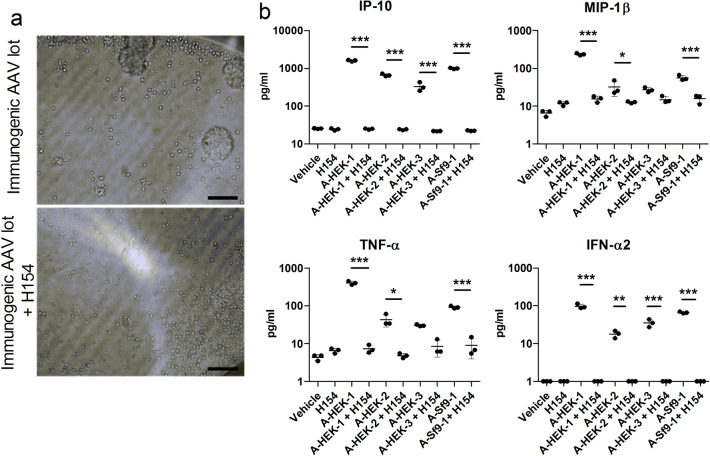
Recognition of “immunogenic” AAV8-CMV-eGFP vector lots by pDCs is TLR9 dependent. Human pDCs were treated with the TLR9 antagonist H154 (50 μM) followed by stimulation with “immunogenic” AAV8 vector lots (MOI: 1:1 × 106 vg) for 18 h. (a) Representative bright field images of purified pDCs treated with “immunogenic” AAV vector lots (upper image) or “immunogenic” AAV vector lots and H154 (lower image). Scale bar is 100 μm. (b) Cytokine release of IP-10, MIP-1β, TNF-α and IFN-α2 by stimulated pDCs. Since in the IFN-α2 measurements some values fell below the assay range, the constant 1 was added to all measured IFN-α2 values for presentation in a semi-logarithmic plot. Shown are means and standard deviations. Statistical significance was determined using one-way ANOVA and Holm-Sidak’s post hoc analysis. P values: ≤ 0.05: *; ≤ 0.01: **; ≤ 0.001: ***.
Figure 4
Figure 4
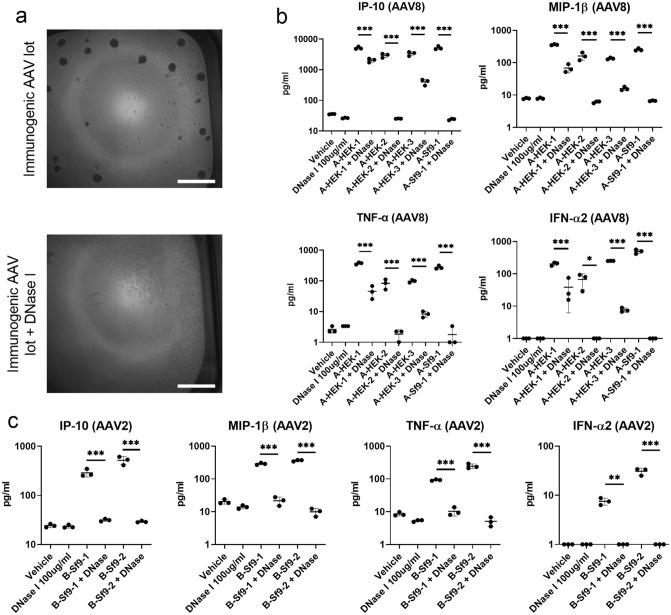
DNase pre-treatment reduces immune responses induced by “immunogenic” AAV8-CMV-eGFP and AAV2-CMV-eGFP vector lots. Human pDCs were stimulated with DNase-treated “immunogenic” AAV8 vector lots for 18 h (MOI: 1:1 × 106 vg). (a) Representative bright field images of purified pDCs stimulated with “immunogenic” AAV vector lots (upper image) and “immunogenic” AAV vector lots pre-treated with 100 μg/ml of DNase I (lower image). Scale bar is 500 μm. (b) Cytokine release of IP-10, MIP-1β, TNF-α and IFN-α2 by AAV8-stimulated pDCs. (c) Cytokine release by AAV2-stimulated pDCs. Since in the IFN-α2 measurements (b and c) and TNF-α measurement (b) some values fell below the assay range, the constant 1 was added to all measured IFN-α2 and TNF-α values for presentation in a semi-logarithmic plot. Shown are means and standard deviations. Statistical significance was determined using one-way ANOVA and Holm–Sidak’s post hoc analysis. P values: ≤ 0.05: *; ≤ 0.01: **; ≤ 0.001: ***.
Figure 5
Figure 5
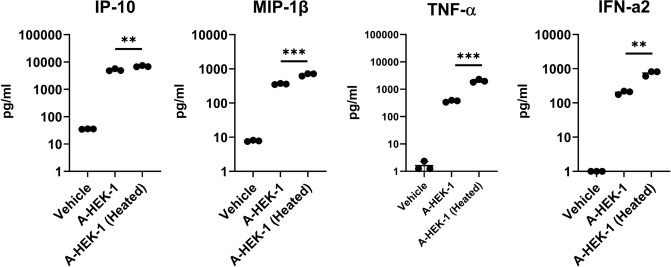
Release of intra-viral DNA by heat-treatment of vectors enhances pro-inflammatory cytokine responses in pDCs. Cytokine release of IP-10, MIP-1β, TNF-α and IFN-α2 by pDCs 18 h after stimulation with heat-treated AAV8 lot A-HEK-1 (MOI: 1:1 × 106 vg). Horizontal lines indicate means and standard deviations. Statistically significant differences between cytokine responses induced by heat-treated and untreated vectors were determined by using Student t-test. P value: ≤ 0.01: **; ≤ 0.001: ***.

References

    1. Gaj T, Epstein BE, Schaffer DV. Genome engineering using Adeno-associated virus: Basic and clinical research applications. Mol. Ther. 2016;24:458–464. doi: 10.1038/mt.2015.151. - DOI - PMC - PubMed
    1. Garita-Hernandez M, et al. AAV-mediated gene delivery to 3D retinal organoids derived from human induced pluripotent stem cells. Int. J. Mol. Sci. 2020;21:994. doi: 10.3390/ijms21030994. - DOI - PMC - PubMed
    1. Russell S, et al. Efficacy and safety of voretigene neparvovec (AAV2-hRPE65v2) in patients with RPE65-mediated inherited retinal dystrophy: A randomised, controlled, open-label, phase 3 trial. Lancet. 2017;390:849–860. doi: 10.1016/S0140-6736(17)31868-8. - DOI - PMC - PubMed
    1. He X, Urip BA, Zhang Z, Ngan CC, Feng B. Evolving AAV-delivered therapeutics towards ultimate cures. J. Mol. Med. 2021;99:1–25. doi: 10.1007/s00109-020-02034-2. - DOI - PMC - PubMed
    1. Bucher K, Rodríguez-Bocanegra E, Dauletbekov D, Fischer MD. Immune responses to retinal gene therapy using adeno-associated viral vectors—Implications for treatment success and safety. Prog. Retin. Eye Res. 2020;83:100915. doi: 10.1016/j.preteyeres.2020.100915. - DOI - PubMed

Publication types