


Artificial intelligence technologies and compassion in healthcare: A systematic scoping review
- PMID: 36733854
- PMCID: PMC9887144
- DOI: 10.3389/fpsyg.2022.971044
Artificial intelligence technologies and compassion in healthcare: A systematic scoping review
Abstract
Background: Advances in artificial intelligence (AI) technologies, together with the availability of big data in society, creates uncertainties about how these developments will affect healthcare systems worldwide. Compassion is essential for high-quality healthcare and research shows how prosocial caring behaviors benefit human health and societies. However, the possible association between AI technologies and compassion is under conceptualized and underexplored.
Objectives: The aim of this scoping review is to provide a comprehensive depth and a balanced perspective of the emerging topic of AI technologies and compassion, to inform future research and practice. The review questions were: How is compassion discussed in relation to AI technologies in healthcare? How are AI technologies being used to enhance compassion in healthcare? What are the gaps in current knowledge and unexplored potential? What are the key areas where AI technologies could support compassion in healthcare?
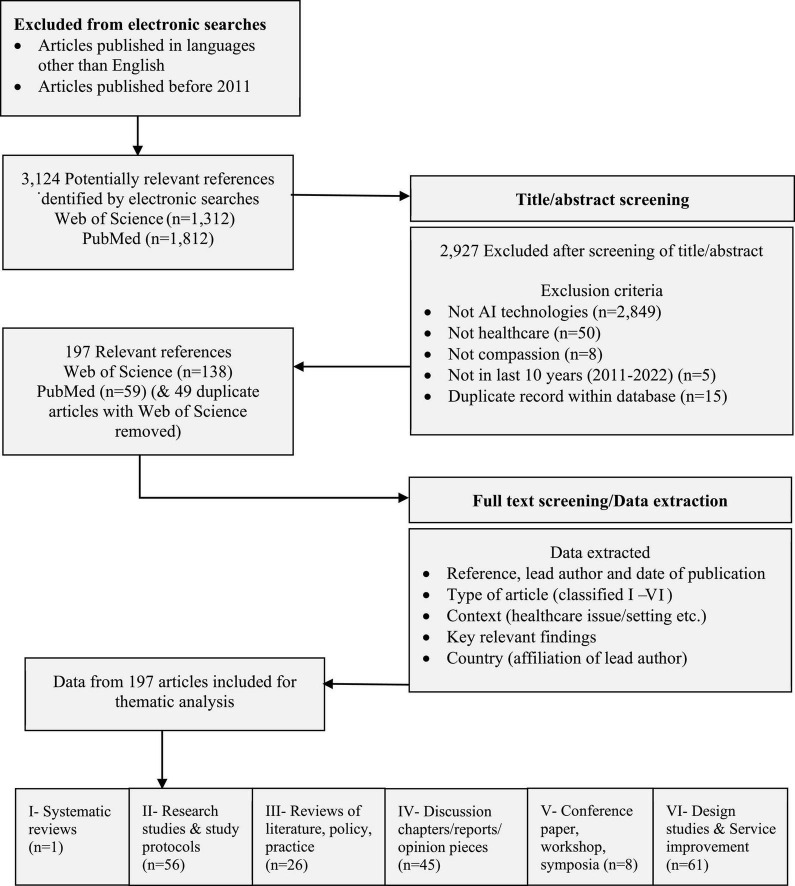
Materials and methods: A systematic scoping review following five steps of Joanna Briggs Institute methodology. Presentation of the scoping review conforms with PRISMA-ScR (Preferred Reporting Items for Systematic reviews and Meta-Analyses extension for Scoping Reviews). Eligibility criteria were defined according to 3 concept constructs (AI technologies, compassion, healthcare) developed from the literature and informed by medical subject headings (MeSH) and key words for the electronic searches. Sources of evidence were Web of Science and PubMed databases, articles published in English language 2011-2022. Articles were screened by title/abstract using inclusion/exclusion criteria. Data extracted (author, date of publication, type of article, aim/context of healthcare, key relevant findings, country) was charted using data tables. Thematic analysis used an inductive-deductive approach to generate code categories from the review questions and the data. A multidisciplinary team assessed themes for resonance and relevance to research and practice.
Results: Searches identified 3,124 articles. A total of 197 were included after screening. The number of articles has increased over 10 years (2011, n = 1 to 2021, n = 47 and from Jan-Aug 2022 n = 35 articles). Overarching themes related to the review questions were: (1) Developments and debates (7 themes) Concerns about AI ethics, healthcare jobs, and loss of empathy; Human-centered design of AI technologies for healthcare; Optimistic speculation AI technologies will address care gaps; Interrogation of what it means to be human and to care; Recognition of future potential for patient monitoring, virtual proximity, and access to healthcare; Calls for curricula development and healthcare professional education; Implementation of AI applications to enhance health and wellbeing of the healthcare workforce. (2) How AI technologies enhance compassion (10 themes) Empathetic awareness; Empathetic response and relational behavior; Communication skills; Health coaching; Therapeutic interventions; Moral development learning; Clinical knowledge and clinical assessment; Healthcare quality assessment; Therapeutic bond and therapeutic alliance; Providing health information and advice. (3) Gaps in knowledge (4 themes) Educational effectiveness of AI-assisted learning; Patient diversity and AI technologies; Implementation of AI technologies in education and practice settings; Safety and clinical effectiveness of AI technologies. (4) Key areas for development (3 themes) Enriching education, learning and clinical practice; Extending healing spaces; Enhancing healing relationships.
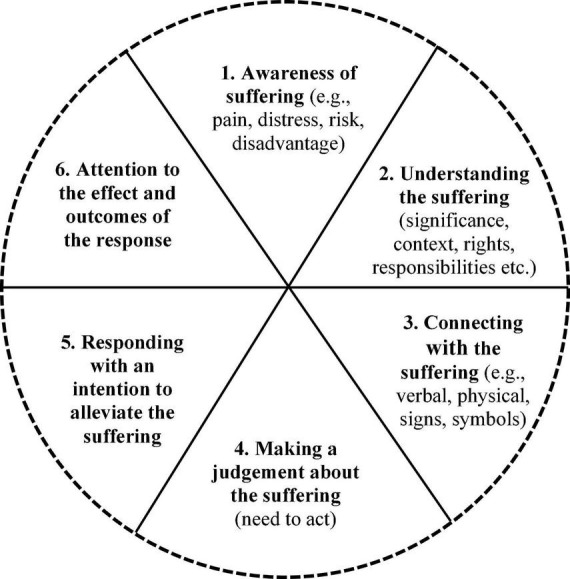
Conclusion: There is an association between AI technologies and compassion in healthcare and interest in this association has grown internationally over the last decade. In a range of healthcare contexts, AI technologies are being used to enhance empathetic awareness; empathetic response and relational behavior; communication skills; health coaching; therapeutic interventions; moral development learning; clinical knowledge and clinical assessment; healthcare quality assessment; therapeutic bond and therapeutic alliance; and to provide health information and advice. The findings inform a reconceptualization of compassion as a human-AI system of intelligent caring comprising six elements: (1) Awareness of suffering (e.g., pain, distress, risk, disadvantage); (2) Understanding the suffering (significance, context, rights, responsibilities etc.); (3) Connecting with the suffering (e.g., verbal, physical, signs and symbols); (4) Making a judgment about the suffering (the need to act); (5) Responding with an intention to alleviate the suffering; (6) Attention to the effect and outcomes of the response. These elements can operate at an individual (human or machine) and collective systems level (healthcare organizations or systems) as a cyclical system to alleviate different types of suffering. New and novel approaches to human-AI intelligent caring could enrich education, learning, and clinical practice; extend healing spaces; and enhance healing relationships.
Implications: In a complex adaptive system such as healthcare, human-AI intelligent caring will need to be implemented, not as an ideology, but through strategic choices, incentives, regulation, professional education, and training, as well as through joined up thinking about human-AI intelligent caring. Research funders can encourage research and development into the topic of AI technologies and compassion as a system of human-AI intelligent caring. Educators, technologists, and health professionals can inform themselves about the system of human-AI intelligent caring.
Keywords: artificial intelligence (AI); compassion; compassionate healthcare; empathy; healthcare technology.
Copyright © 2023 Morrow, Zidaru, Ross, Mason, Patel, Ream and Stockley.
Conflict of interest statement
The authors declare that the research was conducted in the absence of any commercial or financial relationships that could be construed as a potential conflict of interest.
Figures
References
-
- Ajeesh A. K., Rukmini S. (2022). Posthuman perception of artificial intelligence in science fiction: an exploration of kazuo ishiguro’s klara and the sun. AI Soc. 22:1533. 10.1007/s00146-022-01533-9 - DOI
Publication types
LinkOut - more resources
Full Text Sources
