


Whole-brain radiotherapy associated with structural changes resembling aging as determined by anatomic surface-based deep learning
- PMID: 36734195
- PMCID: PMC10326473
- DOI: 10.1093/neuonc/noad029
Whole-brain radiotherapy associated with structural changes resembling aging as determined by anatomic surface-based deep learning
Abstract
Background: Brain metastases are the most common intracranial tumors in adults and are associated with significant morbidity and mortality. Whole-brain radiotherapy (WBRT) is used frequently in patients for palliation, but can result in neurocognitive deficits. While dose-dependent injury to individual areas such as the hippocampus has been demonstrated, global structural shape changes after WBRT remain to be studied.
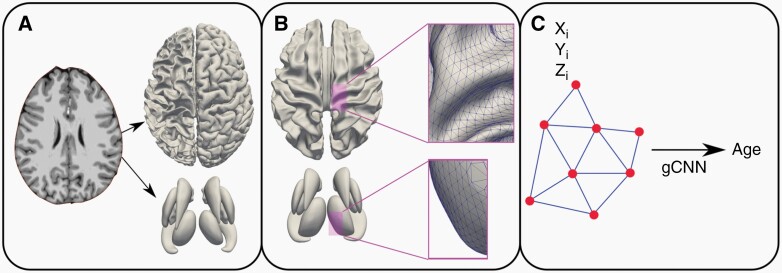
Methods: We studied healthy controls and patients with brain metastases and examined MRI brain anatomic surface data before and after WBRT. We implemented a validated graph convolutional neural network model to estimate patient's "brain age". We further developed a mixed-effects linear model to compare the estimated age of the whole brain and substructures before and after WBRT.
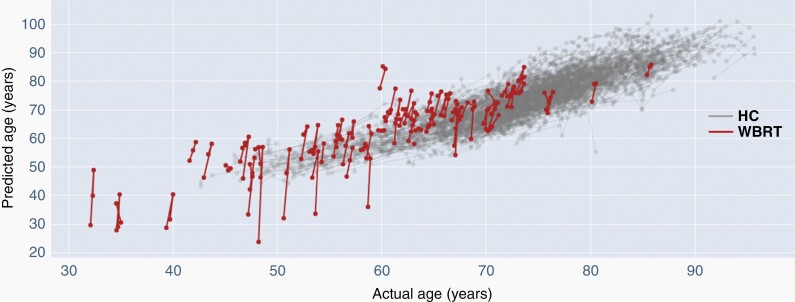
Results: 4220 subjects were analyzed (4148 healthy controls and 72 patients). The median radiation dose was 30 Gy (range 25-37.5 Gy). The whole brain and substructures underwent structural change resembling rapid aging in radiated patients compared to healthy controls; the whole brain "aged" 9.32 times faster, the cortex 8.05 times faster, the subcortical structures 12.57 times faster, and the hippocampus 10.14 times faster. In a subset analysis, the hippocampus "aged" 8.88 times faster in patients after conventional WBRT versus after hippocampal avoidance (HA)-WBRT.
Conclusions: Our findings suggest that WBRT causes the brain and its substructures to undergo structural changes at a pace up to 13x of the normal aging pace, where hippocampal avoidance offers focal structural protection. Correlating these structural imaging changes with neurocognitive outcomes following WBRT or HA-WBRT would benefit from future analysis.
Keywords: MRI; aging; brain metastases; deep learning.
© The Author(s) 2023. Published by Oxford University Press on behalf of the Society for Neuro-Oncology. All rights reserved. For permissions, please e-mail: journals.permissions@oup.com.
Conflict of interest statement
TJK serves on an advisory board and speakers bureau for AstraZeneca and is a consultant for Radialogica LLC. Other authors declare they have no conflicts of interest.
Figures
References
Publication types
MeSH terms
Grants and funding
LinkOut - more resources
Full Text Sources
Medical
