. 2023 Feb 1;6(2):e2254157.
doi: 10.1001/jamanetworkopen.2022.54157.

Assessment of Cancer Predisposition Syndromes in a National Cohort of Children With a Neoplasm

Affiliations

Assessment of Cancer Predisposition Syndromes in a National Cohort of Children With a Neoplasm

Jette J Bakhuizen et al. JAMA Netw Open. .

Abstract

Importance: To improve diagnostics of cancer predisposition syndromes (CPSs) in children with cancer, it is essential to evaluate the effect of CPS gene sequencing among all children with cancer and compare it with genetic testing based on clinical selection. However, a reliable comparison is difficult because recent reports on a phenotype-first approach in large, unselected childhood cancer cohorts are lacking.

Objective: To describe a national children's cancer center's experience in diagnosing CPSs before introducing routine next-generation sequencing.

Design, setting, and participants: This retrospective cohort study was conducted at the National Retinoblastoma Treatment Center (Amsterdam, the Netherlands) and the Princess Máxima Center for Pediatric Oncology (Utrecht, Netherlands) and included Dutch pediatric patients with a new diagnosis of neoplasm between June 1, 2018, and December 31, 2019. Follow-up was at least 18 months after neoplasm diagnosis. Data analysis was conducted from July 2021 to February 2022.

Exposures: As part of routine diagnostics, pediatric oncologists and ophthalmologists checked for characteristics of CPSs and selected children for referral to clinical geneticists and genetic testing.

Main outcomes and measures: Detected cancer predisposition syndromes.

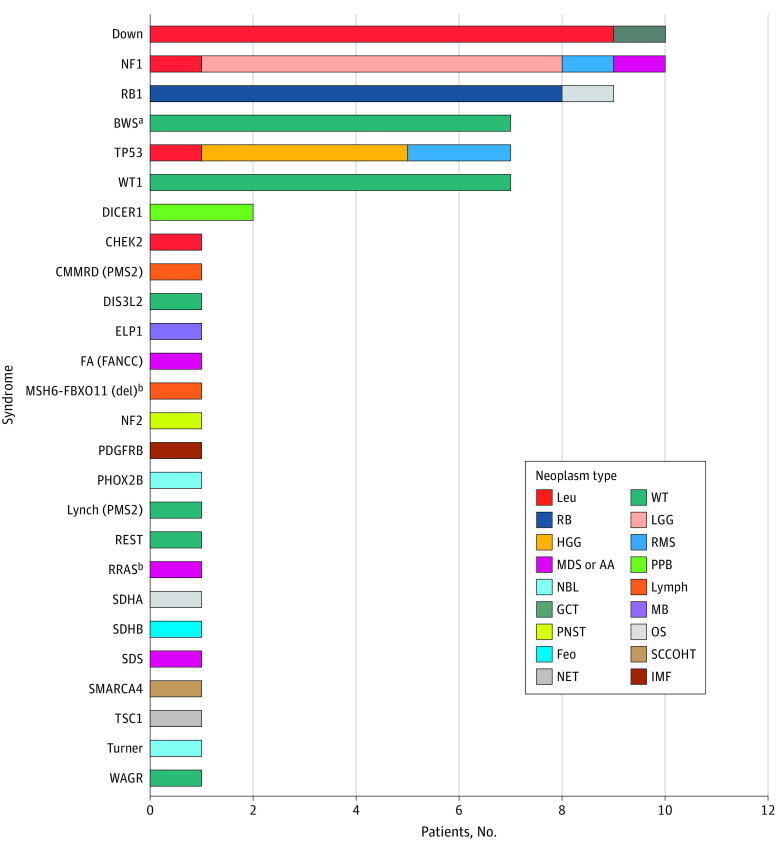
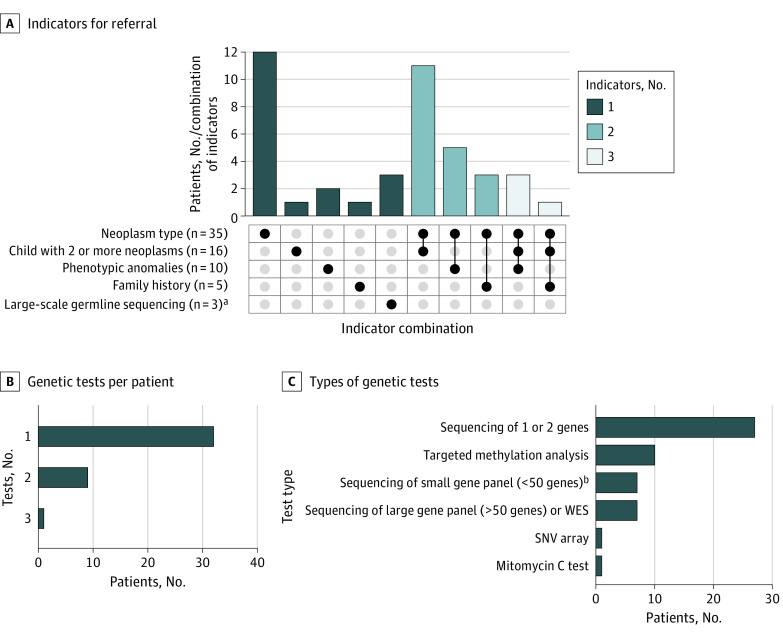
Results: A total of 824 patients (median [range] age at diagnosis 7.5 [0-18.9] years; 361 girls [44%]) were assessed, including 335 children with a hematological neoplasm (41%) and 489 (59%) with a solid tumor. In 71 of 824 children (8.6%), a CPS was identified, of which most (96%) were identified by a phenotype-driven approach. Down syndrome and neurofibromatosis type 1 were the most common CPSs diagnosed. In 42 of 71 patients (59%), a CPS was identified after these children developed a neoplasm. The specific type of neoplasm was the most frequent indicator for genetic testing, whereas family history played a minor role.

Conclusions and relevance: In this cohort study of children with a neoplasm, the prevalence of CPSs identified by a phenotype-driven approach was 8.6%. The diagnostic approach for identifying CPSs is currently shifting toward a genotype-first approach. Future studies are needed to determine the diagnostic value, as well as possible disadvantages of CPS gene sequencing among all children with cancer compared with the phenotype-driven approach.


Conflict of interest statement

Conflict of Interest Disclosures: Drs Bakhuizen and Jongmans and Profs dr Kuiper, Merks, and van Noesel reported grants from the Dutch Children Cancer-free Foundation (Stichting Kinderen Kankervrij [KIKA]). No other disclosures were reported.

Figures

Figure 1.
Figure 1.. Identification of 71 Cancer Predisposition Syndromes in a National, Unselected Cohort of 824 Children With a Neoplasm
AA indicates aplastic anemia; BWS, Beckwith-Wiedemann spectrum; CMMRD, constitutional mismatch repair deficiency; FA, Fanconi anemia; feo, feochromocytoma; GCT, germ cell tumor; HGG, high-grade glioma; IMF, infantile myofibromatosis; leu, leukemia; LGG, low-grade glioma; lymph, lymphoma; MB, medulloblastoma; MDS, myelodysplastic syndrome; NBL, neuroblastoma; NET, neuroendocrine tumor; NF1, neurofibromatosis type 1; OS, osteosarcoma; PNST, peripheral nerve sheath tumor; PPB, pleuropulmonary blastoma; RB, retinoblastoma; RMS, rhabdomyosarcoma; SCCOHT, small-cell carcinoma of the ovary hypercalcemic type; SDS Shwachman-Diamond syndrome; TSC, tuberous sclerosis complex; WT, Wilms tumor. aIncluding molecular diagnosis for BWS based on methylation-specific MLPA nontumor kidney tissue. bPatients were described in case reports.,
Figure 2.
Figure 2.. Diagnostic Process of Identified Cancer Predisposition Syndromes After Neoplasm Development
A, Specific indicators that initiated referral for clinical genetic assessment in 42 patients for whom genetic predisposition was identified after they had developed a neoplasm. The total number of patients per indicator for referral are noted in the column labels. Each column corresponds to a specific combination, and bar charts on top show the number of patients per combination. The filled-in dots show which indicator for referral is part of a combination. The feature “child with 2 or more neoplasms” is defined as the presence of bilateral, multifocal, or metachronous primary neoplasms. B, Number of genetic tests that were performed per patient. C, Type of genetic tests that were performed. SNV, single-nucleotide variation; WES, whole-exome sequencing. aPart of the tumor diagnostic workup or precision medicine study. bIncluding a kidney tumor predisposition gene panel that was offered to all children with Wilms tumors as part of the WES-KidTs study.

References

    1. Kratz CP, Jongmans MC, Cavé H, et al. . Predisposition to cancer in children and adolescents. Lancet Child Adolesc Health. 2021;5(2):142-154. doi:10.1016/S2352-4642(20)30275-3 - DOI - PubMed
    1. Postema FAM, Hopman SMJ, Hennekam RC, Merks JHM. Consequences of diagnosing a tumor predisposition syndrome in children with cancer: a literature review. Pediatr Blood Cancer. 2018;65(1):e26718. doi:10.1002/pbc.26718 - DOI - PubMed
    1. Gröbner SN, Worst BC, Weischenfeldt J, et al. ; ICGC PedBrain-Seq Project; ICGC MMML-Seq Project . The landscape of genomic alterations across childhood cancers. Nature. 2018;555(7696):321-327. doi:10.1038/nature25480 - DOI - PubMed
    1. Byrjalsen A, Hansen TVO, Stoltze UK, et al. . Nationwide germline whole genome sequencing of 198 consecutive pediatric cancer patients reveals a high incidence of cancer prone syndromes. PLoS Genet. 2020;16(12):e1009231. doi:10.1371/journal.pgen.1009231 - DOI - PMC - PubMed
    1. Newman S, Nakitandwe J, Kesserwan CA, et al. . Genomes for kids: the scope of pathogenic mutations in pediatric cancer revealed by comprehensive DNA and RNA sequencing. Cancer Discov. 2021;11(12):3008-3027. doi:10.1158/2159-8290.CD-20-1631 - DOI - PMC - PubMed

Publication types