. 2023 Feb 4;13(1):2047.
doi: 10.1038/s41598-023-29252-1.

Macromolecular crowding regulates matrix composition and gene expression in human gingival fibroblast cultures

Affiliations

Macromolecular crowding regulates matrix composition and gene expression in human gingival fibroblast cultures

Rajesvaran Ramalingam et al. Sci Rep. .

Abstract

Standard cell cultures are performed in aqueous media with a low macromolecule concentration compared to tissue microenvironment. In macromolecular crowding (MMC) experiments, synthetic polymeric crowders are added into cell culture media to better mimic macromolecule concentrations found in vivo. However, their effect on cultured cells is incompletely understood and appears context-dependent. Here we show using human gingival fibroblasts, a cell type associated with fast and scarless wound healing, that MMC (standard medium supplemented with Ficoll 70/400) potently modulates fibroblast phenotype and extracellular matrix (ECM) composition compared to standard culture media (nMMC) over time. MMC significantly reduced cell numbers, but increased accumulation of collagen I, cellular fibronectin, and tenascin C, while suppressing level of SPARC (Secreted Protein Acidic and Cysteine Rich). Out of the 75 wound healing and ECM related genes studied, MMC significantly modulated expression of 25 genes compared to nMMC condition. MMC also suppressed myofibroblast markers and promoted deposition of basement membrane molecules collagen IV, laminin 1, and expression of LAMB3 (Laminin Subunit Beta 3) gene. In cell-derived matrices produced by a novel decellularization protocol, the altered molecular composition of MMC matrices was replicated. Thus, MMC may improve cell culture models for research and provide novel approaches for regenerative therapy.


Conflict of interest statement

The authors declare no competing interests.

Figures

Figure 1
Figure 1
Characterization of fibroblast MMC and nMMC cultures by phase contrast microscopy and immunostaining of cytoskeletal β-tubulin and actin over time. Representative phase contrast microscope (A), immunostaining of β-tubulin (B), and staining of total fibrillar actin with fluorescently labelled phalloidin (C) images from 6 to 12 standardized images obtained from each time point and treatment from two repeated experiments are shown. Inserts show higher magnification of select areas. Images in inserts are individually optimized for brightness/contrast. Magnification bars = 40 μm.
Figure 2
Figure 2
Characterization of cell numbers, morphology, and orientation in MMC and nMMC cultures over time. (A) Representative standardized images of the cultures with nuclear DAPI stain over time. Lower inserts show higher magnification images of select areas with long axis of the nuclei indicated by a line. Upper inserts in 14-day images show nuclear overlap as indicated by white tracing of the outlines of nuclei. Magnification bars = 40 μm. (B) Statistical comparison of change in cell numbers based on calculation of DAPI stained nuclei over time (n = 4 repeated experiments). (C) Pairwise comparison of cell numbers based on calculation of DAPI stained nuclei at each time point (n = 4 repeated experiments). (D) Statistical comparison of change in total RNA yield over time (n = 6–7 repeated experiments). (E) Pairwise comparison of total RNA yield at each time point (n = 6–7 repeated experiments). Comparison of nuclear surface area (F), aspect ratio (G), and angle deviation (H) in DAPI stained images over time (n = 3 repeated experiments). Results show mean + /− SEM from repeated experiments (C,E–H). Statistical testing was performed by one-way ANOVA (B,D) and independent samples t-test (C,E–H), *p < 0.05; **p < 0.01; ***p < 0.001.
Figure 3
Figure 3
Fibroblast gene expression is modulated by MMC culture condition. Table shows GFBL mRNA expression (mean + /− SEM) of 75 genes in MMC relative to nMMC culture condition after 14 days analyzed by RT-qPCR. Cell color highlights statistically significant downregulation (green) or upregulation (red) of mRNA expression in MMC compared to nMMC culture condition. Statistical testing was performed by independent samples t-test (*p < 0.05; **p < 0.01; ***p < 0.001), n = 4–7 repeated experiments.
Figure 4
Figure 4
Quantification of total protein amount and characterization of collagen I organization and abundance in MMC and nMMC cultures over time. (A) Statistical comparison of change in total protein amount in MMC and nMMC cultures over time. (B) Pairwise comparison of total protein abundance at each time point. (C) Statistical comparison of change in relative (normalized for cell numbers determined by nuclear DAPI counts) protein abundance over time. (D) Pairwise comparison of relative protein abundance at each time point. (E) Representative standardized images of collagen I immunostaining from each time point and treatment from two repeated experiments. Inserts show higher magnification of select areas. Images in inserts are individually optimized for brightness/contrast. Magnification bars = 40 μm. (F) Statistical comparison of change in total collagen I abundance over time. (G) Pairwise comparison of total collagen I abundance at each time point. (H) Statistical comparison of change in relative (normalized for cell numbers determined by nuclear DAPI counts) collagen I abundance over time. (I) Pairwise comparison of relative collagen I abundance at each time point. Results show mean + /− SEM (B,D,G,I) and statistical comparison over time (A,C,F,H) from 8 to 11 repeated experiments (AD) and from image analysis performed with 6–12 images obtained from each time point and treatment from two repeated experiments (FI). Statistical testing was performed by one-way ANOVA (A,C,F,H) and by independent samples t-test (B,D,G,I), *p < 0.05; **p < 0.01; ***p < 0.001.
Figure 5
Figure 5
Characterization of collagen IV and cellular fibronectin organization and abundance in MMC and nMMC cultures over time. (A) Representative standardized images of collagen IV immunostaining from each time point and treatment from two repeated experiments. Inserts show higher magnification of select areas. Images in inserts are individually optimized for brightness/contrast. (B) Statistical comparison of change in total collagen IV abundance over time. (C) Pairwise comparison of total collagen IV abundance at each time point. (D) Statistical comparison of change in relative (normalized for cell numbers determined by nuclear DAPI counts) collagen IV abundance over time. (E) Pairwise comparison of relative collagen IV abundance at each time point. (F) Representative standardized images of cellular fibronectin (EDA-fibronectin) immunostaining from each time point and treatment from two repeated experiments. Inserts show higher magnification of select areas. Images in inserts are individually optimized for brightness/contrast. (G) Statistical comparison of change in total cellular fibronectin abundance over time. (H) Pairwise comparison of total cellular fibronectin abundance at each time point. (I) Statistical comparison of change in relative (normalized for cell numbers determined by nuclear DAPI counts) cellular fibronectin abundance over time. (J) Pairwise comparison of relative cellular fibronectin abundance at each time point. Results show mean + /− SEM (C,E,H,J) and statistical comparison over time (B,D,G,I) from image analysis performed with 6–12 images obtained from each time point and treatment from two repeated experiments. Statistical testing was performed by one-way ANOVA (B,D,G,I) and by independent samples t-test (C,E,H,J), *p < 0.05; **p < 0.01; ***p < 0.001. Magnification bars = 40 μm (A,F).
Figure 6
Figure 6
Characterization of laminin 1, tenascin C, SPARC, and LTBP1 organization and abundance in MMC and nMMC cultures at day 14. (A) Representative standardized images of laminin 1, tenascin C, SPARC, and LTBP1 immunostaining from each time point and treatment from two repeated experiments. Inserts show higher magnification of select areas. Images in inserts are individually optimized for brightness/contrast. Magnification bars = 40 μm. Pairwise comparison of total (B) and relative (normalized for cell numbers determined by nuclear DAPI counts) (C) abundance of laminin 1, tenascin C, SPARC, and LTBP1 at day 14. Results show mean + /− SEM from image analysis performed with 6–12 images obtained from each time point and treatment from two repeated experiments (B,C). Statistical testing was performed by independent samples t-test, **p < 0.01; ***p < 0.001.
Figure 7
Figure 7
Characterization of myofibroblast-associated markers and cytoskeletal proteins in MMC and nMMC cultures. (A) Representative standardized images of αSMA immunostaining from each time point and treatment from two repeated experiments. Inserts show higher magnification of select areas. Images in inserts are individually optimized for brightness/contrast. Magnification bars = 40 μm. (B) Representative Western blot of αSMA in MMC and nMMC cultures at day 3–14. GAPDH was used as loading control. Cropped images of Western blots are shown. (C) Quantitation and statistical comparison of change in αSMA abundance at each time point and over time relative to GAPDH determined by Western blotting. Results show mean + /− SEM from four repeated experiments. (D) Quantification (mean + /− SEM) of αSMA stress fibers by image analysis over time and in pairwise comparison at each time point. (E) Quantification (mean + /− SEM) of expression of ACTA2, COL1A1, POSTN and ITGA5 by RT-qPCR in MMC relative to nMMC cultures at day 14 (n = 4–7 repeated experiments). (F) Statistical comparison of change in relative (normalized for cell numbers determined by nuclear DAPI counts) β-tubulin abundance over time. (G) Pairwise comparison of relative β-tubulin abundance at each time point. (H) Statistical comparison of change in relative (normalized for cell numbers determined by nuclear DAPI counts) actin abundance over time. (I) Pairwise comparison of relative actin abundance at each time point. Results show mean + /− SEM (D,G,I) and statistical comparison over time (F,H) from image analysis from 6–12 images obtained from each time point and treatment from two repeated experiments. Statistical comparison between time points was performed by one-way ANOVA (C,D,F,H) and between treatments at each time point by independent samples t-test (C,D,E,G,I), *p < 0.05; **p < 0.01; ***p < 0.001.
Figure 8
Figure 8
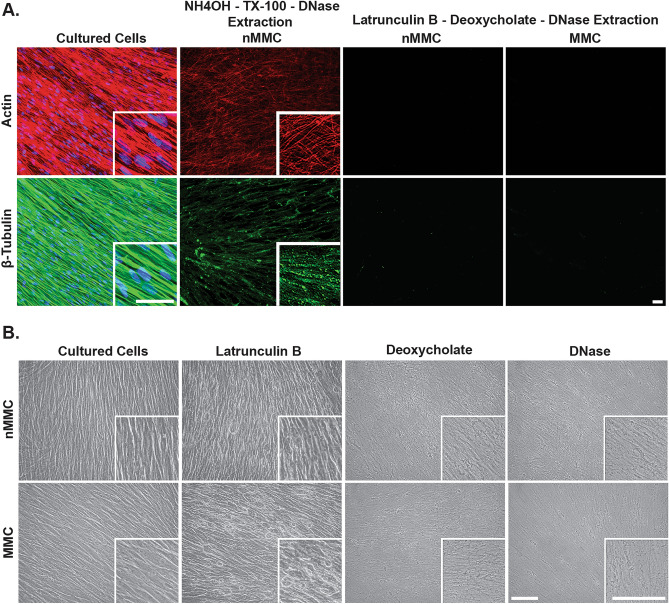
Characterization of decellularization methods. (A) Representative standardized immunofluorescence images of actin and β-tubulin in 14-day MMC and nMMC cultures before and after NH4OH-TX-100-DNase or latrunculin B-deoxycholate-DNase decellularization protocols. DNA was stained with DAPI nuclear stain (blue). (B) Representative standardized phase contrast microscope images of 14-day MMC and nMMC cultures before and after sequential incubations with latrunculin B, deoxycholate, and DNase. Inserts show higher magnification of select areas. Images in inserts are individually optimized for brightness/contrast. Magnification bars = 40 μm.
Figure 9
Figure 9
Characterization of cultures and CDMs generated in MMC and nMMC conditions before and after decellularization. (A) Representative standardized images of collagen I, collagen IV, cellular fibronectin (EDA-fibronectin), laminin 1, tenascin C, SPARC, and LTBP1 immunostaining in 14-day MMC and nMMC cultures with cells (WC) and after decellularization (CDM) from two repeated experiments. Magnification bar = 40 μm. (B,C) Comparison of total (B) and relative (normalized for cell numbers based on nuclear DAPI counts in parallel samples) (C) protein amount over time and between MMC and nMMC CDMs. (D) Comparison of total protein loss due to decellularization over time between MMC and nMMC CDMs. Results show total protein amount (mean + /− SEM) from CDMs relative to corresponding cultures with cells (= 100%) as determined by Bradford assay. (BD) Results show mean + /− SEM from 6 repeated experiments. Statistical testing between time points was performed by one-way ANOVA and between treatments at each time point by independent samples t-test, *p < 0.05; **p < 0.01; ***p < 0.001.

References

    1. Mouw JK, Ou G, Weaver VM. Extracellular matrix assembly: A multiscale deconstruction. Nat. Rev. Mol. Cell Biol. 2014;15:771–785. - PMC - PubMed
    1. Muhl L, et al. Single-cell analysis uncovers fibroblast heterogeneity and criteria for fibroblast and mural cell identification and discrimination. Nat. Commun. 2020;11:1–18. - PMC - PubMed
    1. Ellis RJ. Macromolecular crowding: Obvious but underappreciated. Trends Biochem. Sci. 2001;26:597–604. - PubMed
    1. Ellis RJ, Minton AP. Join the crowd. Nature. 2003;425:27–28. - PubMed
    1. Chen C, Loe F, Blocki A, Peng Y, Raghunath M. Applying macromolecular crowding to enhance extracellular matrix deposition and its remodeling in vitro for tissue engineering and cell-based therapies. Adv. Drug Deliv. Rev. 2011;63:277–290. - PubMed

Publication types

Grants and funding