


Post-COVID conditions and healthcare utilization among adults with and without disabilities-2021 Porter Novelli FallStyles survey
- PMID: 36740547
- PMCID: PMC9762038
- DOI: 10.1016/j.dhjo.2022.101436
Post-COVID conditions and healthcare utilization among adults with and without disabilities-2021 Porter Novelli FallStyles survey
Abstract
Background: Adults with disabilities are at increased risk for SARS-CoV-2 infection and severe disease; whether adults with disabilities are at an increased risk for ongoing symptoms after acute SARS-CoV-2 infection is unknown.
Objectives: To estimate the frequency and duration of long-term symptoms (>4 weeks) and health care utilization among adults with and without disabilities who self-report positive or negative SARS-CoV-2 test results.
Methods: Data from a nationwide survey of 4510 U.S. adults administered from September 24, 2021-October 7, 2021, were analyzed for 3251 (79%) participants who self-reported disability status, symptom(s), and SARS-CoV-2 test results (a positive test or only negative tests). Multivariable models were used to estimate the odds of having ≥1 COVID-19-like symptom(s) lasting >4 weeks by test result and disability status, weighted and adjusted for socio-demographics.
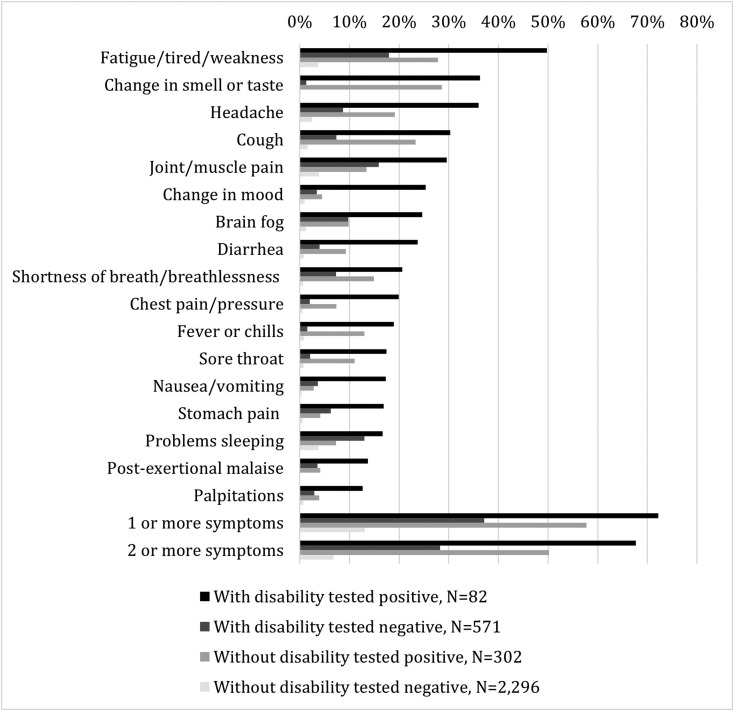
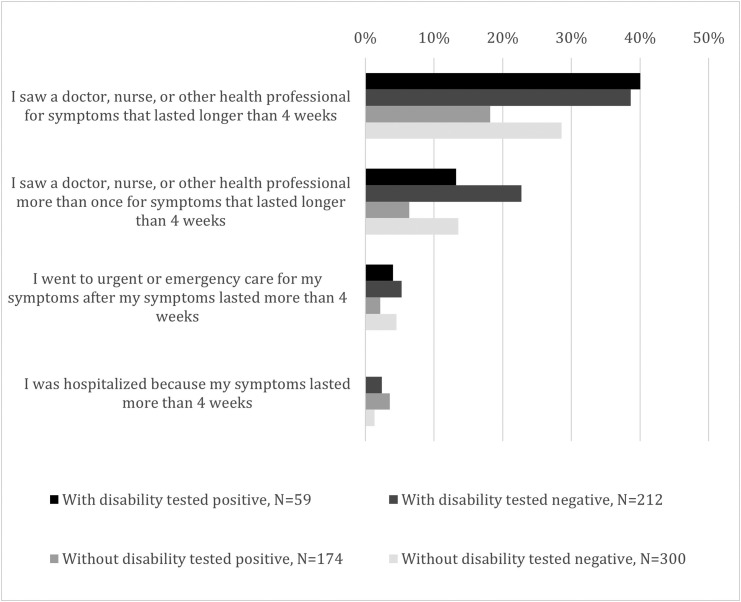
Results: Respondents who tested positive for SARS-CoV-2 had higher odds of reporting ≥1 long-term symptom (with disability: aOR = 4.50 [95% CI: 2.37, 8.54] and without disability: aOR = 9.88 [95% CI: 7.13, 13.71]) compared to respondents testing negative. Among respondents who tested positive, those with disabilities were not significantly more likely to experience long-term symptoms compared to respondents without disabilities (aOR = 1.65 [95% CI: 0.78, 3.50]). Health care utilization for reported symptoms was higher among respondents with disabilities who tested positive (40%) than among respondents without disabilities who tested positive (18%).
Conclusions: Ongoing symptoms among adults with and without disabilities who also test positive for SARS-CoV-2 are common; however, the frequency of health care utilization for ongoing symptoms is two-fold among adults with disabilities.
Keywords: COVID-19; Disabilities; Long COVID; Post-COVID conditions; Post-acute sequelae of SARS-CoV-2 infection.
Published by Elsevier Inc.
Figures
References
-
- C.D.C. Post-COVID Conditions: Information for Healthcare Providers. 2021. https://www.cdc.gov/coronavirus/2019-ncov/hcp/clinical-care/post-covid-c... Accessed from:
-
- Hernandez-Romieu A.C., Carton T.W., Saydah S., et al. Prevalence of select new symptoms and conditions among persons aged younger than 20 Years and 20 Years or older at 31 to 150 days after testing positive or negative for SARS-CoV-2. JAMA Netw Open. 4 Feb 2022 2022;(2) doi: 10.1001/jamanetworkopen.2021.47053. - DOI - PMC - PubMed
-
- Underlying C.D.C. 2022. Medical Conditions Associated with Higher Risk for Severe COVID-19: Information for Healthcare Professionals.https://www.cdc.gov/coronavirus/2019-ncov/hcp/clinical-care/underlyingco... Accessed from:
-
- 28 Oct 2022. C.D.C. Disability Impacts All of Us.https://www.cdc.gov/ncbddd/disabilityandhealth/infographic-disability-im... Accessed from:
Publication types
MeSH terms
LinkOut - more resources
Full Text Sources
Medical
Miscellaneous
