Review
. 2023 Feb 1:14:12-29.
doi: 10.18632/genesandcancer.230. eCollection 2023.

CEACAMS 1, 5, and 6 in disease and cancer: interactions with pathogens

Affiliations
Review

CEACAMS 1, 5, and 6 in disease and cancer: interactions with pathogens

Jerin Thomas et al. Genes Cancer. .

Abstract

The CEA family comprises 18 genes and 11 pseudogenes located at chromosome 19q13.2 and is divided into two main groups: cell surface anchored CEA-related cell adhesion molecules (CEACAMs) and the secreted pregnancy-specific glycoproteins (PSGs). CEACAMs are highly glycosylated cell surface anchored, intracellular, and intercellular signaling molecules with diverse functions, from cell differentiation and transformation to modulating immune responses associated with infection, inflammation, and cancer. In this review, we explore current knowledge surrounding CEACAM1, CEACAM5, and CEACAM6, highlight their pathological significance in the areas of cancer biology, immunology, and inflammatory disease, and describe the utility of murine models in exploring questions related to these proteins.

Keywords: CEACAMs; cancer; immunology; inflammatory diseases.


Conflict of interest statement

CONFLICTS OF INTEREST Authors have no conflicts of interest to declare.

Figures
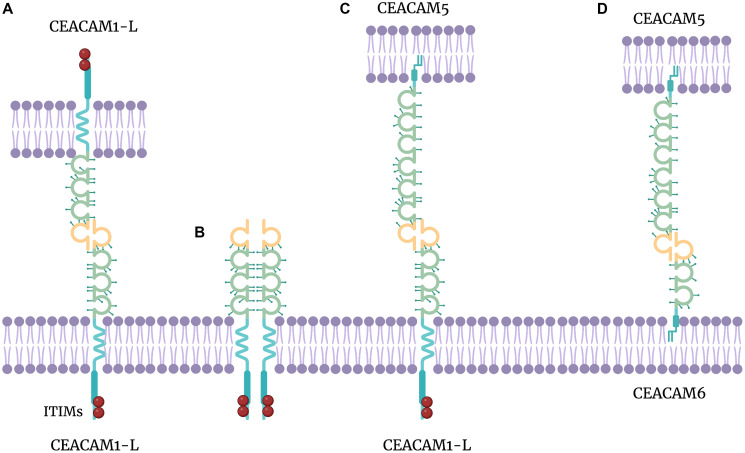
Figure 1
Figure 1. CEACAM interactions.
(A) CEACAM trans-homophilic binding (CEACAM1-L – CEACAM1-L). (B) CEACAM cis-homodimer (CEACAM1-L – CEACAM1-L). (C) CEACAM trans-heterophilic binding (CEACAM5 – CEACAM1). (D) CEACAM heterophilic binding (CEACAM5 – CEACAM1).
Figure 2
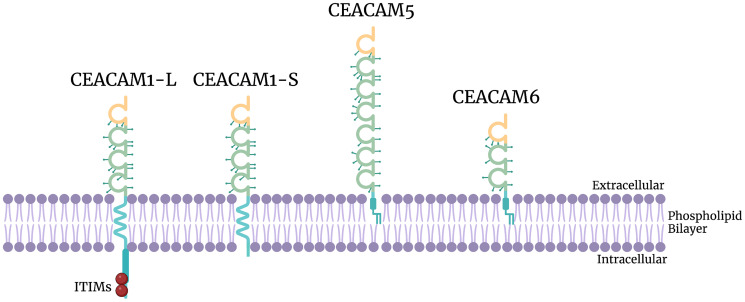
Figure 2. Structure of CEACAM1-L, CEACAM1-S, CEACAM5, and CEACAM6.
CEACAM1-L isoform, CEACAM1-S isoform, CEACAM5, and CEACAM6. CEACAM1 is a transmembrane protein while CEACAM5 and CEACAM6 are GPI linked to the external surface. Yellow represents N-terminal variable domains; green represents C2-like Ig domains; blue represents GPI linkers (CEACAM5/CEACAM6) or transmembrane and cytosolic portions of the CEACAM (CEACAM1); red circles represent ITIM motifs; spikes on the extracellular domain represent glycosylation sites of CEACAMs.
Figure 3
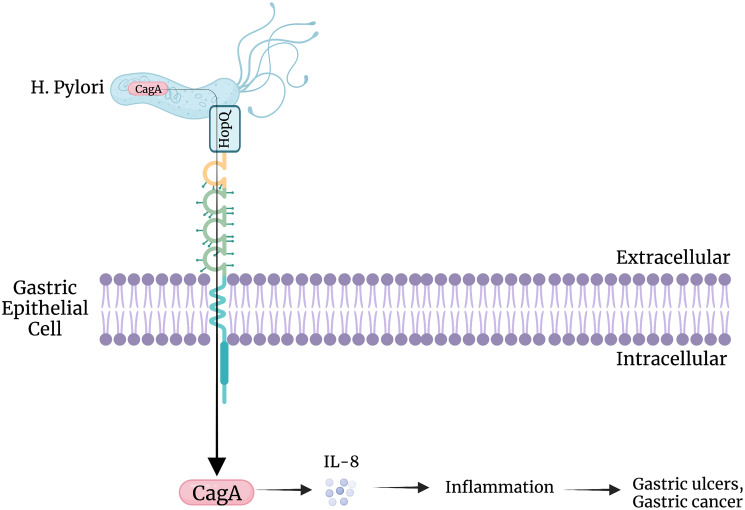
Figure 3. CEACAM-HopQ interaction.
HopQ, the surface exposed adhesin of H. pylori, binds to CEACAM1, allowing for the secretion of virulent factor,CagA. This secretion enhances the release of inflammatory mediators, such as interleukin 8, ultimately resulting in gastric ulcers and gastric cancer.
Figure 4
Figure 4. Signaling of dimeric CEACAM1 long tail isoform in epithelial cells and T cells.
In epithelial cells, CEACAM1 is phosphorylated at the ITIM residues, namely Tyr493, leading to recruitment of Shc, sequestering Grb2 and SOS, reducing signaling downstream of a receptor tyrosine kinase such as insulin receptor or epidermal growth factor receptor. In T cells, dimeric CEACAM1 is phosphorylated at the ITIM residues leading to the recruitment of SHP2, whose phosphatase action reduces signaling downstream of the TCR/CD3 complex.

References

    1. Gold P, Freedman SO. Specific carcinoembryonic antigens of the human digestive system. J Exp Med. 1965; 122:467–81. 10.1084/jem.122.3.467. - DOI - PMC - PubMed
    1. Kim J, Kaye FJ, Henslee JG, Shively JE, Park JG, Lai SL, Linnoila RI, Mulshine JL, Gazdar AF. Expression of carcinoembryonic antigen and related genes in lung and gastrointestinal cancers. Int J Cancer. 1992; 52:718–25. 10.1002/ijc.2910520509. - DOI - PubMed
    1. Beauchemin N, Draber P, Dveksler G, Gold P, Gray-Owen S, Grunert F, Hammarström S, Holmes KV, Karlsson A, Kuroki M, Lin SH, Lucka L, Najjar SM, et al.. Redefined nomenclature for members of the carcinoembryonic antigen family. Exp Cell Res. 1999; 252:243–49. 10.1006/excr.1999.4610. - DOI - PubMed
    1. Gray-Owen SD, Blumberg RS. CEACAM1: contact-dependent control of immunity. Nat Rev Immunol. 2006; 6:433–46. 10.1038/nri1864. - DOI - PubMed
    1. Kim WM, Huang YH, Gandhi A, Blumberg RS. CEACAM1 structure and function in immunity and its therapeutic implications. Semin Immunol. 2019; 42:101296. 10.1016/j.smim.2019.101296. - DOI - PMC - PubMed