


A new YOLO-based method for real-time crowd detection from video and performance analysis of YOLO models
- PMID: 36744218
- PMCID: PMC9885395
- DOI: 10.1007/s11554-023-01276-w
A new YOLO-based method for real-time crowd detection from video and performance analysis of YOLO models
Abstract
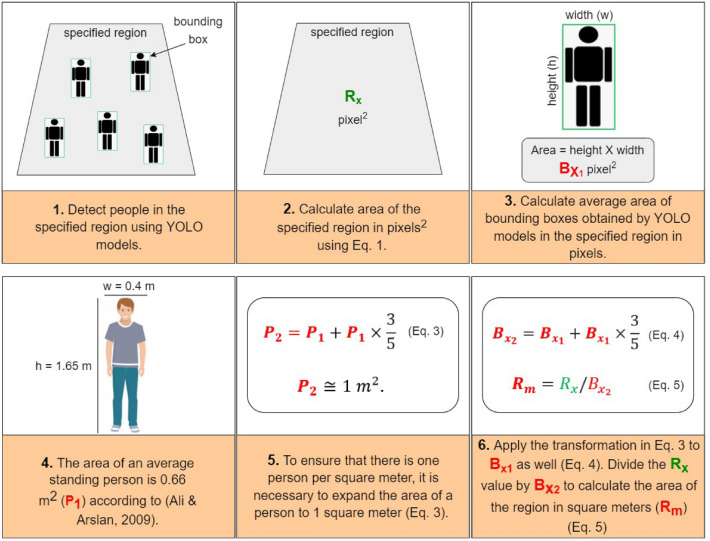
As seen in the COVID-19 pandemic, one of the most important measures is physical distance in viruses transmitted from person to person. According to the World Health Organization (WHO), it is mandatory to have a limited number of people in indoor spaces. Depending on the size of the indoors, the number of persons that can fit in that area varies. Then, the size of the indoor area should be measured and the maximum number of people should be calculated accordingly. Computers can be used to ensure the correct application of the capacity rule in indoors monitored by cameras. In this study, a method is proposed to measure the size of a prespecified region in the video and count the people there in real time. According to this method: (1) predetermining the borders of a region on the video, (2) identification and counting of people in this specified region, (3) it is aimed to estimate the size of the specified area and to find the maximum number of people it can take. For this purpose, the You Only Look Once (YOLO) object detection model was used. In addition, Microsoft COCO dataset pre-trained weights were used to identify and label persons. YOLO models were tested separately in the proposed method and their performances were analyzed. Mean average precision (mAP), frame per second (fps), and accuracy rate metrics were found for the detection of persons in the specified region. While the YOLO v3 model achieved the highest value in accuracy rate and mAP (both 0.50 and 0.75) metrics, the YOLO v5s model achieved the highest fps rate among non-Tiny models.
Keywords: Area estimation; Deep learning; People counting; Person detection; Real-time video processing; YOLO.
© The Author(s), under exclusive licence to Springer-Verlag GmbH Germany, part of Springer Nature 2023, Springer Nature or its licensor (e.g. a society or other partner) holds exclusive rights to this article under a publishing agreement with the author(s) or other rightsholder(s); author self-archiving of the accepted manuscript version of this article is solely governed by the terms of such publishing agreement and applicable law.
Conflict of interest statement
Conflict of interestThe authors did not receive support from any organization for the submitted work. The authors declare they have no financial interests. The authors have no conflicts of interest to declare that are relevant to the content of this article.
Figures




References
-
- WHO: Coronavirus disease (COVID-19) advice for the public (2020). Retrieved July 15, 2022, from: https://www.who.int/emergencies/diseases/novelcoronavirus-2019/advice-fo...
-
- Akhtar, N., & Mian, A.: Threat of adversarial attacks on deep learning in computer vision: a survey. In IEEE Access (C. 6, ss. 14410–14430). Institute of Electrical and Electronics Engineers Inc. (2018)
-
- Cho, K., van Merriënboer, B., Bahdanau, D., Bengio, Y.: On the properties of neural machine translation: Encoder–decoder approaches. Proceedings of SSST 2014- 8th Workshop on Syntax, Semantics and Structure in Statistical Translation. (2014)
-
- Young, T., Hazarika, D., Poria, S., & Cambria, E.: Recent trends in deep learning based natural language processing [Review Article]. In IEEE Computational Intelligence Magazine (C. 13, Sayı 3, ss. 55–75). Institute of Electrical and Electronics Engineers Inc. (2018)
-
- Bayat S, Işık G. Recognition of Aras bird species from their voices with deep learning methods. J. Inst. Sci. Technol. 2022;12(3):1250–1263. doi: 10.21597/jist.1124674. - DOI
LinkOut - more resources
Full Text Sources
Research Materials
Miscellaneous