. 2023 Jan 1:48:bjad003.
doi: 10.1093/chemse/bjad003.

Paradoxical electro-olfactogram responses in TMEM16B knock-out mice

Affiliations

Paradoxical electro-olfactogram responses in TMEM16B knock-out mice

Giorgia Guarneri et al. Chem Senses. .

Abstract

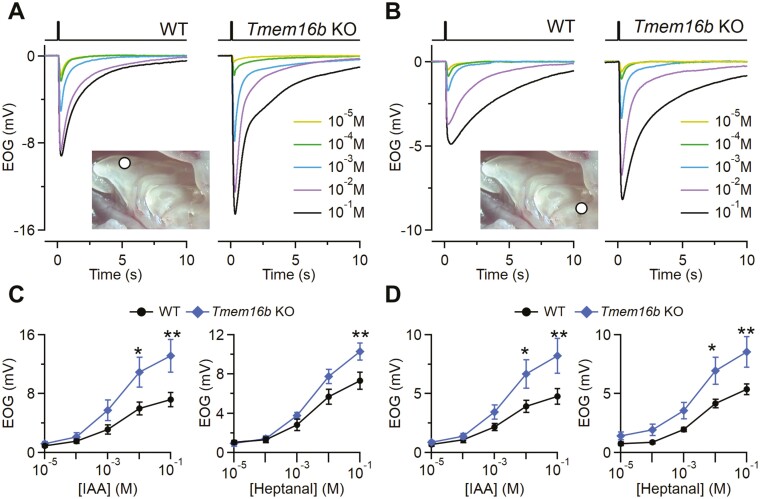
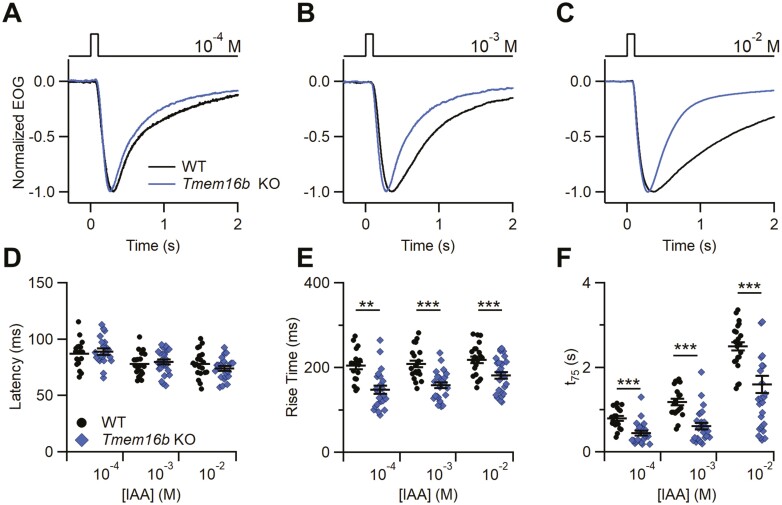
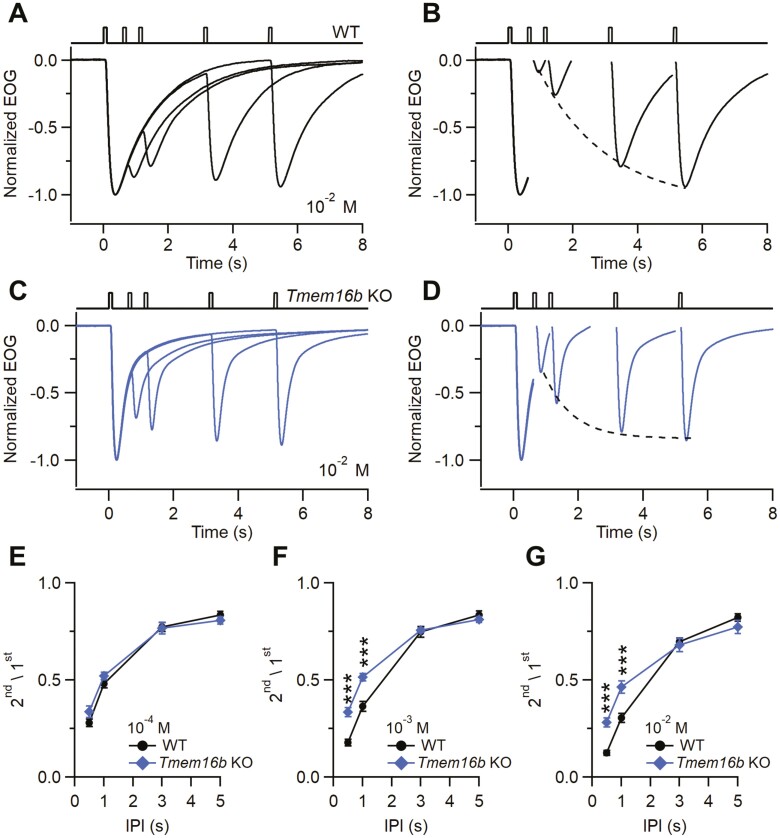
The Ca2+-activated Cl¯ channel TMEM16B carries up to 90% of the transduction current evoked by odorant stimulation in olfactory sensory neurons and control the number of action potential firing and therefore the length of the train of action potentials. A loss of function approach revealed that TMEM16B is required for olfactory-driven behaviors such as tracking unfamiliar odors. Here, we used the electro-olfactogram (EOG) technique to investigate the contribution of TMEM16B to odorant transduction in the whole olfactory epithelium. Surprisingly, we found that EOG responses from Tmem16b knock out mice have a bigger amplitude compared to those of wild type. Moreover, the kinetics of EOG responses is faster in absence of TMEM16B, while the ability to adapt to repeated stimulation is altered in knock out mice. The larger EOG responses in Tmem16b knock out may be the results of the removal of the clamping and/or shunting action of the Ca2+-activated Cl¯ currents leading to the paradox of having smaller transduction current but larger generator potential.

Keywords: ANO2; Ca2+-activated Cl¯ currents; olfactory sensory neurons; olfactory transduction.


Figures

Figure 1.
Figure 1.
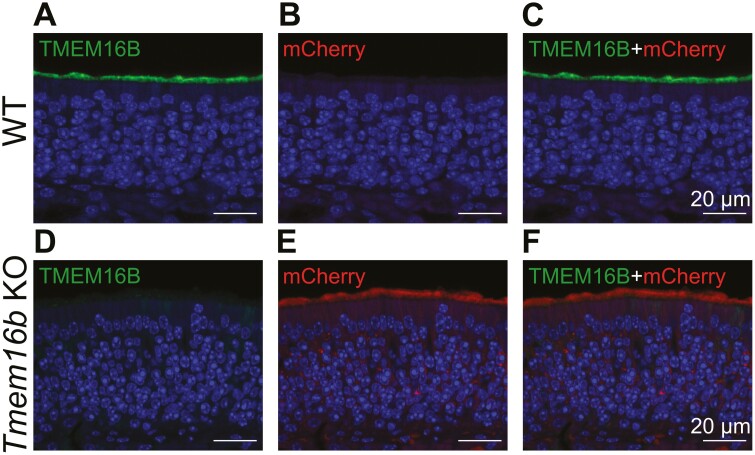
TMEM16B is expressed in olfactory sensory neurons. Confocal micrographs of coronal sections of the olfactory epithelium of WT (A–C) and Tmem16b KO (D–F). TMEM16B was expressed in the ciliary layer of WT (A) but not in KO mice (D). mCherry stains the cells of Tmem16b KO that normally express TMEM16B and was only detected in OSNs from KO mice (B, E). Nuclei were stained with DAPI.
Figure 2.
Figure 2.
Odorant responses in WT and Tmem16b KO mice. Representative EOG recordings from WT or Tmem16b KO mice. The responses were evoked by 100 ms stimulation with isoamyl acetate (IAA) vapor of increasing concentrations ranging from 10-5 to 10-1 M as indicated. EOG recordings were obtained from anterior (A) or posterior (B) portions of OEs as shown in the inset. Dose–response relationships of average peak EOG amplitudes from WT or Tmem16b KO mice to IAA or heptanal vapor obtained from anterior (C) or posterior (D) portions of OE (n = 9–12; **P < 0.01 *P < 0.05 t-test with Bonferroni correction after mixed two way ANOVA). Error bars represent sem.
Figure 3.
Figure 3.
Kinetics of the odorant response in WT and Tmem16b KO mice. (A–C) Representative normalized EOG recordings from WT or Tmem16b KO mice. The responses were evoked by 100 ms stimulation of vapors of the indicated IAA solution concentration. Scatter dot plot with average ± sem showing the values of latency (D), rise time (E) and decay time (t75) (F) in WT or Tmem16b KO mice at each odorant concentration (n = 17–21; **P < 0.01 ***P < 0.01 Student’s t test).
Figure 4.
Figure 4.
Paired pulse odorant responses in WT and Tmem16b KO mice. Representative normalized EOG double pulse responses from WT (A) and Tmem16b KO mice (C). OEs were stimulated with 100 ms-long pulses with different interpulse intervals (IPI 0.5, 1, 3, 5 s) with IAA at 10–2 M concentration. (B, D) Net responses to each stimulus for the recordings are shown in (A–C). Dotted line represents the mono-exponential fit obtained with the peak responses to the second odor pulses. (E–G) Ratio of the second stimulus to the first ± sem at the indicated odorant concentration plotted versus the IPI (n = 8–10; ***P < 0.001 t-test with Bonferroni correction after mixed two-way ANOVA).

References

    1. Agostinelli E, Gonzalez-Velandia KY, Hernandez-Clavijo A, Kumar Maurya D, Xerxa E, Lewin GR, Dibattista M, Menini A, Pifferi S.. A Role for STOML3 in Olfactory Sensory Transduction. ENeuro. 2021;8:ENEURO.0565ENEURO.0565-20.2021–ENEURO.0565ENEURO.0565-20.2021. - PMC - PubMed
    1. Belluscio L, Gold GH, Nemes A, Axel R.. Mice deficient in G(olf) are anosmic. Neuron. 1998;20:69–81. - PubMed
    1. Billig GM, Pál B, Fidzinski P, Jentsch TJ.. Ca2+-activated Cl− currents are dispensable for olfaction. Nat Neurosci. 2011;14:763–769. - PubMed
    1. Boccaccio A, Menini A.. Temporal development of cyclic nucleotide-gated and Ca2+ -activated Cl- currents in isolated mouse olfactory sensory neurons. J Neurophysiol. 2007;98:153–160. - PubMed
    1. Boccaccio, A, Menini, A., Pifferi, S.. The cyclic AMP signaling pathway in the rodent main olfactory system. Cell Tissue Res. 2021;383:429–443. - PubMed

Publication types