Endovascular versus Medical Management of Acute Basilar Artery Occlusion: A Systematic Review and Meta-Analysis of the Randomized Controlled Trials
- PMID: 36746382
- PMCID: PMC9911851
- DOI: 10.5853/jos.2022.03755
Endovascular versus Medical Management of Acute Basilar Artery Occlusion: A Systematic Review and Meta-Analysis of the Randomized Controlled Trials
Abstract
Background and purpose: The optimal management of patients with acute basilar artery occlusion (BAO) is uncertain. We aimed to evaluate the safety and efficacy of endovascular thrombectomy (EVT) compared to medical management (MM) for acute BAO through a meta-analysis of randomized controlled trials (RCTs).
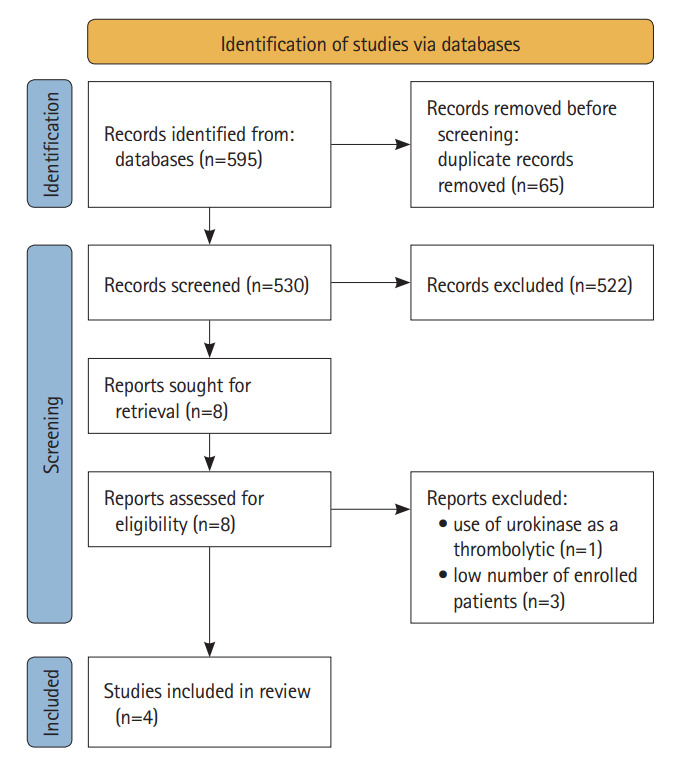
Methods: We performed a systematic review and meta-analysis of RCTs of patients with acute BAO. We analyzed the pooled effect of EVT compared to MM on the primary outcome (modified Rankin Scale [mRS] of 0-3 at 3 months), secondary outcome (mRS 0-2 at 3 months), symptomatic intracranial hemorrhage (sICH), and 3-month mortality rates. For each study, effect sizes were computed as odds ratios (ORs) with random effects and Mantel-Haenszel weighting.
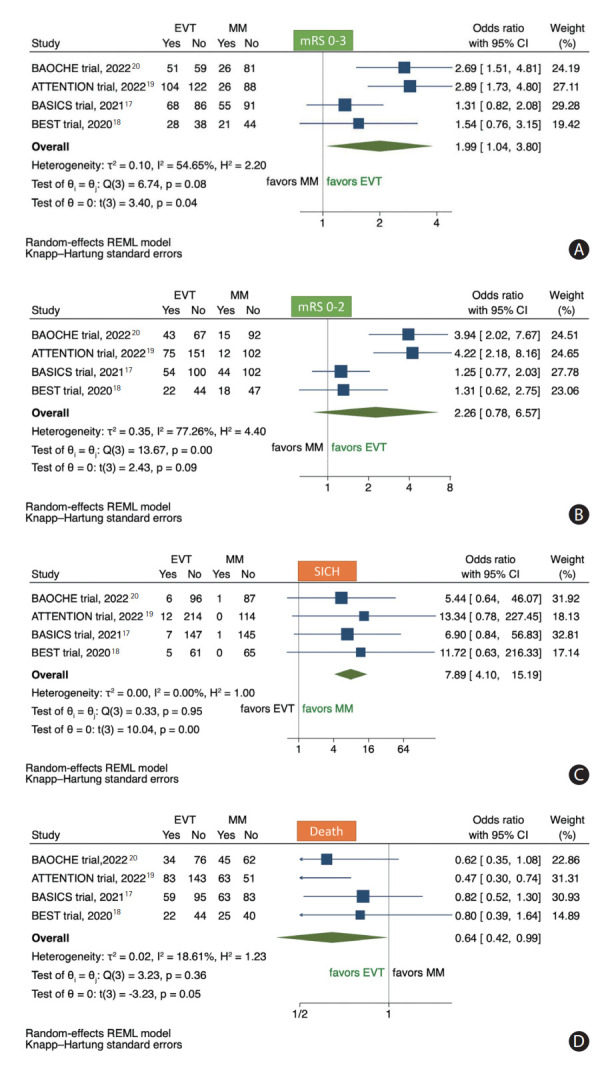
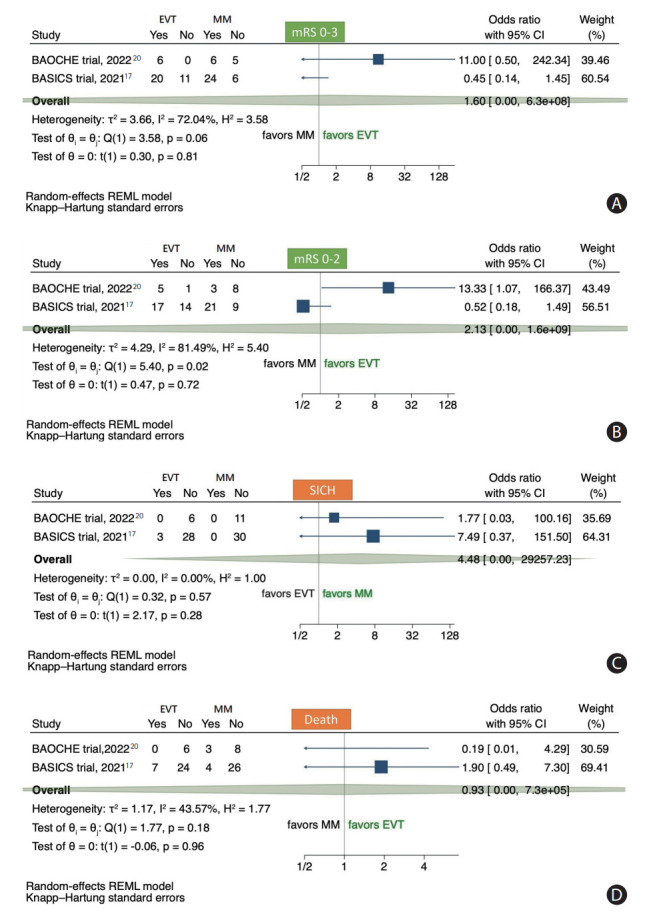
Results: Four RCTs met inclusion criteria including 988 patients. There were higher odds of mRS of 0-3 at 90 days in the EVT versus MM group (45.1% vs. 29.1%, OR 1.99, 95% confidence interval [CI] 1.04-3.80; P=0.04). Patients receiving EVT had a higher sICH compared to MM (5.4% vs. 0.8%, OR 7.89, 95% CI 4.10-15.19; P<0.01). Mortality was lower in the EVT group (35.5% vs. 45.1%, OR 0.64, 95% CI 0.42-0.99; P=0.05). In an analysis of two trials with BAO patients and National Institutes of Health Stroke Scale (NIHSS) <10, there was no difference in 90-day outcomes between EVT versus MM.
Conclusion: In this systematic review and meta-analysis, EVT was associated with favorable outcome and decreased mortality in patients with BAO up to 24 hours from stroke symptoms compared to MM. The treatment effect in BAO patients with NIHSS <10 was less certain. Further studies are of interest to evaluate the efficacy of EVT in basilar occlusion patients with milder symptoms.
Keywords: Acute basilar artery occlusion; Acute stroke; Meta-analysis; Posterior circulation.
Figures
References
-
- Berkhemer OA, Fransen PS, Beumer D, van den Berg LA, Lingsma HF, Yoo AJ, et al. A randomized trial of intraarterial treatment for acute ischemic stroke. N Engl J Med. 2015;372:11–20. - PubMed
-
- Campbell BC, Mitchell PJ, Kleinig TJ, Dewey HM, Churilov L, Yassi N, et al. Endovascular therapy for ischemic stroke with perfusion-imaging selection. N Engl J Med. 2015;372:1009–1018. - PubMed
-
- Goyal M, Demchuk AM, Menon BK, Eesa M, Rempel JL, Thornton J, et al. Randomized assessment of rapid endovascular treatment of ischemic stroke. N Engl J Med. 2015;372:1019–1030. - PubMed
-
- Jovin TG, Chamorro A, Cobo E, de Miquel MA, Molina CA, Rovira A, et al. Thrombectomy within 8 hours after symptom onset in ischemic stroke. N Engl J Med. 2015;372:2296–2306. - PubMed
-
- Saver JL, Goyal M, Bonafe A, Diener HC, Levy EI, Pereira VM, et al. Stent-retriever thrombectomy after intravenous t-PA vs. t-PA alone in stroke. N Engl J Med. 2015;372:2285–2295. - PubMed
Publication types
LinkOut - more resources
Full Text Sources
Miscellaneous