


Editorial
doi: 10.1093/asj/sjad021.
Response to: Platysma Hammock or Sling: Are They Different?
- PMID: 36746774
- PMCID: PMC10085543
- DOI: 10.1093/asj/sjad021
Item in Clipboard
Editorial
Response to: Platysma Hammock or Sling: Are They Different?
Aesthet Surg J.
.
No abstract available
Figures
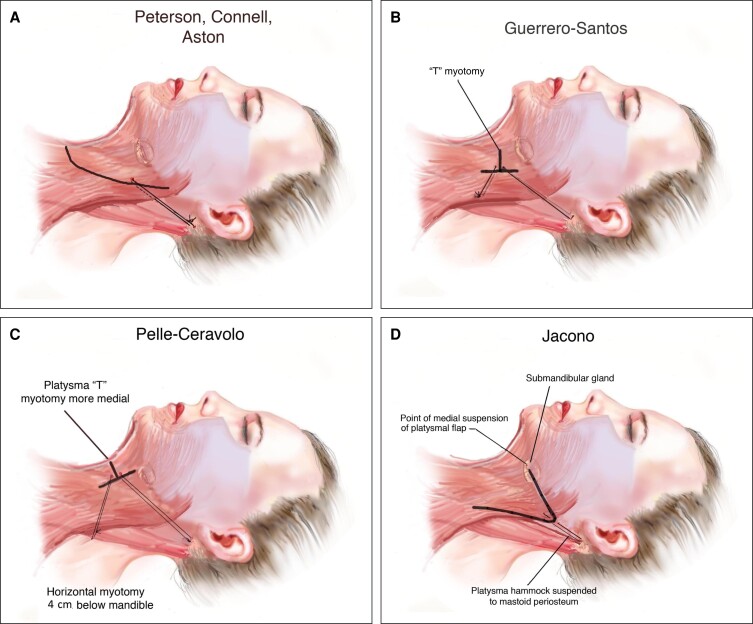
Previously described platytsma myotomies compared to platysma hammock myotomies. (A) Peterson, Connell, Aston: low transverse myotomy. (B) Guerrero-Santos: 2-flap technique, elevating the platysma posteriorly from the SCM, with the platysma myotomy at the midpoint of the vertical length of the SCM, typically 3 to 4 cm below the mandibular line, with the superior and inferior flaps suspended in opposite directions. (C) Pelle-Ceravolo: a composite flap elevating the platysma at a location at the midpoint of the mandibular body placed 4 cm anterior to the SCM, with the platysma mytomy at the midpoint of the vertical length of the SCM, typically 3-4 cm below the mandibular line, with the superior and inferior flaps suspended in opposite directions. (D) Jacono: high myotomy just below the mandibular line after elevating the platysma for 5 cm inferior to the angle of the mandible and medially from the SCM to the anterior aspect of the submandibular gland. SCM, sternocleidomastoid muscle.
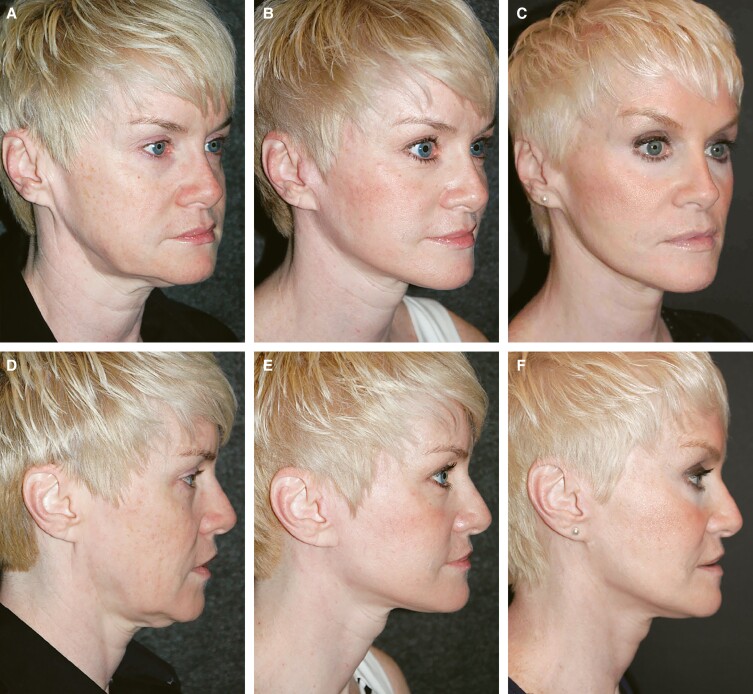
(A-C) Preoperative, 1-year, and 7-year postoperative oblique views of a 53-year-old female patient after extended deep plane facelift and platysma hammock. (D-F) Preoperative, 1-year, and 7-year postoperative lateral views of the patient. The extended deep plane facelift platysma hammock flap has maintained the improvement in submandibular gland ptosis and platysma cording at 7 years.
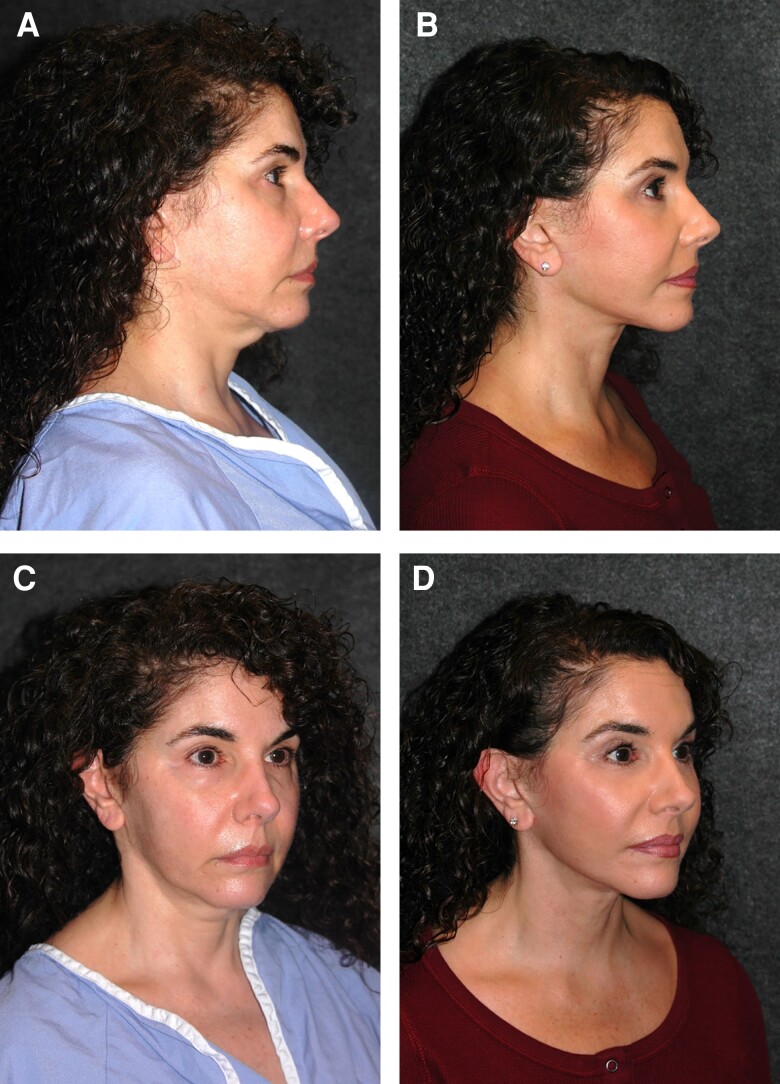
(A, C) Preoperative and (B, D) 1-year postoperative views of a 60-year-old female patient after undergoing an extended deep plane facelift and platysma hammock after a previous biplanar superficial musculoaponeurotic system facelift with low platysma transection performed elsewhere 18 months previously. Notice the how the platysma transection and platysma hammock created a defined submandibular contour, suspended the submandibular gland, and created significantly improved platysma redraping at 1 year.
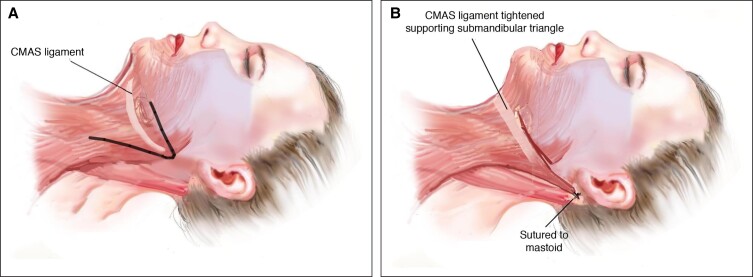
Aging creates laxity and redundancy in the CMAS ligament. The platysma hammock flap creates a flap centered around the CMAS ligament, and therefore redraping and suspending the flap engages the ligament. (A) The heavy black line outlines where the platysma is elevated from the sternocleidomastoid muscle and the high platysma myotomy. (B) A natural effect of the tension bar, the platysma hammock with the durability of the CMAS ligament supports the submandibular triangle, elevates ptotic submandibular glands, and creates a submandibular concavity below the mandibular line. CMAS ligament, cervicomental angle suspensory ligament.
Comment on
-
Platysma Hammock or Sling: Are They Different?Aesthet Surg J. 2023 Apr 10;43(5):NP391-NP392. doi: 10.1093/asj/sjac354. Aesthet Surg J. 2023. PMID: 36624072 No abstract available.
References
-
- Skoog T. Chapter XIII: The aging face. In:Plastic Surgery: New Methods and Refinements.Almqvist & Wiksell; 1974:315–317.
