Evaluation of distal skin temperature and tissue oxygen saturation determined by near-infrared spectroscopy for predicting ultrasound-guided lateral infraclavicular block success
- PMID: 36746906
- PMCID: PMC9902633
- DOI: 10.17085/apm.22181
Evaluation of distal skin temperature and tissue oxygen saturation determined by near-infrared spectroscopy for predicting ultrasound-guided lateral infraclavicular block success
Abstract
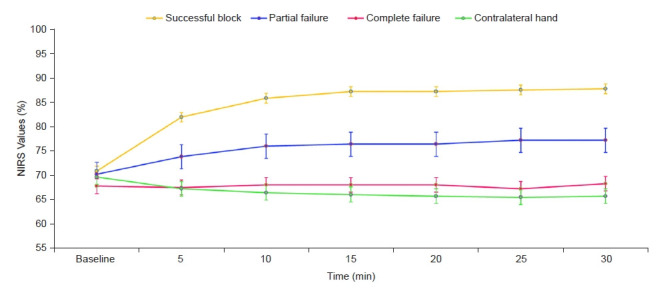
Background: Changes in tissue oxygen saturation determined by near-infrared spectroscopy (NIRS) may help predict and determine the success of a lateral infraclavicular (LIC) block.We investigated whether evaluation of tissue oxygen saturation determined by NIRS couldbe an indicator of LIC block success.
Methods: Forty patients scheduled for hand or forearm surgery under LIC block were studied. NIRS sensors were placed on the ventral aspect of both mid-forearms, and the contralateral hand was used as the control group. NIRS values were recorded before the block andat regular intervals during the following 30 min.
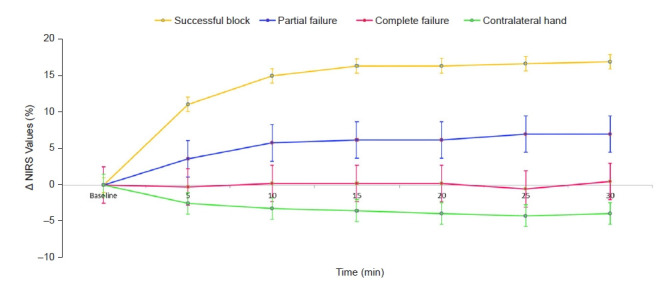
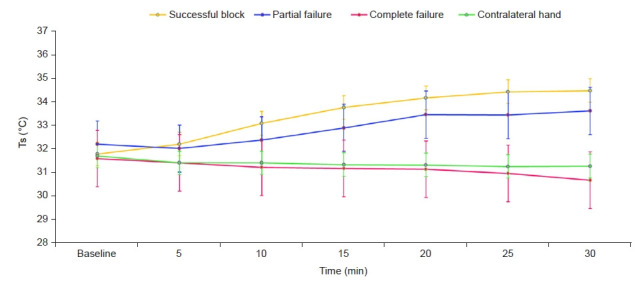
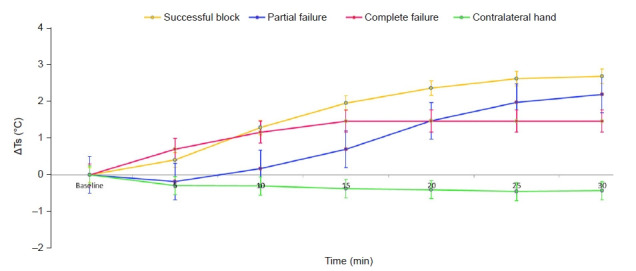
Results: NIRS values were significantly higher in the successfully blocked patients whencompared to the complete failure, partial failure, and contralateral hand groups at the 10thmin. In the successfully blocked patients, NIRS values (mean ± SD [change in %]) increasedby 11.09 ± 4.86 (16.03%), 15.00 ± 4.53 (21.76%), 16.35 ± 5.14 (23.77%), 16.38 ± 4.88(23.85%), 16.67 ± 5.04 (24.29%), and 16.96 ± 5.71 (24.78%), respectively, from baselineto 5, 10, 15, 20, 25, and 30 min. ΔTs values were significantly higher in the successfullyblocked patients than in the complete failure patients and contralateral hand at the 30thmin. However, there was no statistically significant difference when comparing ΔTs values ofsuccessful block and partial failure block patients at the 30th min.
Conclusions: We conclude that measurement of tissue oxygen saturation by NIRS withinthe scope of evaluation of the lateral infraclavicular block is a rapid, effective, and applicabletechnique.
Keywords: Local anesthetics; Near-infrared spectroscopy; Peripheral nerves; Skin temperature; Sympathetic nervous system.
Conflict of interest statement
No potential conflict of interest relevant to this article was reported.
Figures
References
-
- Sandhu NS, Manne JS, Medabalmi PK, Capan LM. Sonographically guided infraclavicular brachial plexus block in adults: a retrospective analysis of 1146 cases. J Ultrasound Med. 2006;25:1555–61. - PubMed
-
- Sandhu NS, Capan LM. Ultrasound-guided infraclavicular brachial plexus block. Br J Anaesth. 2002;89:254–9. - PubMed
-
- Arcand G, Williams SR, Chouinard P, Boudreault D, Harris P, Ruel M, et al. Ultrasound-guided infraclavicular versus supraclavicular block. Anesth Analg. 2005;101:886–90. - PubMed
-
- Curatolo M, Petersen-Felix S, Arendt-Nielsen L. Assessment of regional analgesia in clinical practice and research. Br Med Bull. 2005;71:61–76. - PubMed
-
- Paqueron X, Gentili ME, Willer JC, Coriat P, Riou B. Time sequence of sensory changes after upper extremity block: swelling sensation is an early and accurate predictor of success. Anesthesiology. 2004;101:162–8. - PubMed
LinkOut - more resources
Full Text Sources