


The oxidative balance and stopover departure decisions in a medium- and a long-distance migrant
- PMID: 36747277
- PMCID: PMC9903453
- DOI: 10.1186/s40462-023-00372-7
The oxidative balance and stopover departure decisions in a medium- and a long-distance migrant
Abstract
Background: Birds have extremely elevated metabolic rates during migratory endurance flight and consequently can become physiologically exhausted. One feature of exhaustion is oxidative damage, which occurs when the antioxidant defense system is overwhelmed by the production of damaging reactive oxygen species (ROS). Migrating birds have been shown to decrease the amount of oxidative lipid damage during stopovers, relatively stationary periods in between migratory flights. It has therefore been argued that, in addition to accumulating fuel, one of the functions of stopover is to restore the oxidative balance. If this is so, we would expect that migrating birds are unlikely to resume migration from stopover when they still have high amounts of lipid damage.
Methods: To test this hypothesis, we measured parameters of the oxidative balance and related these to stopover departure decisions of song thrushes (Turdus philomelos) and northern wheatears (Oenanthe oenanthe), a medium- and long-distance songbird migrant, respectively. We measured malondialdehyde (MDA) concentration, a biomarker for oxidative lipid damage, and total non-enzymatic antioxidant capacity (AOX), an overall biomarker of protection against ROS. Stopover departure decisions were determined using a fully automated telemetry system set-up on our small island study site.
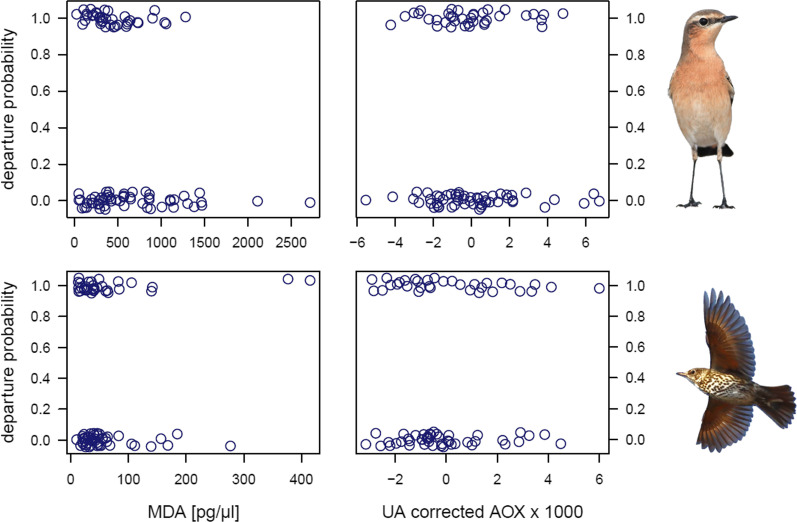
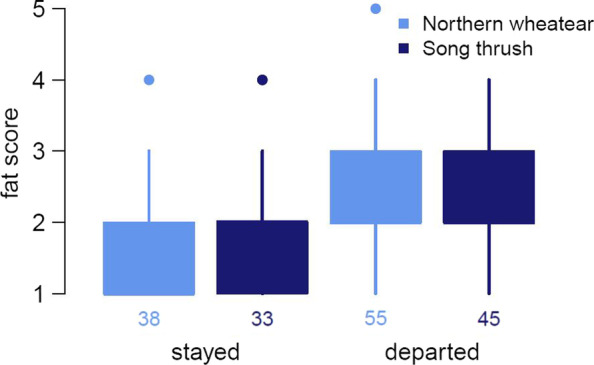
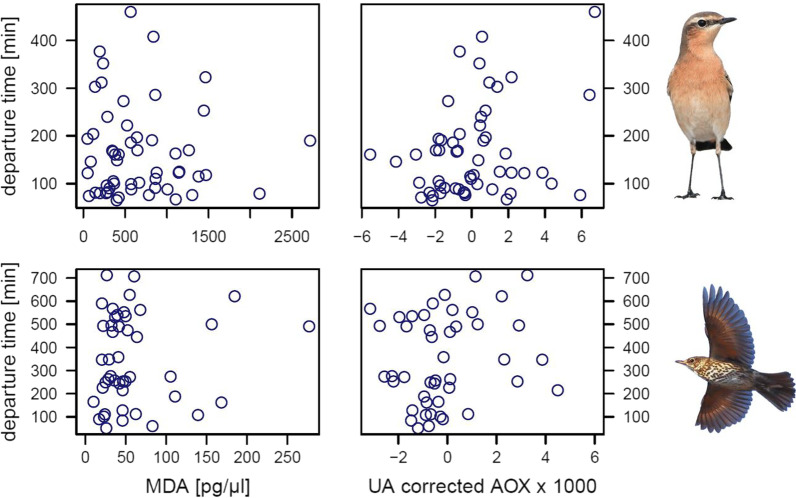
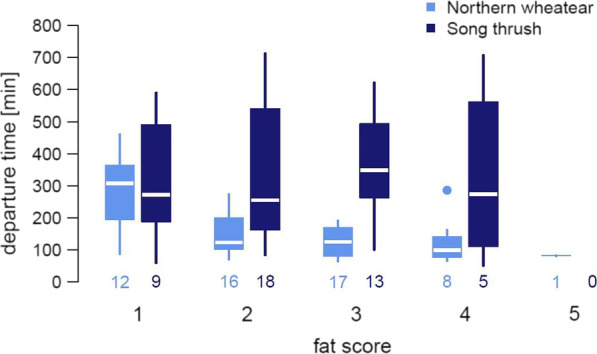
Results: The decision to resume migration was not related with MDA concentration in either study species, also not when this was corrected for circulating fatty acid concentrations. Similarly, AOX did not affect this decision, also not when corrected for uric-acid concentration. The time within the night when birds departed also was not affected by MDA concentration or AOX. However, confirming earlier observations, we found that in both species, fat individuals were more likely to depart than lean individuals, and fat northern wheatears departed earlier within the night than lean conspecifics. Northern wheatears additionally departed earlier in spring with more southerly winds.
Conclusions: We found no support for the idea that stopovers departure decisions are influenced by parameters of the oxidative balance. We discuss possible reasons for this unexpected finding.
Keywords: Departure; Migration; Physiology; Radio-telemetry; Stopover.
© 2023. The Author(s).
Conflict of interest statement
The authors have no competing interests.
Figures
References
-
- Andersson MN, Wang HL, Nord A, Salmón P, Isaksson C. Composition of physiologically important fatty acids in great tits differs between urban and rural populations on a seasonal basis. Front Ecol Evol. 2015;3:93. doi: 10.3389/fevo.2015.00093. - DOI
-
- Brust V, Eikenaar C, Packmor F, Schmaljohann HJ, Hüppop O, Czirják GA. Do departure and flight route decisions correlate with immune parameters in migratory songbirds? Funct Ecol. 2022;36:3007–3021. doi: 10.1111/1365-2435.14187. - DOI
Publication types
Grants and funding
LinkOut - more resources
Full Text Sources
