[Preprint]. 2023 Jan 23:2023.01.23.525256.
doi: 10.1101/2023.01.23.525256.

A Model-Based Hierarchical Bayesian Approach to Sholl Analysis

Affiliations

A Model-Based Hierarchical Bayesian Approach to Sholl Analysis

Erik Vonkaenel et al. bioRxiv. .

Update in

Abstract

Due to the link between microglial morphology and function, morphological changes in microglia are frequently used to identify pathological immune responses in the central nervous system. In the absence of pathology, microglia are responsible for maintaining homeostasis, and their morphology can be indicative of how the healthy brain behaves in the presence of external stimuli and genetic differences. Despite recent interest in high throughput methods for morphological analysis, Sholl analysis is still the gold standard for quantifying microglia morphology via imaging data. Often, the raw data are naturally hierarchical, minimally including many cells per image and many images per animal. However, existing methods for performing downstream inference on Sholl data rely on truncating this hierarchy so rudimentary statistical testing procedures can be used. To fill this longstanding gap, we introduce a fully parametric model-based approach for analyzing Sholl data. We generalize our model to a hierarchical Bayesian framework so that inference can be performed without aggressive reduction of otherwise very rich data. We apply our model to three real data examples and perform simulation studies comparing the proposed method with a popular alternative.

Keywords: Bayesian analysis; Generalized non-linear models; Hierarchical models; Microglia; Sholl analysis.


Figures
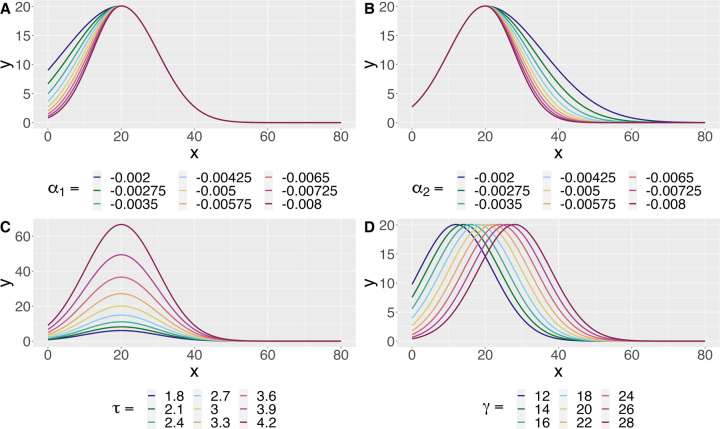
Fig. 1.
Fig. 1.
The mean model induced by Equation 2.1 as each parameter varies. A: The growth parameter α1 controls the behavior of the curve before the change-point. B: The decay parameter α2 controls the behavior of the curve after the change-point. D: The parameter τ controls the branch maximum of the fitted curve via eτ . C: The parameter γ controls the critical value, i.e. the change-point, of the fitted curve.
Fig. 2.
Fig. 2.
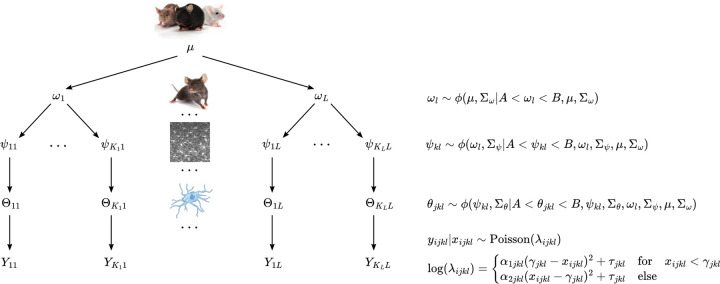
Hierarchical structure for model 1. We assume parameters at any level are randomly sampled from the corresponding distribution in the next highest level. Here, ϕ(∗) denotes the Gaussian distribution, µ denotes population-level parameters, ω denotes animal-level parameters, ψ denotes image-level parameters, θ denotes cell-level parameters, and Y denotes Sholl curve process crossings. For a given parameter ∗, Σ denotes variance parameters for the corresponding Gaussian. Gaussian priors are truncated via A and B to enforce the parameter constraints of Equation 2.1.
Fig. 3.
Fig. 3.
Hierarchical structure for Model 2. Denote groups in the first categorical variable as either ND or MD, and the second as either I or C. Notation is consistent with Figure 2 except, for some combination of groups *, ζ* denotes group-level parameters, Ω*=ω1*,,ωL* denotes animal-level parameters, and Y*=y1lm,,yNlm denotes Sholl curve process crossings. Additionally, group combination is indexed by m and we model group level effects as additive terms b on the mean parameter for group level distributions.
Fig. 4.
Fig. 4.
Hierarchical structure for model 3. As before, all notation is shared with models displayed in Figures 2.3 and 2.4, except ξ denotes genotype-level parameters. Additionally, bKO denotes the genotype level effect, bCrush denotes the condition level effect, and bKO/Crush denotes the interaction effect between condition and genotype. I* is an indicator variable equal to 1 for observations in group ∗, and 0 else.
Fig. 5.
Fig. 5.
Fitted curves at each level of the model hierarchy, obtained with model 1 via MCMC. A: Cell-level fitted curves for each animal, where color indicates the cell. B: Image-level fitted curves for each animal, where color indicated image. C: Animal-level fitted curves. D: All cell-level fitted curves displayed in panel A, superimposed to show the cell-level variation. E: All image-level fitted curves displayed in panel B, superimposed to show the image-level variation. F: All animal-level fitted curves displayed in panel C, superimposed to show the animal-level variation.
Fig. 6.
Fig. 6.
Group-level fitted curves obtained by fitting model 2 to the MD/ND dataset. A: Fitted curves faceted by group, superimposed over animal level Sholl curves. B: All four facets from panel A, superimposed to better show hyper-ramification of the MD/Contra group.
Fig. 7.
Fig. 7.
95% credible intervals for each effect in model 2, fitted to the MD/ND dataset. Credible intervals are computed as the highest density posterior interval. Credible intervals are superimposed over the approximate posterior distributions obtained via MCMC. Estimated posterior means are represented by black dots with point estimates displayed above. The dotted red line is fixed at 0.
Fig. 8.
Fig. 8.
Cell-level fitted curves faceted by animal obtained by fitting model 3 to the GPNMB knockout dataset. An animal is either wild-type (WT), or has gene GPNMB knocked out (KO). Cells are associated with either an eye subject to optical nerve crush injury, or control. Each animal has both a crush eye and a control eye.
Fig. 9.
Fig. 9.
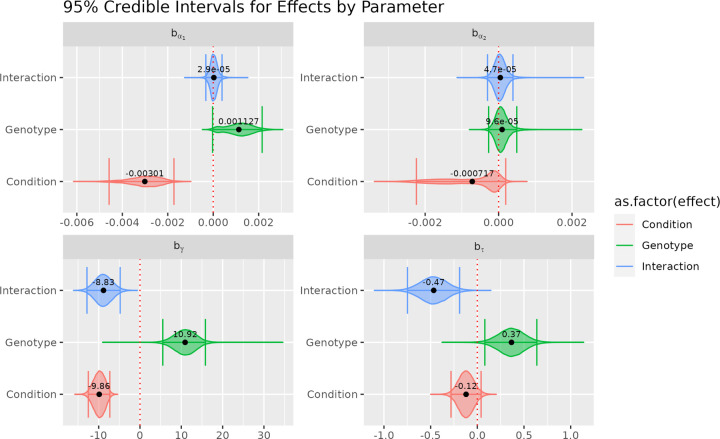
95% credible intervals for each effect in model 3, fitted to the GPNMB knockout dataset. Credible intervals are computed as the highest density posterior interval. Credible intervals are superimposed over the approximate posterior distributions obtained via MCMC. Estimated posterior means are represented by black dots with point estimates displayed above. The dotted red line is fixed at 0.

References

    1. Bogie Jeroen F J, Stinissen Piet and Hendriks Jerome J A. (2014, June). Macrophage subsets and microglia in multiple sclerosis. Acta Neuropathol 128(2), 191–213. - PubMed
    1. Colombo Gloria, Cubero Ryan John A, Kanari Lida, Venturino Alessandro, Schulz Rouven, Scolamiero Martina, Agerberg Jens, Mathys Hansruedi, Tsai Li-Huei, Chachólski Wojciech, Hess Kathryn and others. (2022, September). A tool for mapping microglial morphology, morphOMICs, reveals brain-region and sex-dependent phenotypes. Nat Neurosci 25(10), 1379–1393. - PMC - PubMed
    1. Franco Rafael and Fernández-Suárez Diana. (2015, June). Alternatively activated microglia and macrophages in the central nervous system. Prog Neurobiol 131, 65–86. - PubMed
    1. Gelman Andrew. (2006). Prior distributions for variance parameters in hierarchical models (comment on article by browne and draper). Bayesian analysis 1(3), 515–534.
    1. Gomez-Nicola Diego and Perry V Hugh. (2014, April). Microglial dynamics and role in the healthy and diseased brain: a paradigm of functional plasticity. Neuroscientist 21(2), 169–184. - PMC - PubMed

Publication types