Review
. 2023 Jan;23(1):3-106.
doi: 10.5230/jgc.2023.23.e11.

Korean Practice Guidelines for Gastric Cancer 2022: An Evidence-based, Multidisciplinary Approach

Affiliations
Review

Korean Practice Guidelines for Gastric Cancer 2022: An Evidence-based, Multidisciplinary Approach

Tae-Han Kim et al. J Gastric Cancer. 2023 Jan.

Erratum in

  • Erratum: Korean Practice Guidelines for Gastric Cancer 2022: An Evidence-based, Multidisciplinary Approach.
    Kim TH, Kim IH, Kang SJ, Choi M, Kim BH, Eom BW, Kim BJ, Min BH, Choi CI, Shin CM, Tae CH, Gong CS, Kim DJ, Cho AE, Gong EJ, Song GJ, Im HS, Ahn HS, Lim H, Kim HD, Kim JJ, Yu JI, Lee JW, Park JY, Kim JH, Song KD, Jung M, Jung MR, Son SY, Park SH, Kim SJ, Lee SH, Kim TY, Bae WK, Koom WS, Jee Y, Kim YM, Kwak Y, Park YS, Han HS, Nam SY, Kong SH. Kim TH, et al. J Gastric Cancer. 2023 Apr;23(2):365-373. doi: 10.5230/jgc.2023.23.e20. J Gastric Cancer. 2023. PMID: 37129159 Free PMC article.

Abstract

Gastric cancer is one of the most common cancers in Korea and the world. Since 2004, this is the 4th gastric cancer guideline published in Korea which is the revised version of previous evidence-based approach in 2018. Current guideline is a collaborative work of the interdisciplinary working group including experts in the field of gastric surgery, gastroenterology, endoscopy, medical oncology, abdominal radiology, pathology, nuclear medicine, radiation oncology and guideline development methodology. Total of 33 key questions were updated or proposed after a collaborative review by the working group and 40 statements were developed according to the systematic review using the MEDLINE, Embase, Cochrane Library and KoreaMed database. The level of evidence and the grading of recommendations were categorized according to the Grading of Recommendations, Assessment, Development and Evaluation proposition. Evidence level, benefit, harm, and clinical applicability was considered as the significant factors for recommendation. The working group reviewed recommendations and discussed for consensus. In the earlier part, general consideration discusses screening, diagnosis and staging of endoscopy, pathology, radiology, and nuclear medicine. Flowchart is depicted with statements which is supported by meta-analysis and references. Since clinical trial and systematic review was not suitable for postoperative oncologic and nutritional follow-up, working group agreed to conduct a nationwide survey investigating the clinical practice of all tertiary or general hospitals in Korea. The purpose of this survey was to provide baseline information on follow up. Herein we present a multidisciplinary-evidence based gastric cancer guideline.

Keywords: Chemotherapy; Endoscopy; Guidelines; Stomach neoplasms; Surgery.


Conflict of interest statement

Seong-Ho Kong has received research funding from Stryker Co., Ltd. and Medtronic Inc. as the principal investigator and is the CEO of VITCAL, Co., Ltd. No potential conflict of interest relevant to this article was reported.

Figures

Fig. 1
Fig. 1. Forest plot comparing staging accuracy between axial plane plus MPR vs. axial plane only in multidetector row computed tomography.
MPR = multiplanar reformation; CI = confidence interval.
Fig. 2
Fig. 2. Forest plot for comparison of local recurrence. (A) Risk of local recurrence in endoscopic treatment group vs. follow-up without therapy group. (B) Risk of local recurrence in endoscopic treatment group vs. gastrectomy.
Tx = treatment; CI = confidence interval.
Fig. 3
Fig. 3. Forest plot for a comparison of the risk of metachronous gastric cancer between Helicobacter pylori eradication (experimental) vs. no treatment (control).
SE = standard error; IV = interval variable; CI = confidence interval.
Fig. 4
Fig. 4. Forest plots comparing reconstruction methods. (A) Operation time. (B) Complications. (C) Hospital stay. (D) Bile reflux. (E) Esophageal reflux.
SD = standard deviation; IV = interval variable; CI = confidence interval.
Fig. 5
Fig. 5. Forest plots for comparison between proximal gastrectomy with double tract reconstruction vs. total gastrectomy in retrospective studies. (A) Vitamin B12 deficiency. (B) Weight loss. (C) Early complications. (D) Reflux symptom.
PG = proximal gastrectomy; DTR = double tract reconstruction; TG = total gastrectomy; IV = interval variable; CI = confidence interval.
Fig. 6
Fig. 6. Forest plot for a comparison between no splenectomy (experimental) vs. splenectomy (control). (A) Survival. (B) Complications.
CI = confidence interval.
Fig. 7
Fig. 7. Forest plot, LN metastasis rates of distal stomach according to the depth of tumor. (A) LN metastasis rate comparison T3 vs. T2 (P=0.17). (B) LN metastasis rate comparison T4 vs. T2 (P<0.01).
LN = lymph node; CI = confidence interval.
Fig. 8
Fig. 8. Forest plots for comparisons between the TH abdominal approach vs. TT approach. TT approaches in the observational studies included. In-hospital mortality: (A) RCTs; (B) Observational studies. Pulmonary complications: (C) RCTs; (D) Observational studies. Five-year survival: (E) RCTs; (F) Observational studies.
TH = transhiatal; TT = transthoracic; CI = confidence interval; RCT = randomized controlled trial.
Fig. 9
Fig. 9. Forest plots for comparison between the sentinel node navigation surgery vs. conventional surgery in observational studies. (A) Overall survival. (B) Body weight: percentages compared to preoperative body weight.
SE = standard error; SNNS = sentinel node navigation surgery; SD = standard deviation; IV = interval variable; CI = confidence interval.
Fig. 10
Fig. 10. Forest plots for comparisons between laparoscopic and open (conventional) distal gastrectomy in c-Stage I gastric cancer. (A)Overall survival. (B)Complications. (C) Intraoperative blood loss.
SE = standard error; SD = standard deviation; IV = interval variable; CI = confidence interval.
Fig. 11
Fig. 11. Forest plots for comparisons between laparoscopic and open (conventional) distal gastrectomy in cT2-4a gastric cancer. (A) Overall survival. (B) Complications. (C) Intraoperative blood loss. (D) Operation time. (E) Hospital stay.
SE = standard error; SD = standard deviation; IV = interval variable; CI = confidence interval.
Fig. 12
Fig. 12. Forest plots for comparisons between daVinci™ robot gastrectomy vs. laparoscopic gastrectomy. (A) Complications (RCTs). (B) Pancreatic fistula (RCTs and observational studies). (C) Overall survival (observational studies). (D) Operation time (observational studies).
SE = standard error; SD = standard deviation; IV = interval variable; CI = confidence interval; RCT = randomized controlled trial.
Fig. 13
Fig. 13. Forest plots for comparisons between PO (experimental) vs. TO (control) in advanced gastric cancer in observational studies. (A) Overall survival (propensity score matched). (B) Relapse-free survival (propensity score matched). (C) Complications.
PO = partial omentectomy; TO = total omentectomy; SE = standard error; IV = interval variable; CI = confidence interval.
Fig. 14
Fig. 14. Forest plots for comparisons between adjuvant chemotherapy vs. surgery only and doublet vs. S1 monotherapy. (A) Overall survival for adjuvant chemotherapy (experimental) vs. surgery only (control). (B) Disease-free survival for adjuvant chemotherapy (experimental) vs. surgery only (control). (C) Disease-free survival for oral fluoropyrimidine-based doublet (experimental) vs. S1 monotherapy (control).
SE = standard error; IV = interval variable; CI = confidence interval.
Fig. 15
Fig. 15. Forest plots for comparisons between palliative first-line chemotherapy (experimental) vs. best supportive care (control). (A) Overall survival. (B) Progression-free survival.
SE = standard error; IV = interval variable; CI = confidence interval.
Fig. 16
Fig. 16. Forest plots for comparisons between palliative first-line chemotherapy with immune checkpoint inhibitor (experimental) vs. chemotherapy (control). (A) Overall survival. (B) Progression-free survival.
ICI = immune checkpoint inhibitor; SE = standard error; IV = interval variable; CI = confidence interval.
Fig. 17
Fig. 17. Forest plots for comparisons between palliative second-line systemic therapy (experimental) vs. best supportive care or placebo (control). (A) Overall survival. (B) Progression-free survival.
SE = standard error; IV = interval variable; CI = confidence interval.
Fig. 18
Fig. 18. Forest plots for comparisons between palliative third-line systemic therapy (experimental) vs. best supportive care (control). (A) Overall survival. (B) Progression-free survival.
SE = standard error; IV = interval variable; CI = confidence interval.
Fig. 19
Fig. 19. Forest plot for a comparison of disease-free survival between neoadjuvant chemotherapy as part of perioperative chemotherapy (experimental) vs. adjuvant chemotherapy only (control).
SE = standard error; IV = interval variable; CI = confidence interval.
Fig. 20
Fig. 20. Forest plots for comparison between adjuvant concurrent CRT vs. adjuvant platinum-based combination CA. (A) Overall survival. (B) Disease-free survival. (C) Locoregional recurrence.
CRT = chemoradiation therapy; CA = chemotherapy alone; SE = standard error; IV = interval variable; CI = confidence interval.
Fig. 21
Fig. 21. Forest plots for comparisons between NCRT compared to NCT. (A) Overall survival. (B) Pathologic complete response. (C) Pathologic complete nodal regression. (D) R0 resection.
NCRT = neoadjuvant chemoradiation; NCT = neoadjuvant chemotherapy; SE = standard error; CI = confidence interval.
Fig. 22
Fig. 22. Forest plot results of meta-analysis of procedure outcomes. (A) Technical success. (B) Clinical success. (C) Procedure related mortality.
CI = confidence interval.
Fig. 23
Fig. 23. Forest plot results of meta-analysis of postoperative outcomes. (A) Resumption of oral intake. (B) Duration of hospital stay. (C) Minor complications. (D) Major complications. (E) Re-intervention. (F) Patency duration. (G) Overall survival.
SD = standard deviation; IV = interval variable; CI = confidence interval.
Fig. 24
Fig. 24. Forest plot for a comparison of overall survival between surgery after chemotherapy vs. chemotherapy alone in metastatic gastric cancer.
SE = standard error; IV = interval variable; CI = confidence interval.
Fig. 25
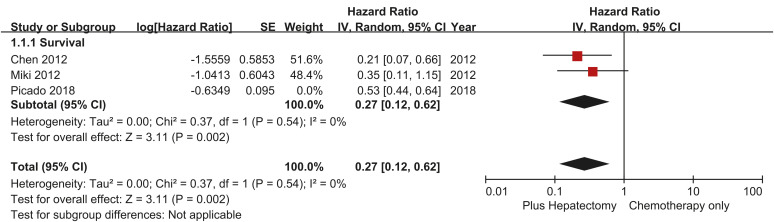
Fig. 25. Forest plot for comparison of overall survival between (hepatectomy and gastrectomy with chemotherapy) vs. (chemotherapy only) in gastric cancer with oligometastasis confined to liver from observational studies.
SE = standard error; IV = interval variable; CI = confidence interval.
Fig. 26
Fig. 26. Forest plot for comparison of overall survival between (oophorectomy and gastrectomy with chemotherapy) vs. (chemotherapy only) in gastric cancer with oligometastasis confined to ovary in observational studies.
SE = standard error; IV = interval variable; CI = confidence interval.
Flowchart 1
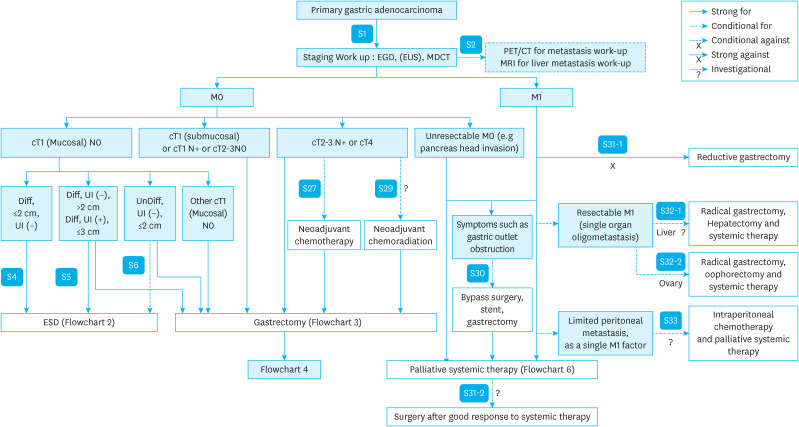
Flowchart 1. Overall treatment algorithm.
EGD = esophagogastroduodenoscopy; EUS = endoscopic ultrasound; MDCT = multidetector row computed tomography; PET = positron emission tomography; CT = computed tomography; MRI = magnetic resonance imaging; Diff = well or moderately differentiated; UI = ulcer lesion; UnDiff = poorly differentiated/poorly cohesive (including signet-ring cell); ESD = endoscopic submucosal dissection.
Flowchart 2
Flowchart 2. Endoscopic treatment.
Diff = well or moderately differentiated; UI = ulcer lesion; UnDiff = poorly differentiated/poorly cohesive (including signet-ring cell); ESD = endoscopic submucosal dissection; APC = argon plasma coagulation.
Flowchart 3
Flowchart 3. Approach and extent of gastrectomy.
DG = distal gastrectomy; TG = total gastrectomy; PPG = pylorus-preserving gastrectomy; PG = proximal gastrectomy; LND = lymph node dissection; LN = lymph node.
Flowchart 4
Flowchart 4. Treatment plans after gastrectomy.
LN = lymph node; XELOX = capecitabine and oxaliplatin. *To obtain negative margin, single or combinations of various methods including intraoperative frozen section, perioperative gastroscopy, various preoperative clipping or dyeing, fluorescence imaging technique, ultrasonography, and simple X-ray, etc. can be applied. Preferred in pStage II with LN+ or pStage III.
Flowchart 5
Flowchart 5. Treatment guidelines in gastroesophageal junction adenocarcinoma.
ESD = endoscopic submucosal dissection; TG = total gastrectomy; PG = proximal gastrectomy; LND = lymph node dissection.
Flowchart 6
Flowchart 6. Treatment guideline for palliative systemic therapy.
HER2 = human epidermal growth factor receptor 2; PD-L1 = programmed cell death-ligand 1; CPS = combined positive score; FOLFOX = 5-fluorouracil, leucovorin, and oxaliplatin; XELOX = capecitabine and oxaliplatin; FP = 5-fluorouracil and cisplatin; XP = capecitabine plus cisplatin; MSI-H = microsatellite instability-high; dMMR = mismatch repair deficient.

Comment in

References

    1. International Agency for Research on Cancer. Cancer fact sheet stomach: Globocan 2020 [Internet] Geneva: World Health Organization; 2022. Available from: https://gco.iarc.fr/today/data/factsheets/cancers/7-Stomach-fact-sheet.pdf.
    1. Hong S, Won YJ, Lee JJ, Jung KW, Kong HJ, Im JS, et al. Cancer statistics in Korea: incidence, mortality, survival, and prevalence in 2018. Cancer Res Treat. 2021;53:301–315. - PMC - PubMed
    1. National Cancer Center, Korea Central Cancer Registry. Korean Cancer Report 2020. Goyang: National Cancer Center; 2022.
    1. Park SH, Kang MJ, Yun EH, Jung KW. Epidemiology of gastric cancer in Korea: trends in incidence and survival based on Korea Central Cancer Registry Data (1999–2019) J Gastric Cancer. 2022;22:160–168. - PMC - PubMed
    1. Information Committee of the Korean Gastric Cancer Association. Korean Gastric Cancer Association-led nationwide survey on surgically treated gastric cancers in 2019. J Gastric Cancer. 2021;21:221–235. - PMC - PubMed