. 2023 Feb 8;13(1):2222.
doi: 10.1038/s41598-023-27489-4.

Dynamic characteristics of skin reaction force in different body postures

Affiliations

Dynamic characteristics of skin reaction force in different body postures

Nick Marsidi et al. Sci Rep. .

Abstract

Mechanical stress influences scarring of a surgical wound. Several lines have been proposed for the best excision direction. It is unknown if these lines still apply when the body posture changes. The objective is to measure the skin reaction force in four directions and determine the direction of least force. Secondary objective is to determine if the reaction force varies in a different body posture. Skin reaction force was measured with the compressiometer in 30 participants on four different locations (forearm/upper arm/shoulder blade/lower back) in four directions (0°-45°-90°-135°) and two body postures. The direction of least skin reaction force changed with a different body posture and was significant for the forearm (p < 0.01) and shoulder blade (p = 0.05) The skin reaction force in all four direction changed significantly in a different body posture, except the 45° line in the upper arm and shoulder blade. Our results demonstrate that the skin reaction force in four directions in four locations varies with change in body posture. Focus should therefore not only lay on choosing the right direction, but also on managing skin tension postoperatively.


Conflict of interest statement

The authors declare no competing interests.

Figures

Figure 1
Figure 1
The compressiometer. (A) 3 M ECG stickers to fixate the device to the skin; (B) the compressed spring; (C) the button to release the spring; Asterisks: the locations for the 45, 90 and 135° measurements.
Figure 2
Figure 2
The postures: top left forearm, top right upper arm, bottom left shoulder blad, bottom right lower back.
Figure 3
Figure 3
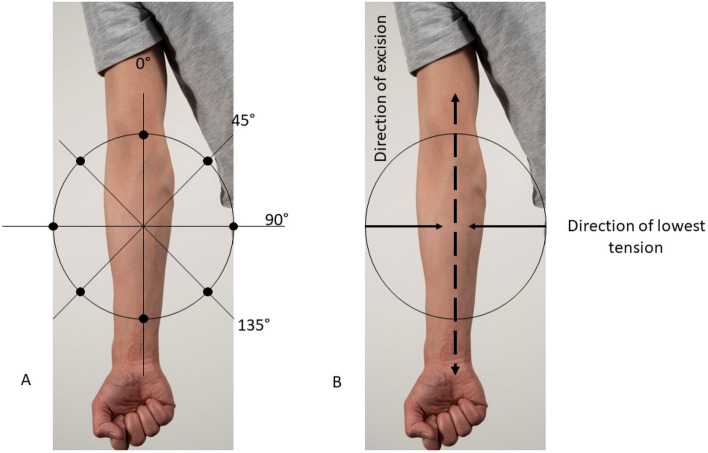
(A) The four angles measured: 0, 45, 90 and 135°. The 0 line represents the known Langer line from the literature. In theory, the 90° line should be the direction of lowest skin tension. (B) Example: if 90° is the lowest measured tension, the preferred excision line would be 90° perpendicular.
Figure 4
Figure 4
Shows the means of the lowest skin reaction force in Newton per direction (0, 45, 90 and 135°) in two body postures (blue = extension forearm and upper arm, arms closed shoulder blade and sitting straight lower back; orange = flexion forearm and upper arm, arms wide shoulder blade and sitting bend lower back).

References

    1. Wolfram D, et al. Hypertrophic scars and keloids—A review of their pathophysiology, risk factors, and therapeutic management. Dermatol. Surg. 2009;35(2):171–181. doi: 10.1111/j.1524-4725.2008.34406.x. - DOI - PubMed
    1. Bijlard E, et al. A systematic review on the prevalence, etiology, and pathophysiology of intrinsic pain in dermal scar tissue. Pain Phys. 2017;20(2):1–13. doi: 10.36076/ppj.2017.2.13. - DOI - PubMed
    1. Hong WX, et al. The role of hypoxia-inducible factor in wound healing. Adv. Wound Care (New Rochelle) 2014;3(5):390–399. doi: 10.1089/wound.2013.0520. - DOI - PMC - PubMed
    1. Butzelaar L, et al. Going into surgery: Risk factors for hypertrophic scarring. Wound Repair Regen. 2015;23(4):531–537. doi: 10.1111/wrr.12302. - DOI - PubMed
    1. Gauglitz GG, et al. Hypertrophic scarring and keloids: Pathomechanisms and current and emerging treatment strategies. Mol. Med. 2011;17(1–2):113–125. doi: 10.2119/molmed.2009.00153. - DOI - PMC - PubMed