Review
. 2023 Aug;23(8):511-521.
doi: 10.1038/s41577-023-00835-3. Epub 2023 Feb 8.

Can we predict T cell specificity with digital biology and machine learning?

Affiliations
Review

Can we predict T cell specificity with digital biology and machine learning?

Dan Hudson et al. Nat Rev Immunol. 2023 Aug.

Abstract

Recent advances in machine learning and experimental biology have offered breakthrough solutions to problems such as protein structure prediction that were long thought to be intractable. However, despite the pivotal role of the T cell receptor (TCR) in orchestrating cellular immunity in health and disease, computational reconstruction of a reliable map from a TCR to its cognate antigens remains a holy grail of systems immunology. Current data sets are limited to a negligible fraction of the universe of possible TCR-ligand pairs, and performance of state-of-the-art predictive models wanes when applied beyond these known binders. In this Perspective article, we make the case for renewed and coordinated interdisciplinary effort to tackle the problem of predicting TCR-antigen specificity. We set out the general requirements of predictive models of antigen binding, highlight critical challenges and discuss how recent advances in digital biology such as single-cell technology and machine learning may provide possible solutions. Finally, we describe how predicting TCR specificity might contribute to our understanding of the broader puzzle of antigen immunogenicity.


Conflict of interest statement

G.O. is a co-founder of T-Cypher Bio. D.H. and R.A.F provide consultancy services to companies active in T cell antigen discovery and vaccine development. The other authors declare no competing interests.

Figures
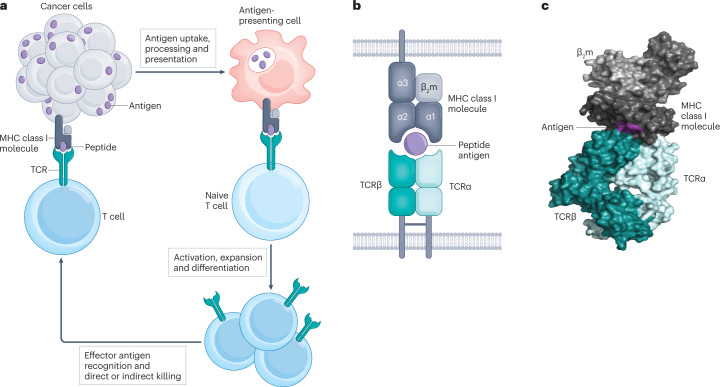
Fig. 1
Fig. 1. Structure and function of the TCR.
a, Cartoon illustrating cancer cell antigen presentation to a naive T cell; T cell activation and expansion and effector  T cell engagement of the cancer cell. b, Antigen recognition by conventional T cells through the interaction of the αβ T cell receptor (TCR) heterodimer with peptide antigen presented by an MHC class I molecule. c, Crystal structure of the affinity-enhanced A3A TCR engaging with melanoma-associated antigen 3 (MAGE-A3)-derived peptide presented by HLA-A*01 (ref. ) (generated with data from ref. and visualized with PyMOL (see Related links)).
Fig. 2
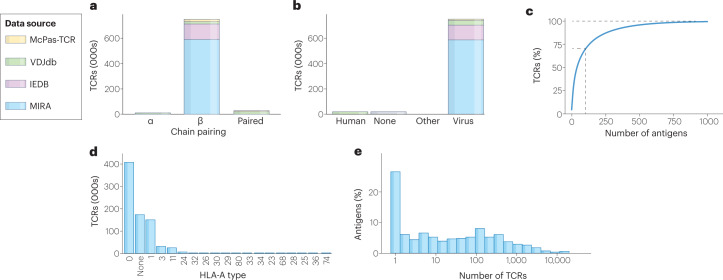
Fig. 2. The current landscape of known TCR–antigen pairs.
a, Number of T cell receptors (TCRs) containing α-chains, β-chains or paired chains, showing variation in numbers according to the data set (manually curated catalogue of pathology-associated TCR sequences (McPas-TCR), VDJ database (VDJdb), Immune Epitope Database (IEDB) and multiplex identification of TCR antigen specificity (MIRA)). b, Number of TCRs per antigen species of origin, showing that the majority of all antigens reported as binding a TCR are of viral origin. c, Cumulative frequency of antigens, showing that a group of 100 antigens makes up 70% of TCR–antigen pairs. d, Number of TCRs by HLA-A type, showing that known antigens are reported in complex with only a few common HLA alleles. e, Frequency histogram showing that most antigens have only one known cognate TCR in the combined data set.
Fig. 3
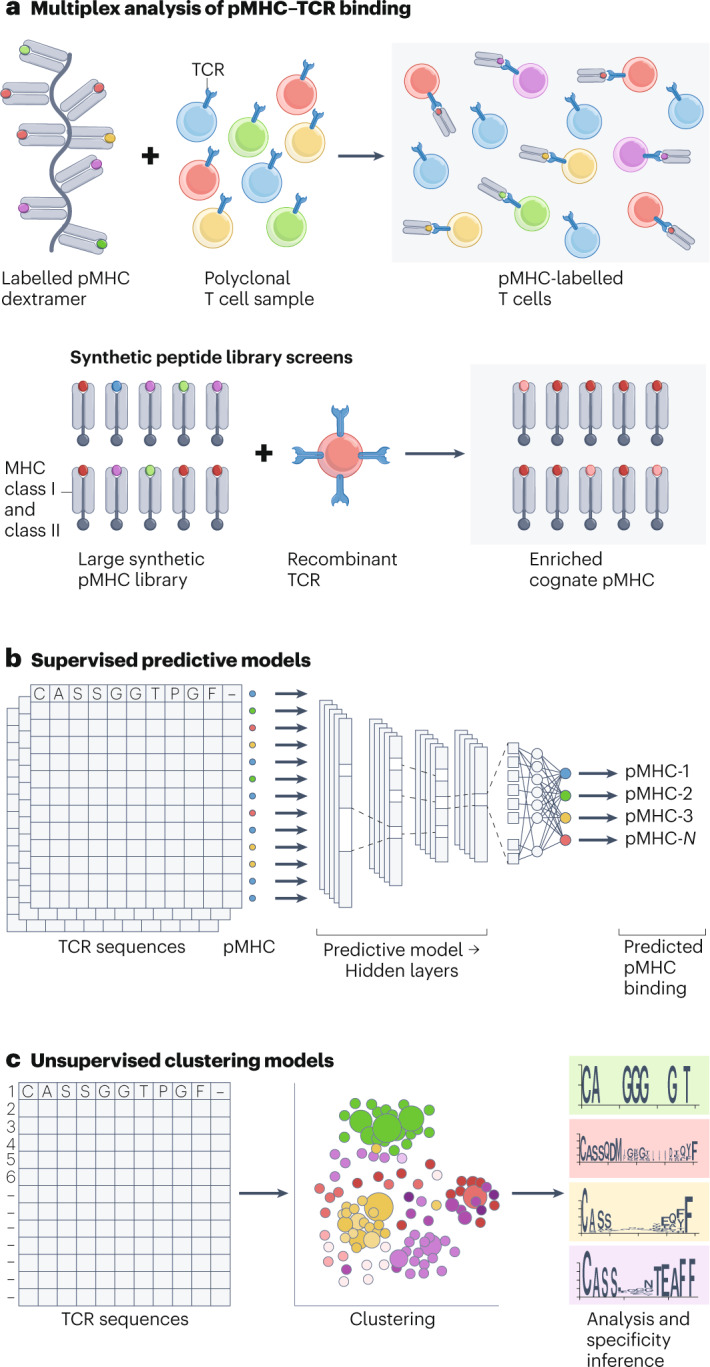
Fig. 3. Screening and computational methods.
a, Multiplex analysis of T cell receptor (TCR)–peptide–MHC (pMHC) antigen specificity and synthetic peptide library screens for interrogation of peptide specificity of a single TCR. b, Representation of a deep neural network for supervised prediction of TCR–antigen specificity. c, Unsupervised clustering analysis of TCR–antigen specificity showing (centre) an example clustering visualization and (right) complementarity-determining loop 3 sequence logos.

References

    1. Nguyen AT, Szeto C, Gras S. The pockets guide to HLA class I molecules. Biochem. Soc. Trans. 2021;49:2319–2331. doi: 10.1042/BST20210410. - DOI - PMC - PubMed
    1. de Jong A, Ogg G. CD1a function in human skin disease. Mol. Immunol. 2021;130:14–19. doi: 10.1016/j.molimm.2020.12.006. - DOI - PMC - PubMed
    1. de Libero G, Chancellor A, Mori L. Antigen specificities and functional properties of MR1-restricted T cells. Mol. Immunol. 2021;130:148–153. doi: 10.1016/j.molimm.2020.12.016. - DOI - PubMed
    1. Sun L, Middleton DR, Wantuch PL, Ozdilek A, Avci FY. Carbohydrates as T-cell antigens with implications in health and disease. Glycobiology. 2016;26:1029–1040. doi: 10.1093/glycob/cww062. - DOI - PMC - PubMed
    1. Bagaev DV, et al. VDJdb in 2019: database extension, new analysis infrastructure and a T-cell receptor motif compendium. Nucleic Acids Res. 2020;48:D1057–D1062. doi: 10.1093/nar/gkz874. - DOI - PMC - PubMed

Publication types