Review
. 2023 Jan 23:14:1130009.
doi: 10.3389/fimmu.2023.1130009. eCollection 2023.

Sepsis-induced changes in differentiation, maintenance, and function of memory CD8 T cell subsets

Affiliations
Review

Sepsis-induced changes in differentiation, maintenance, and function of memory CD8 T cell subsets

Mohammad Heidarian et al. Front Immunol. .

Abstract

Formation of long-lasting memory lymphocytes is one of the foundational characteristics of adaptive immunity and the basis of many vaccination strategies. Following the rapid expansion and contraction of effector CD8 T cells, the surviving antigen (Ag)-specific cells give rise to the memory CD8 T cells that persist for a long time and are phenotypically and functionally distinct from their naïve counterparts. Significant heterogeneity exists within the memory CD8 T cell pool, as different subsets display distinct tissue localization preferences, cytotoxic ability, and proliferative capacity, but all memory CD8 T cells are equipped to mount an enhanced immune response upon Ag re-encounter. Memory CD8 T cells demonstrate numerical stability under homeostatic conditions, but sepsis causes a significant decline in the number of memory CD8 T cells and diminishes their Ag-dependent and -independent functions. Sepsis also rewires the transcriptional profile of memory CD8 T cells, which profoundly impacts memory CD8 T cell differentiation and, ultimately, the protective capacity of memory CD8 T cells upon subsequent stimulation. This review delves into different aspects of memory CD8 T cell subsets as well as the immediate and long-term impact of sepsis on memory CD8 T cell biology.

Keywords: CD8 T cell; Immunoparalysis; composition; differentiation; function; memory; sepsis.


Conflict of interest statement

The authors declare that the research was conducted in the absence of any commercial or financial relationships that could be construed as a potential conflict of interest.

Figures
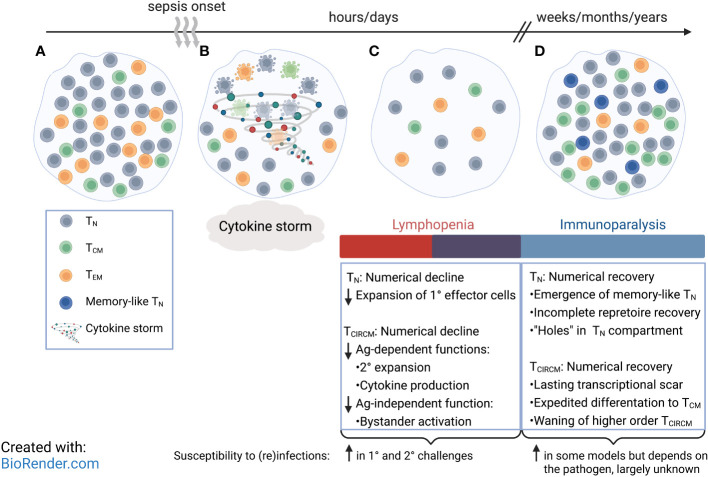
Figure 1
Figure 1
Compositional and phenotypical changes of circulatory CD8 T cell pool after sepsis. (A) Circulatory CD8 T cell pool consists of naïve CD8 T (TN) cells and memory CD8 T (TCIRCM) cell subsets. (B) Increased levels of circulating pro- and anti-inflammatory cytokines mark the initial phase of a septic insult, followed by induction of apoptosis in CD8 TN and TCIRCM in a stochastic manner. (C) Rapid loss of CD8 TN and TCIRCM and other lymphocytes result in transient lymphopenia, accompanied with early signs of immunoparalysis. (D) Number of CD8 TN and TCIRCM return to pre-sepsis values; however, some CD8 TN express memory-like phenotype, and the central memory CD8 T (TCM) cells are enriched over effector memory CD8 T (TEM) cells. Many patients continue to suffer from a long-lasting state of immunoparalysis.
Figure 2
Figure 2
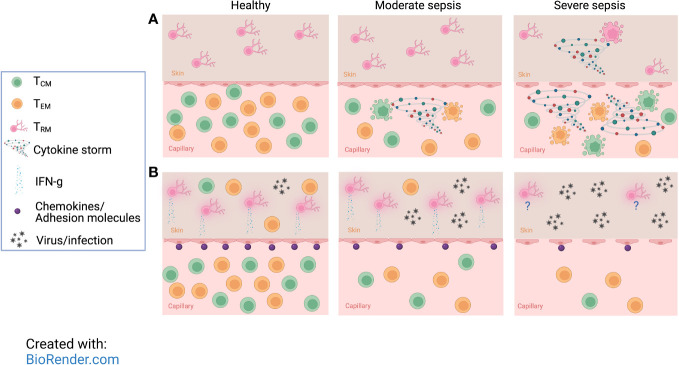
Severe sepsis imposes more drastic numerical and functional diminishment in memory CD8 T cells than moderate sepsis. (A) Despite rapid loss of CD8 TCIRCM, undamaged endothelial barriers protect tissue-resident memory CD8 T (TRM) cells from moderate sepsis-induced apoptosis. However, severe sepsis not only causes a more drastic decline in number of TCIRCM, but it also overcomes the endothelial barrier and TRM become vulnerable to detrimental effects inflicted by the sepsis-induced cytokine storm resulting in rapid apoptosis of TRM cells. (B) Moderate sepsis does not change the number and per cell function of TRM cells, but it reduces the ability of endothelial cells to upregulate chemokines and adhesion molecules in response to TRM-derived cues which leads to reduced recruitment of effector cells and poor protection against localized rechallenges. With increasing severity of sepsis, the protection against localized reinfections is even more compromised due to reduced number of TCIRCM and TRM. This figure was designed using “The Inflammatory response” template available at BioRender.com.

References

    1. Adamo S, Michler J, Zurbuchen Y, Cervia C, Taeschler P, Raeber ME, et al. . Signature of long-lived memory Cd8(+) T cells in acute sars-Cov-2 infection. Nature (2022) 602(7895):148–55. doi: 10.1038/s41586-021-04280-x - DOI - PMC - PubMed
    1. Pamer EG. Immune responses to listeria monocytogenes. Nat Rev Immunol (2004) 4(10):812–23. doi: 10.1038/nri1461 - DOI - PubMed
    1. Schmidt ME, Varga SM. The Cd8 T cell response to respiratory virus infections. Front Immunol (2018) 9:678. doi: 10.3389/fimmu.2018.00678 - DOI - PMC - PubMed
    1. Sahin U, Derhovanessian E, Miller M, Kloke BP, Simon P, Lower M, et al. . Personalized rna mutanome vaccines mobilize poly-specific therapeutic immunity against cancer. Nature (2017) 547(7662):222–6. doi: 10.1038/nature23003 - DOI - PubMed
    1. Martin MD, Kim MT, Shan Q, Sompallae R, Xue HH, Harty JT, et al. . Phenotypic and functional alterations in circulating memory Cd8 T cells with time after primary infection. PloS Pathog (2015) 11(10):e1005219. doi: 10.1371/journal.ppat.1005219 - DOI - PMC - PubMed

Publication types