


Anteriolateral versus anterior-posterior electrodes in external cardioversion of atrial fibrillation: A systematic review and meta-analysis of clinical trials
- PMID: 36756856
- PMCID: PMC10106664
- DOI: 10.1002/clc.23987
Anteriolateral versus anterior-posterior electrodes in external cardioversion of atrial fibrillation: A systematic review and meta-analysis of clinical trials
Abstract
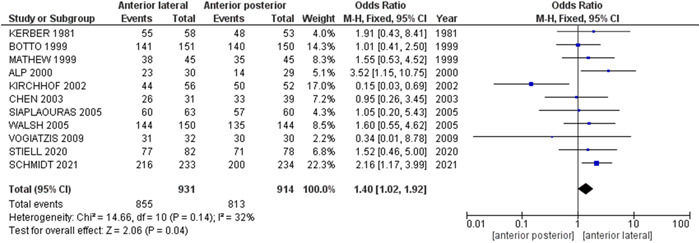
The efficacy of anteriolateral versus anterior-posterior electrode positions in the success of atrial fibrillation's (AF) electrical cardioversion is unclear. Our aim is to perform a meta-analysis to compare the success rate of both electrode positions. PUBMED, WOS, OVID, and SCOPUS were searched. Inclusion criteria were clinical trials that compared anterior-lateral with anterior-posterior electrodes in external cardioversion of AF. After the full-text screening, 11 trials were included in the analysis. The total number of patients included in the study is 1845. The pooled analysis showed a statistically significant association between anterior-lateral electrode and increased cardioversion rate of AF (odds ratio [OR] = 1.40, 95% confidence interval [CI] = 1.02-1.92, p = .04). Subgroup analysis revealed a statistically significant association between the anterior-lateral electrode and increased cardioversion rate of AF in subgroups of less than five shocks, patients with 60 years old or more and patients with left atrial (LA) diameter >45 mm (OR = 1.72, 95% CI = 1.17-2.54, p = .006), (OR = 1.73, 95% CI = 1.18-2.54, p = .005), and (OR = 1.86, 95% CI = 1.04-3.34, p = .04), respectively. Anteriolateral electrode is more effective than anterior-posterior electrode in external cardioversion of AF, particularly in patients who have received less than 5 shocks, are 60 years old or older and have a LA diameter greater than 45 mm.
Keywords: anterior-lateral electrode; anterior-posterior electrode; atrial fibrillation; cardioversion.
© 2023 The Authors. Clinical Cardiology published by Wiley Periodicals LLC.
Conflict of interest statement
The authors declare no conflict of interest.
Figures




Comment in
-
Letter regarding "Anteriolateral versus anterior-posterior electrodes in external cardioversion of atrial fibrillation: A systematic review and meta-analysis of clinical trials".Clin Cardiol. 2024 Mar;47(3):e24249. doi: 10.1002/clc.24249. Clin Cardiol. 2024. PMID: 38436483 Free PMC article. No abstract available.
-
Response to Nguyen et al.'s letter regarding "Anteriolateral versus anterior-posterior electrodes in external cardioversion of atrial fibrillation: A systematic review and meta-analysis of clinical trials".Clin Cardiol. 2024 Mar;47(3):e24253. doi: 10.1002/clc.24253. Clin Cardiol. 2024. PMID: 38483050 Free PMC article. No abstract available.
References
-
- Miyasaka Y, Barnes ME, Gersh BJ, et al. Secular trends in incidence of atrial fibrillation in Olmsted County, Minnesota, 1980 to 2000, and implications on the projections for future prevalence. Circulation. 2006;114(2):119‐125. - PubMed
-
- Wyse DG, Waldo A L, DiMarco JP, et al. A comparison of rate control and rhythm control in patients with atrial fibrillation. N Engl J Med. 2002;347(23):1825‐1833. - PubMed
-
- Kirchhof P, Camm AJ, Goette A, et al. Early rhythm‐control therapy in patients with atrial fibrillation. N Engl J Med. 2020;383(14):1305‐1316. - PubMed
-
- Kirchhof P, Benussi S, Kotecha D, et al. 2016 ESC guidelines for the management of atrial fibrillation developed in collaboration with EACTS. Eur J Cardiothorac Surg. 2016;50(5):e1‐e88. - PubMed
-
- Manning WJ, Silverman DI, Gordon S, Krumholz HM, Douglas PS. Cardioversion from atrial fibrillation without prolonged anticoagulation with use of transesophageal echocardiography to exclude the presence of atrial thrombi. N Engl J Med. 1993;328(11):750‐755. - PubMed
Publication types
MeSH terms
Grants and funding
LinkOut - more resources
Full Text Sources
Medical
