


Altered global signal topography in Alzheimer's disease
- PMID: 36758481
- PMCID: PMC9941064
- DOI: 10.1016/j.ebiom.2023.104455
Altered global signal topography in Alzheimer's disease
Abstract
Background: Alzheimer's disease (AD) is a neurodegenerative disease associated with widespread disruptions in intrinsic local specialization and global integration in the functional system of the brain. These changes in integration may further disrupt the global signal (GS) distribution, which might represent the local relative contribution to global activity in functional magnetic resonance imaging (fMRI).
Methods: fMRI scans from a discovery dataset (n = 809) and a validated dataset (n = 542) were used in the analysis. We investigated the alteration of GS topography using the GS correlation (GSCORR) in patients with mild cognitive impairment (MCI) and AD. The association between GS alterations and functional network properties was also investigated based on network theory. The underlying mechanism of GSCORR alterations was elucidated using imaging-transcriptomics.
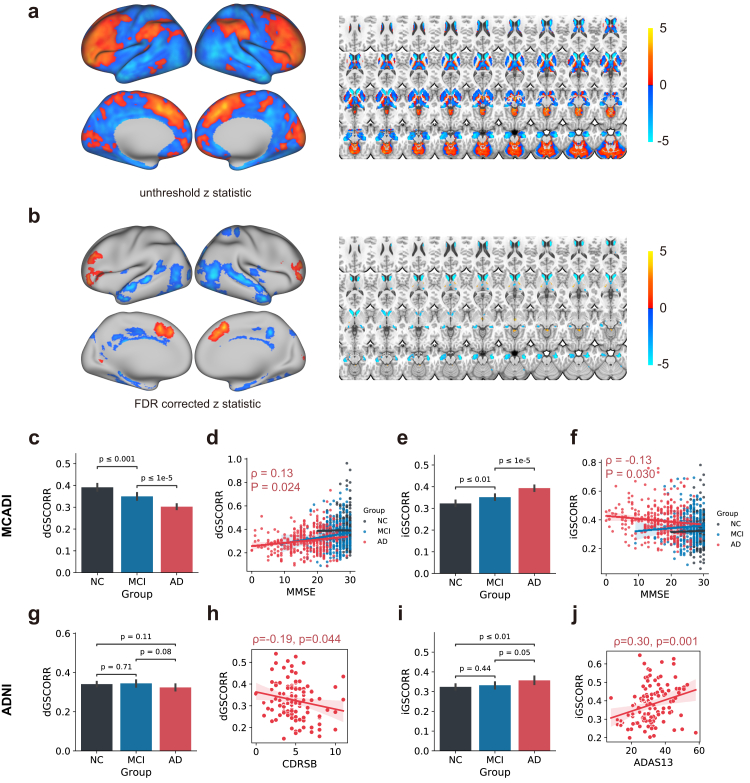
Findings: Significantly increased GS topography in the frontal lobe and decreased GS topography in the hippocampus, cingulate gyrus, caudate, and middle temporal gyrus were observed in patients with AD (Padj < 0.05). Notably, topographical GS changes in these regions correlated with cognitive ability (P < 0.05). The changes in GS topography also correlated with the changes in functional network segregation (ρ = 0.5). Moreover, the genes identified based on GS topographical changes were enriched in pathways associated with AD and neurodegenerative diseases.
Interpretation: Our findings revealed significant changes in GS topography and its molecular basis, confirming the informative role of GS in AD and further contributing to the understanding of the relationship between global and local neuronal activities in patients with AD.
Funding: Beijing Natural Science Funds for Distinguished Young Scholars, China; Fundamental Research Funds for the Central Universities, China; National Natural Science Foundation, China.
Keywords: Alzheimer's disease; Functional network; Global signal; Transcriptomics.
Copyright © 2023 The Author(s). Published by Elsevier B.V. All rights reserved.
Conflict of interest statement
Declaration of interests PW reports grants from the National Natural Science Foundation of China, during the conduct of the study; DW reports grants from the National Natural Science Foundation of China, during the conduct of the study; YH reports grants from the National Natural Science Foundation of China, during the conduct of the study; XZ reports grants from National Natural Science Foundation of China, during the conduct of the study; YL reports grants from Ministry of Education of the People's Republic of China, grants from Beijing Natural Science Funds, grants from National Natural Science Foundation of China, during the conduct of the study. The remaining authors reported no relevant conflicts.
Figures



References
-
- Aquino K.M., Fulcher B.D., Parkes L., Sabaroedin K., Fornito A. Identifying and removing widespread signal deflections from fMRI data: rethinking the global signal regression problem. Neuroimage. 2020;212 - PubMed
MeSH terms
Grants and funding
LinkOut - more resources
Full Text Sources
Medical
