Review
. 2023 Feb 10;22(1):29.
doi: 10.1186/s12943-023-01731-z.

Roles of cancer-associated fibroblasts (CAFs) in anti- PD-1/PD-L1 immunotherapy for solid cancers

Affiliations
Review

Roles of cancer-associated fibroblasts (CAFs) in anti- PD-1/PD-L1 immunotherapy for solid cancers

Liping Pei et al. Mol Cancer. .

Abstract

In recent years, breakthroughs have been made in tumor immunotherapy. However, tumor immunotherapy, particularly anti-PD-1/PD-L1 immune checkpoint inhibitors, is effective in only a small percentage of patients in solid cancer. How to improve the efficiency of cancer immunotherapy is an urgent problem to be solved. As we all know, the state of the tumor microenvironment (TME) is an essential factor affecting the effectiveness of tumor immunotherapy, and the cancer-associated fibroblasts (CAFs) in TME have attracted much attention in recent years. As one of the main components of TME, CAFs interact with cancer cells and immune cells by secreting cytokines and vesicles, participating in ECM remodeling, and finally affecting the immune response process. With the in-depth study of CAFs heterogeneity, new strategies are provided for finding targets of combination immunotherapy and predicting immune efficacy. In this review, we focus on the role of CAFs in the solid cancer immune microenvironment, and then further elaborate on the potential mechanisms and pathways of CAFs influencing anti-PD-1/PD-L1 immunotherapy. In addition, we summarize the potential clinical application value of CAFs-related targets and markers in solid cancers.

Keywords: Cancer-associated fibroblasts; Immunotherapy; PD-1/PD-L1 inhibitors.


Conflict of interest statement

The authors declare no competing interests.

Figures
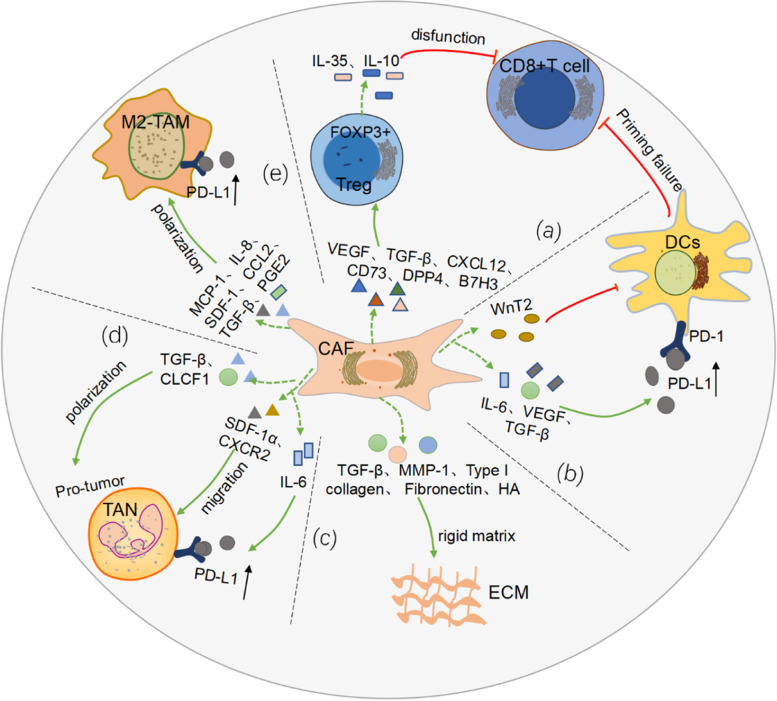
Fig. 1
Fig. 1
The mechanism of CAFs regulating TME to affect PD-1/PD-L1 inhibitor immunotherapy. a CAFs secrete VEGF, TGF-β, CXCL12, etc., which promote Treg recruitment, migration and FOXP3+Treg differentiation. The latter promotes CD8+ T cell dysfunction by secreting IL-35 and IL-10. b CAFs secrete WnT2, etc., thereby inhibiting the anti-tumor response of DC-cell-mediated CD8+ T cells. c CAFs secrete TGF-β, MMP-1, HA, etc. to remodel ECM, increase rigidity, and prevent immune cell infiltration. d TGF-β and CLCF1 differentiate TAN into tumor-promoting types; IL-6 promotes the expression of PD-L1 by TAN, leading to the formation of immune tolerance; SDF-1α and CXCR2 promote TAN migration to tumor tissue. e CAFs produce MCP-1, IL-8, SDF-1, etc. to promote monocyte recruitment, induce TAMs to M2 phenotypic differentiation, and impair effector T cell function, and increase the expression level of PD-L1 on the surface of the TAMs, impairing its phagocytosis
Fig. 2
Fig. 2
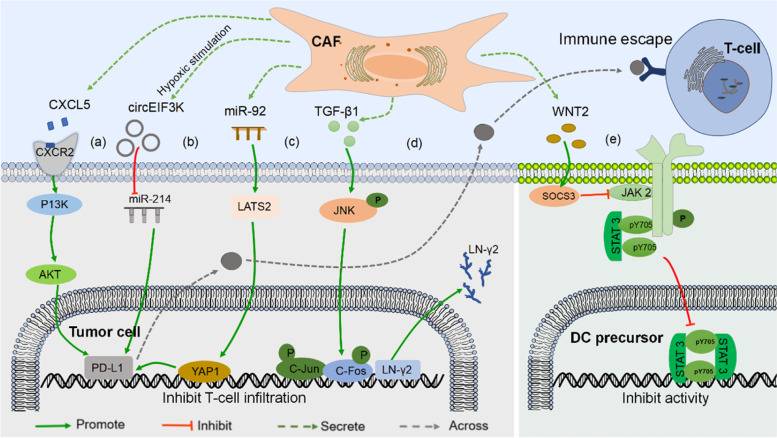
CAFs affect PD-1/PD-L1 inhibitor immunotherapy-related regulatory pathways. a WNT2 upregulates SOCS3 on DC precursors, thereby inhibiting the JAK2/STAT3 pathway and blocking DC differentiation and maturation. b TGF-β1 induces the expression of LN-γ2 in cancer cells through JNK/AP1 signal transduction, thereby hindering T cell invasion of cancer nests. c CAFs secrete CXCL5 to bind to CXCR2 on cancer cells, and then activate the PI3K/AKT pathway to promote PD-L1 expression on the cancer cell surface. d After miR-92 is taken up by cancer cells, it acts on LATS2/YAP1 signaling and increases PD-L1 transcriptional activity. e Hypoxia induces CAFS secretion of circeIF3K, which acts on the miR-214/PD-L1 axis, ultimately leading to immune evasion
Fig. 3
Fig. 3
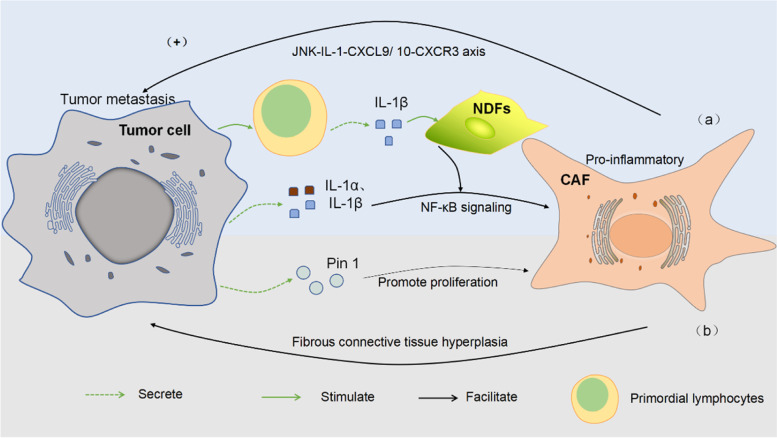
Tumor cells drive CAFs through different mechanisms to affect immune efficacy. a By directly secreting cytokines or indirectly stimulating primitive lymphocytes, tumor cells act on the NF-κB signaling pathway, activate fibroblasts, differentiate them into pro-inflammatory phenotypes, and then CAF acts on the JNK-IL-1-CXCL9/ 10-CXCR3 axis to promote tumor metastasis. b Pin1 promotes CAF proliferation, promotes fibrous connective tissue proliferation and immunosuppressive TME formation, which in turn is conducive to cancer progression
Fig. 4
Fig. 4
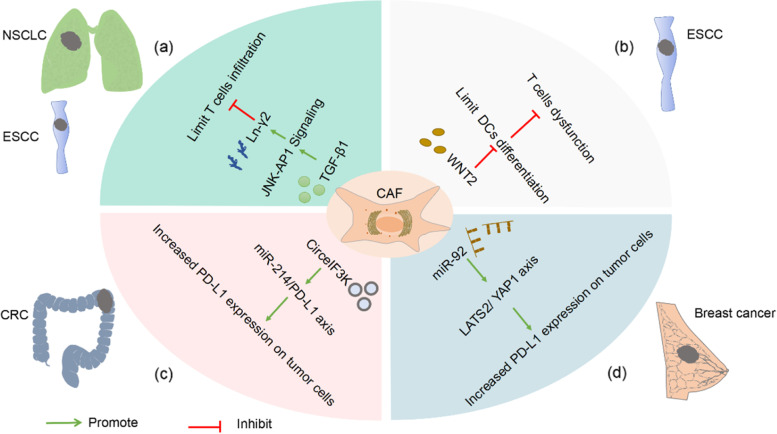
CAFs affect PD-1/PD-L1 inhibitor immunotherapy in different solid cancers. a In non–small cell lung cancer (NSCLC) or esophageal squamous cell carcinoma (ESCC), CAFs prevent T cells from penetrating into the cancer nest by promoting the secretion of Ln-γ2 by cancer cells. b CAFs-derived WNT2 inhibits the differentiation of DC cells and ultimately impairs the killing of T cells in ESCCs. c Hypoxia induces CAFS secretion of CirceIF3K, induces PD-L1 expression in colorectal cancer (CRC) cells through the miR-214/PD-L1 axis, leading to immune escape. d Exosome miR-92 acts on the LATS2-YAP1 axis to increase the transcription level of PD-L1 in breast cancer cells. Ultimately, T cell apoptosis and proliferation disorders are induced

References

    1. Zhang Y, Zhang Z. The history and advances in cancer immunotherapy: understanding the characteristics of tumor-infiltrating immune cells and their therapeutic implications. Cell Mol Immunol. 2020;17:807–21. - PMC - PubMed
    1. O’Donnell JS, Teng MWL, Smyth MJ. Cancer immunoediting and resistance to T cell-based immunotherapy. Nat Rev Clin Oncol. 2019;16:151–167. - PubMed
    1. Kim TK, Vandsemb EN, Herbst RS, Chen L. Adaptive immune resistance at the tumour site: mechanisms and therapeutic opportunities. Nat Rev Drug Discov. 2022;21:529–40. - PubMed
    1. Sharma P, Retz M, Siefker-Radtke A, Baron A, Necchi A, Bedke J, et al. Nivolumab in metastatic urothelial carcinoma after platinum therapy (CheckMate 275): a multicentre, single-arm, phase 2 trial. Lancet Oncol. 2017;18:312–322. - PubMed
    1. Xia H, Wang W, Crespo J, Kryczek I, Li W, Wei S, et al. Suppression of FIP200 and autophagy by tumor-derived lactate promotes naïve T cell apoptosis and affects tumor immunity. Sci Immunol. 2017;2:4631. - PMC - PubMed

Publication types