


Combined use of CA125, neutrophil/lymphocyte ratio and platelet/lymphocyte ratio for the diagnosis of borderline and malignant epithelial ovarian tumors
- PMID: 36759870
- PMCID: PMC9912622
- DOI: 10.1186/s13048-023-01106-4
Combined use of CA125, neutrophil/lymphocyte ratio and platelet/lymphocyte ratio for the diagnosis of borderline and malignant epithelial ovarian tumors
Abstract
Background: The mortality rate of ovarian cancer ranks first among three common gynecological malignant tumors due to insidious onset and lack of effective early diagnosis methods. Borderline epithelial ovarian tumor (BEOT) is a type of low malignant potential tumor that is typically associated with better outcomes than ovarian cancer. However, BEOTs are easily confused with benign and malignant epithelial ovarian tumors (EOTs) due to similar clinical symptoms and lack of specific tumor biomarkers and imaging examinations. Notably, a small subset of BEOTs will transform into low-grade serous ovarian carcinoma with a poor prognosis. Therefore, searching for potential biomarkers that can be easily obtained and accurately identify malignant epithelial ovarian tumors (MEOTs) as well as BEOTs is essential for the clinician. Cancer antigen 125 (CA125) is a commonly used biomarker for the diagnosis of EOTs in the preoperative scenario but has low sensitivity and specificity. Nowadays, inflammatory biomarkers including inflammatory cell counts and derived ratios such as neutrophil/lymphocyte ratio (NLR) and platelet/lymphocyte ratio (PLR) have been proved to be associated with tumor progression and poor prognosis, and were considered to be the most economically potential surrogate biomarkers for various malignancies. The purpose of this study was to find appropriate combinations of inflammatory and tumor biomarkers to improve the diagnostic efficiency of EOTs, especially the BEOTs.
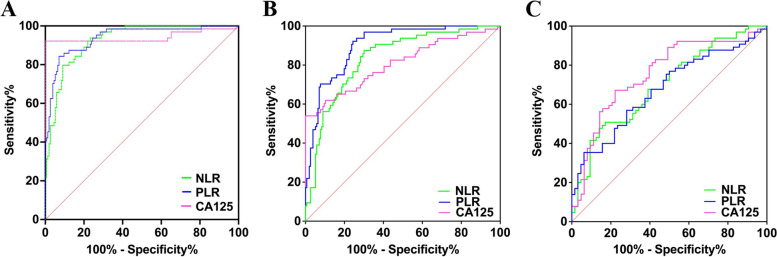
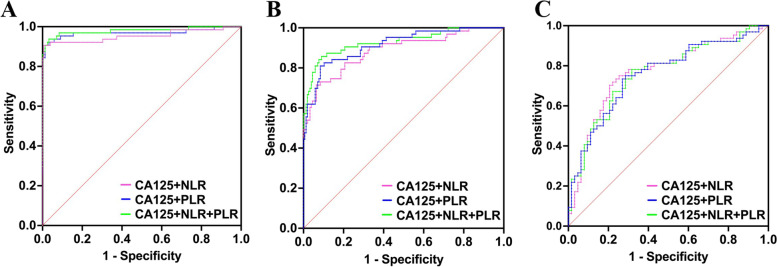
Results: CA125, NLR and PLR increased steadily among benign, borderline and malignant EOTs and tended to be higher in advanced (stage III-IV) and lymph node metastasis MEOT groups than in early stage (stage I-II) and non-lymph node metastasis MEOT groups. CA125, NLR and PLR could be used separately in the differentiation of EOTs but could not take into account both sensitivity and specificity. The combined use of CA125, NLR and PLR was evaluated to be more efficient, especially in the identification of BEOTs, with both high sensitivity and high specificity.
Conclusions: The levels of CA125, NLR and PLR were closely related to the nature of EOTs and malignant progression of MEOTs. The combination of CA125, NLR and PLR was more accurate in identifying the nature of EOTs than either alone or double combination, especially for BEOTs.
Keywords: Cancer antigen 125; Epithelial ovarian tumor; Neutrophil/lymphocyte ratio; Platelet/lymphocyte ratio.
© 2023. The Author(s).
Conflict of interest statement
The authors declare that they have no competing interests.
Figures
References
-
- Ahmadi H, Djaladat H, Cai J, Miranda G, Daneshmand S. Precystectomy serum levels of carbohydrate antigen 19-9, carbohydrate antigen 125, and carcinoembryonic antigen: prognostic value in invasive urothelial carcinoma of the bladder. Urol Oncol. 2014;32:648–656. doi: 10.1016/j.urolonc.2014.01.019. - DOI - PubMed
-
- Partridge EE, Greenlee RT, Riley TL, Commins J, Ragard L, Xu JL, Buys SS, Prorok PC, Fouad MN. Assessing the risk of ovarian malignancy in asymptomatic women with abnormal CA 125 and transvaginal ultrasound scans in the prostate, lung, colorectal, and ovarian screening trial. Obstet Gynecol. 2013;121:25–31. doi: 10.1097/AOG.0b013e3182755e14. - DOI - PMC - PubMed
MeSH terms
Substances
Grants and funding
LinkOut - more resources
Full Text Sources
Medical
Research Materials
Miscellaneous
