Anti-Oomycete Activity and Pepper Root Colonization of Pseudomonas plecoglossicida YJR13 and Pseudomonas putida YJR92 against Phytophthora capsici
- PMID: 36760054
- PMCID: PMC9929162
- DOI: 10.5423/PPJ.OA.01.2023.0001
Anti-Oomycete Activity and Pepper Root Colonization of Pseudomonas plecoglossicida YJR13 and Pseudomonas putida YJR92 against Phytophthora capsici
Abstract
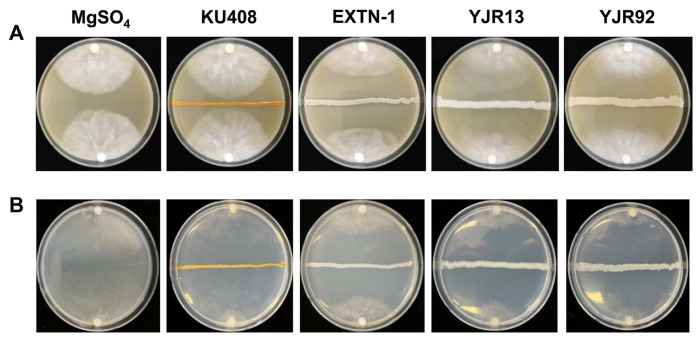
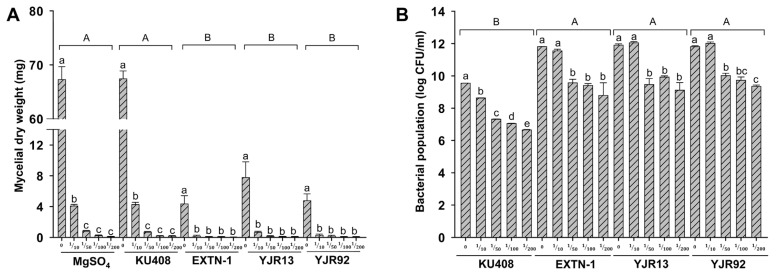
Previously, Pseudomonas plecoglossicida YJR13 and Pseudomonas putida YJR92 from a sequential screening procedure were proven to effectively control Phytophthora blight caused by Phytophthora capsici. In this study, we further investigated the anti-oomycete activities of these strains against mycelial growth, zoospore germination, and germ tube elongation of P. capsici. We also investigated root colonization ability of the bacterial strains in square dishes, including cell motility (swimming and swarming motilities) and biofilm formation. Both strains significantly inhibited mycelial growth in liquid and solid V8 juice media and M9 minimal media, zoospore germination, and germ tube elongation compared with Bacillus vallismortis EXTN-1 (positive biocontrol strain), Sphingomonas aquatilis KU408 (negative biocontrol strain), and MgSO4 solution (untreated control). In diluted (nutrient-deficient) V8 juice broth, the tested strain populations were maintained at >108 cells/ml, simultaneously providing mycelial inhibitory activity. Additionally, these strains colonized pepper roots at a 106 cells/ml concentration for 7 days. The root colonization of the strains was supported by strong swimming and swarming activities, biofilm formation, and chemotactic activity towards exudate components (amino acids, organic acids, and sugars) of pepper roots. Collectively, these results suggest that strains YJR13 and YJR92 can effectively suppress Phytophthora blight of pepper through direct anti-oomycete activities against mycelial growth, zoospore germination and germ tube elongation. Bacterial colonization of pepper roots may be mediated by cell motility and biofilm formation together with chemotaxis to root exudates.
Keywords: Phytophthora capsici; Pseudomonas plecoglossicida; Pseudomonas putida; bacterial colonization; pepper.
Conflict of interest statement
No potential conflict of interest relevant to this article was reported.
Figures



References
-
- Alaux P-L, César V, Naveau F, Cranenbrouck S, Declerck S. Impact of Rhizophagus irregularis MUCL 41833 on disease symptoms caused by Phytophthora infestans in potato grown under field conditions. Crop Prot. 2018;107:26–33.
-
- Aravind R, Kumar A, Eapen SJ, Ramana KV. Endophytic bacterial flora in root and stem tissues of black pepper (Piper nigrum L.) genotype: isolation, identification and evaluation against Phytophthora capsici . Lett. Appl. Microbiol. 2009;48:58–64. - PubMed
-
- Arora NK, Kim MJ, Kang SC, Maheshwari DK. Role of chitinase and β-1,3-glucanase activities produced by a fluorescent pseudomonad and in vitro inhibition of Phytophthora capsici and Rhizoctonia solani . Can. J. Microbiol. 2007;53:207–212. - PubMed
-
- Barahona E, Navazo A, Martínez-Granero F, Zea-Bonilla T, Pérez-Jiménez RM, Martín M, Rivilla R. Pseudomonas fluorescens F113 mutant with enhanced competitive colonization ability and improved biocontrol activity against fungal root pathogens. Appl. Environ. Microbiol. 2011;77:5412–5419. - PMC - PubMed
-
- Barnhoorn I, van Dyk C. The first report of selected herbicides and fungicides in water and fish from a highly utilized and polluted freshwater urban impoundment. Environ. Sci. Pollut. Res. 2020;27:33393–33398. - PubMed
Grants and funding
LinkOut - more resources
Full Text Sources