Review
. 2023 Jan 24:10:1094188.
doi: 10.3389/fcvm.2023.1094188. eCollection 2023.

Glycation of LDL: AGEs, impact on lipoprotein function, and involvement in atherosclerosis

Affiliations
Review

Glycation of LDL: AGEs, impact on lipoprotein function, and involvement in atherosclerosis

Anastasia V Poznyak et al. Front Cardiovasc Med. .

Abstract

Atherosclerosis is a complex disease, and there are many factors that influence its development and the course of the disease. A deep understanding of the pathological mechanisms underlying atherogenesis is needed to develop optimal therapeutic strategies and treatments. In this review, we have focused on low density lipoproteins. According to multiple studies, their atherogenic properties are associated with multiple modifications of lipid particles. One of these modifications is Glycation. We considered aspects related to the formation of modified particles, as well as the influence of modification on their functioning. We paid special attention to atherogenicity and the role of glycated low-density lipoprotein (LDL) in atherosclerosis.

Keywords: AGE; LDL; LDL modification; atherosclerosis; glycation; lipids.


Conflict of interest statement

The authors declare that the research was conducted in the absence of any commercial or financial relationships that could be construed as a potential conflict of interest.

Figures
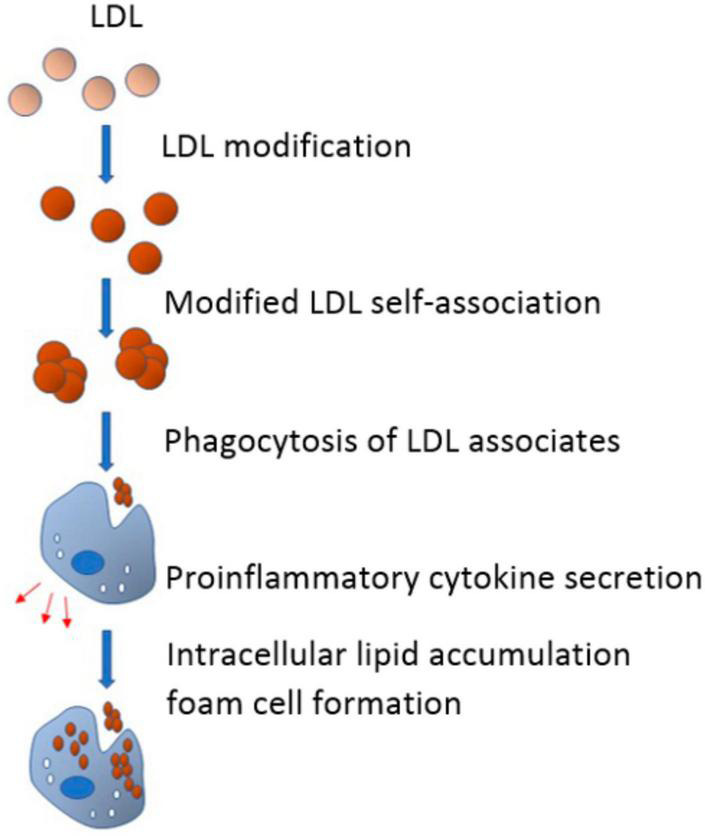
FIGURE 1
FIGURE 1
In the blood flow, low-density lipoprotein (LDL) undergoes multiple modifications and acquires atherogenic properties. Modified LDL particles have a tendency to form self-associates that, in turn, promote phagocytosis of subendothelial arterial cells. Being triggered by phagocytosis, proinflammatory response emerges and pro-inflammatory cytokines are secreted. Pro-inflammatory cytokines promote or even cause the accumulation of intracellular lipids, which leads to the formation of foam cells (From 52).

References

    1. Snelson M, Coughlan M. Dietary advanced glycation end products: digestion, metabolism and modulation of gut microbial ecology. Nutrients. (2019) 11:215. 10.3390/nu11020215 - DOI - PMC - PubMed
    1. ALjahdali N, Carbonero F. Impact of Maillard reaction products on nutrition and health: current knowledge and need to understand their fate in the human digestive system. Crit Rev Food Sci Nutr. (2019) 59:474–87. 10.1080/10408398.2017.1378865 - DOI - PubMed
    1. Förster A, Kühne Y, Henle T. Studies on absorption and elimination of dietary Maillard reaction products. Ann NY Acad Sci. (2005) 1043:474–81. 10.1196/annals.1333.054 - DOI - PubMed
    1. Palimeri S, Palioura E, Diamanti-Kandarakis E. Current perspectives on the health risks associated with the consumption of advanced glycation end products: recommendations for dietary management. Diabetes Metab Syndr Obes. (2015) 8:415–26. 10.2147/DMSO.S63089 - DOI - PMC - PubMed
    1. Poulsen M, Andersen J, Hedegaard R, Madsen A, Krath B, Monošík R, et al. Short-term effects of dietary advanced glycation end products in rats. Br J Nutr. (2016) 115:629–36. 10.1017/S0007114515004833 - DOI - PubMed

LinkOut - more resources
