


Potential dual synergy between electrochemotherapy and sequence of immunotherapies in metastatic melanoma: A case report
- PMID: 36761389
- PMCID: PMC9905651
- DOI: 10.3892/mco.2023.2604
Potential dual synergy between electrochemotherapy and sequence of immunotherapies in metastatic melanoma: A case report
Abstract
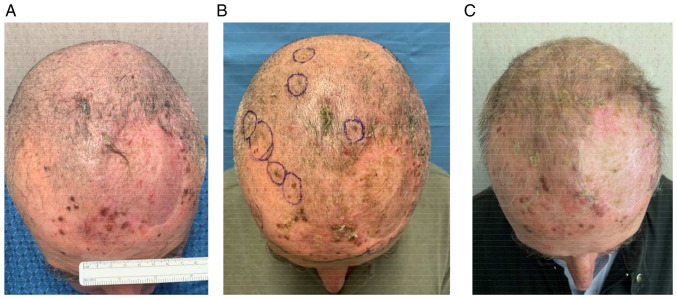
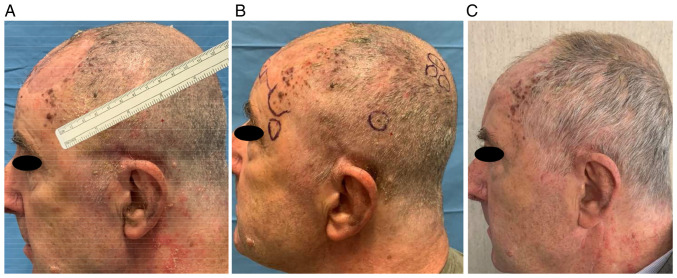
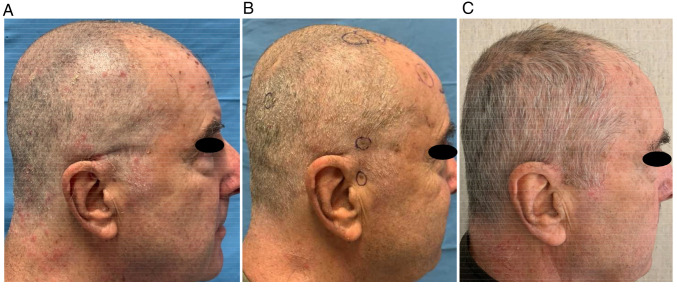
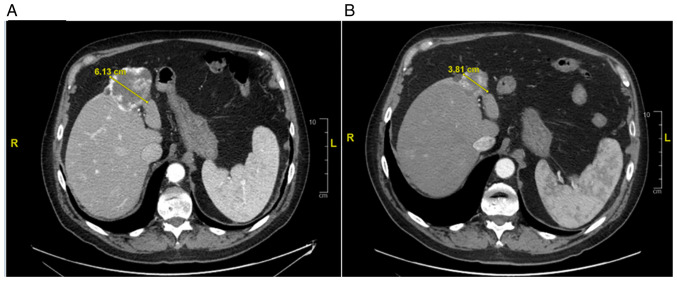
Immune checkpoint inhibitors have changed the natural history of advanced melanoma. Despite this, a notable proportion of patients immediately relapse or develop resistance during immunotherapy, especially with the appearance of superficial metastases and consequently with a dramatic impact on clinical outcomes. Local treatment by electrochemotherapy (ECT), parallel to regional control with palliative aim, seems to release neoantigens potentially determining a significant systemic anticancer immune reactivation. The present study reported a case of a patient with metastatic melanoma receiving Pembrolizumab, electrochemotherapy and then Ipilimumab for in-transit and finally locoregional lymph nodes and distant bone metastases with experience of clinic-radiological remission. Specifically, the present patient progressed during adjuvant treatment with in-transit metastases on the scalp; he underwent two cycle of ECT obtaining partial and then unexpected and very fast nearly complete response with the Ipilimumab treatment. Concomitantly, he developed grade 4 endocrine adverse events (hypophysitis and diabetes mellitus type I) as immune-related toxicities. At 12 months from ECT the patient is in ECOG Performance Status 0 and he has resumed a regular social life. In our experience, ECT in two administrations increased and accelerated the response of Ipilimumab. The present confirmed its promising contribution in inducing a powerful immune response in order to overcome primary or acquired resistance to immune checkpoint inhibitors such as anti-programmed death antigen-1 drugs.
Keywords: electrochemotherapy; immunotherapy; in-transit melanoma metastasis; very fast response.
Copyright © 2020, Spandidos Publications.
Conflict of interest statement
FM was a consultant/advisory board member for BMS and MSD. The rest of the authors declare that they have no competing interests.
Figures
References
-
- Eggermont AMM, Blank CU, Mandalà M, Long GV, Atkinson VG, Dalle S, Haydon AM, Meshcheryakov A, Khattak A, Carlino MS, et al. Adjuvant pembrolizumab versus placebo in resected stage III melanoma (EORTC 1325-MG/KEYNOTE-054): Distant metastasis-free survival results from a double-blind, randomised, controlled, phase 3 trial. Lancet Oncol. 2021;22:643–654. doi: 10.1016/S1470-2045(21)00065-6. - DOI - PubMed
-
- Robert C, Ribas A, Schachter J, Arance A, Grob JJ, Mortier L, Daud A, Carlino MS, McNeil CM, Lotem M, et al. Pembrolizumab versus ipilimumab in advanced melanoma (KEYNOTE-006): Post-hoc 5-year results from an open-label, multicentre, randomised, controlled, phase 3 study. Lancet Oncol. 2019;20:1239–1251. doi: 10.1016/S1470-2045(19)30388-2. - DOI - PubMed
Publication types
LinkOut - more resources
Full Text Sources