


Associations of COVID-19 Lockdowns on Eating Behaviors and Body Mass Index in Patients with a History of Bariatric Surgery: a Cross-Sectional Analysis
- PMID: 36763309
- PMCID: PMC9912237
- DOI: 10.1007/s11695-023-06460-2
Associations of COVID-19 Lockdowns on Eating Behaviors and Body Mass Index in Patients with a History of Bariatric Surgery: a Cross-Sectional Analysis
Abstract
Introduction: Few studies have explored the impact of the COVID-19 pandemic on the eating behaviors, dietary quality, and changes in weight of postoperative bariatric surgery patients.
Methods: A cross-sectional survey on eating behaviors and attitudes toward food was emailed or given to patients who had bariatric surgery before March 2020. Patient charts were reviewed for weight measures.
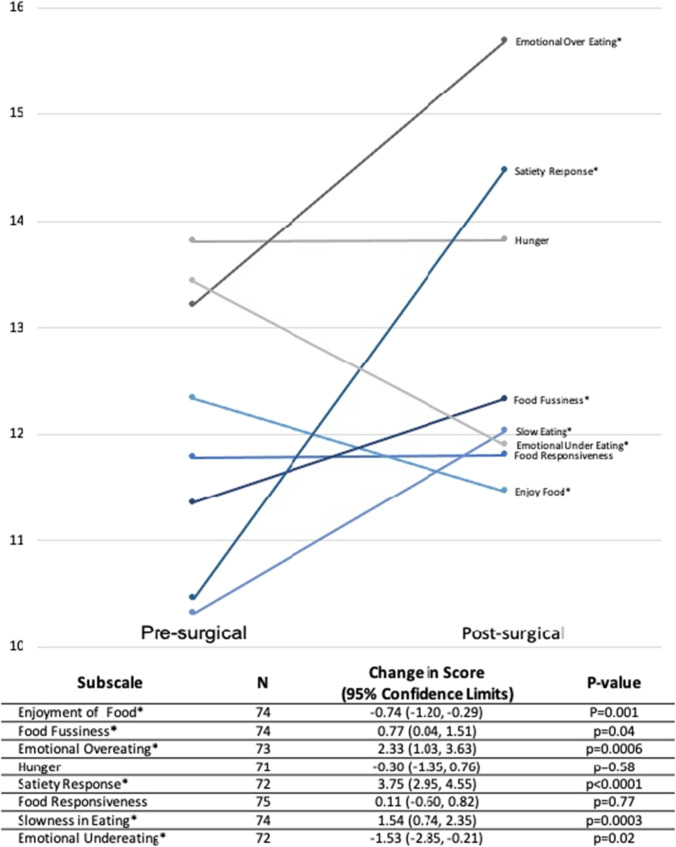
Results: Seventy-five (71.43%) patients experienced weight recurrence with an average increase in body mass index (BMI) of 2.83 kg/m2 (SD: 2.19). The majority of patients reported no symptoms of binge eating (n = 81, 77.14%) with 16 (15.24%) qualifying for loss of control eating (LOCE). LOCE was significantly associated with grazing behavior (p = 0.04), emotional over-eating (p = 0.001), and food responsiveness (p = 0.002). LOCE was negatively associated with dietary quality (p = 0.0009) and satiety responsiveness (p = 0.01). Grazing behavior was significantly associated with emotional over-eating (p < 0.0001) and food responsiveness (p < 0.0001) as well as negatively associated with dietary quality (p < 0.0001). Slow eating was negatively associated with grazing (p = 0.01), emotional over-eating (p = 0.003), and food responsiveness (p < 0.0001). When included in a regression model controlling for age and sex, emotional over-eating was a significant predictor of weight recurrence (β = 0.25; p = 0.04).
Conclusion: Our results suggest that maladaptive eating behaviors contributed to LOCE and poor dietary quality during the COVID-19 pandemic; however, slow eating may be protective against grazing, emotional over-eating, and food responsiveness.
Keywords: AEBQ; Adult eating behavior questionnaire; Bariatric surgery; Dietary quality; Eating behaviors; Loss of control eating; Surgical weight loss; Weight recurrence.
© 2023. The Author(s), under exclusive licence to Springer Science+Business Media, LLC, part of Springer Nature.
Conflict of interest statement
AHu has no conflict of interest. AHarvey has no conflict of interest. AMR has received honoraria from Intuitive Surgical, Medtronic, Ethicon Endosurgery, and WL Gore. All other authors have no financial disclosures. AR has no conflict of interest. MB has no conflict of interest.
Figures
References
-
- Athanasiadis DI, Hernandez E, Hilgendorf W, et al. How are bariatric patients coping during the coronavirus disease 2019 (COVID-19) pandemic? Analysis of factors known to cause weight regain among postoperative bariatric patients. Surg Obes Relat Dis. 2021;17(4):756–764. doi: 10.1016/j.soard.2020.11.021. - DOI - PMC - PubMed
Publication types
MeSH terms
LinkOut - more resources
Full Text Sources
Medical
