Role of NKG2D ligands and receptor in haploidentical related donor hematopoietic cell transplantation
- PMID: 36763517
- PMCID: PMC10300293
- DOI: 10.1182/bloodadvances.2022008922
Role of NKG2D ligands and receptor in haploidentical related donor hematopoietic cell transplantation
Abstract
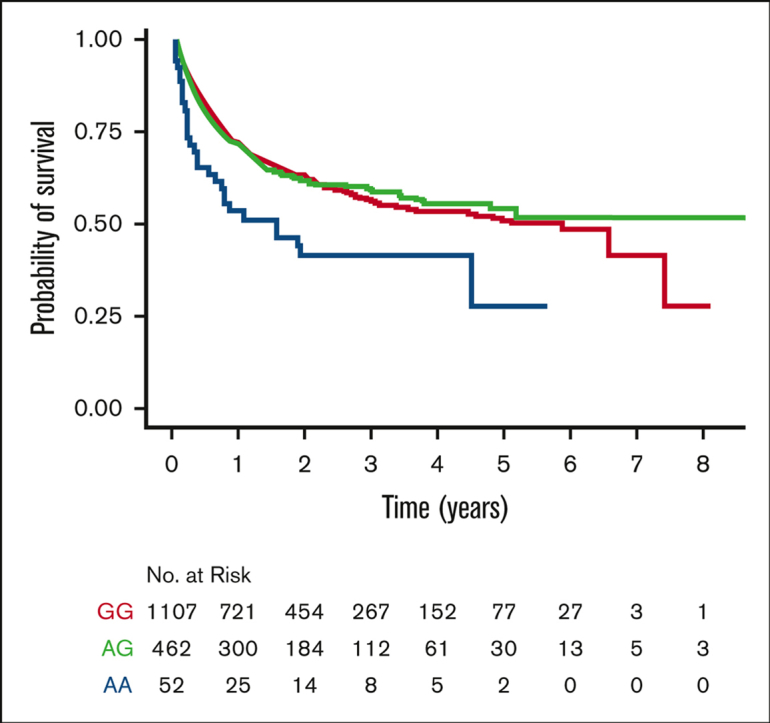
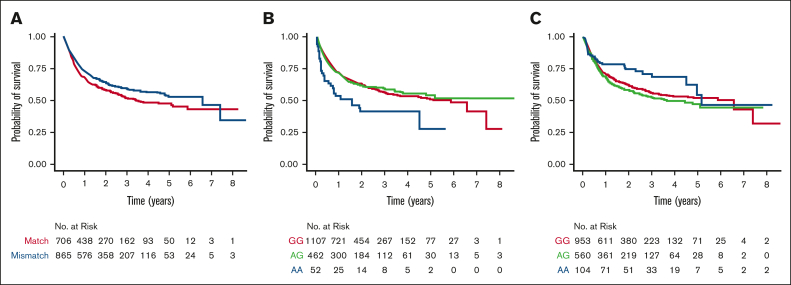
The recurrence of malignancy after hematopoietic cell transplantation (HCT) is the primary cause of transplantation failure. The NKG2D axis is a powerful pathway for antitumor responses, but its role in the control of malignancy after HCT is not well-defined. We tested the hypothesis that gene variation of the NKG2D receptor and its ligands MICA and MICB affect relapse and survival in 1629 patients who received a haploidentical HCT for the treatment of a malignant blood disorder. Patients and donors were characterized for MICA residue 129, the exon 5 short tandem repeat (STR), and MICB residues 52, 57, 98, and 189. Donors were additionally defined for the presence of NKG2D residue 72. Mortality was higher in patients with MICB-52Asn relative to those with 52Asp (hazard ratio [HR], 1.83; 95% confidence interval [CI], 1.24-2.71; P = .002) and lower in those with MICA-STR mismatch than in those with STR match (HR, 0.66; 95% CI, 0.54-0.79; P = .00002). Relapse was lower with NKG2D-72Thr donors than with 72Ala donors (relapse HR, 0.57; 95% CI, 0.35-0.91; P = .02). The protective effects of patient MICB-52Asp with donor MICA-STR mismatch and NKG2D-72Thr were enhanced when all 3 features were present. The NKG2D ligand/receptor pathway is a transplantation determinant. The immunobiology of relapse is defined by the concerted effects of MICA, MICB, and NKG2D germ line variation. Consideration of NKG2D ligand/receptor pairings may improve survival for future patients.
© 2023 by The American Society of Hematology. Licensed under Creative Commons Attribution-NonCommercial-NoDerivatives 4.0 International (CC BY-NC-ND 4.0), permitting only noncommercial, nonderivative use with attribution. All other rights reserved.
Conflict of interest statement
Conflict-of-interest disclosure: E.W.P., M.M., K.C.H., T.G., C.M., S.R.S., and P.S. report grants from National Institutes of Health, during the conduct of the study. R.K.S. reports patent US20180371051. M.H. declares no competing financial interests.
Figures
References
-
- Ruggeri L, Capanni M, Urbani E, et al. Effectiveness of donor natural killer cell alloreactivity in mismatched hematopoietic transplants. Science. 2002;295(5562):2097–2100. - PubMed
-
- Locatelli F, Pende D, Falco M, Della Chiesa M, Moretta A, Moretta L. NK cells mediate a crucial graft-versus-leukemia effect in haploidentical-HSCT to cure high-risk acute leukemia. Trends Immunol. 2018;39(7):577–590. - PubMed
-
- Hsu KC, Gooley T, Malkki M, et al. KIR ligands and prediction of relapse after unrelated donor hematooietic cell transplantation for hematologic malignancy. Biol Blood Marrow Transplant. 2006;12(8):828–836. - PubMed
-
- Moretta A, Bottino C, Vitale M, et al. Receptors for HLA class-I molecules in human natural killer cells. Annu Rev Immunol. 1996;14(1):619–648. - PubMed