


Efficacy of the Glucagon-Like Peptide-1 Receptor Agonists Liraglutide and Semaglutide for the Treatment of Weight Regain After Bariatric surgery: a Retrospective Observational Study
- PMID: 36765019
- PMCID: PMC9918402
- DOI: 10.1007/s11695-023-06484-8
Efficacy of the Glucagon-Like Peptide-1 Receptor Agonists Liraglutide and Semaglutide for the Treatment of Weight Regain After Bariatric surgery: a Retrospective Observational Study
Abstract
Purpose: Weight regain after bariatric surgery occurs in up to a third of patients and reduces treatment-associated health benefits. The efficacy of glucagon-like peptide-1 receptor agonists (GLP1-RA) for treatment of type 2 diabetes mellitus and obesity is well established, but their role in the treatment of weight regain after bariatric surgery remains to be defined.
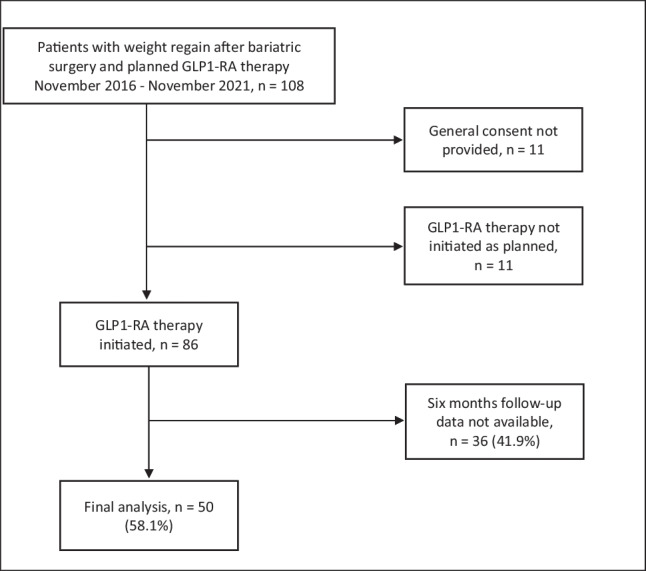
Materials and methods: This was a single centre retrospective observational study conducted at a Swiss bariatric reference centre. Patients with 6 months of treatment with GLP1-RA, up until November 2021, due to weight regain after bariatric surgery were identified. Data on body weight and relevant clinical parameters were collected before and after 6 months of treatment with GLP1-RA. Data are presented as median (interquartile range).
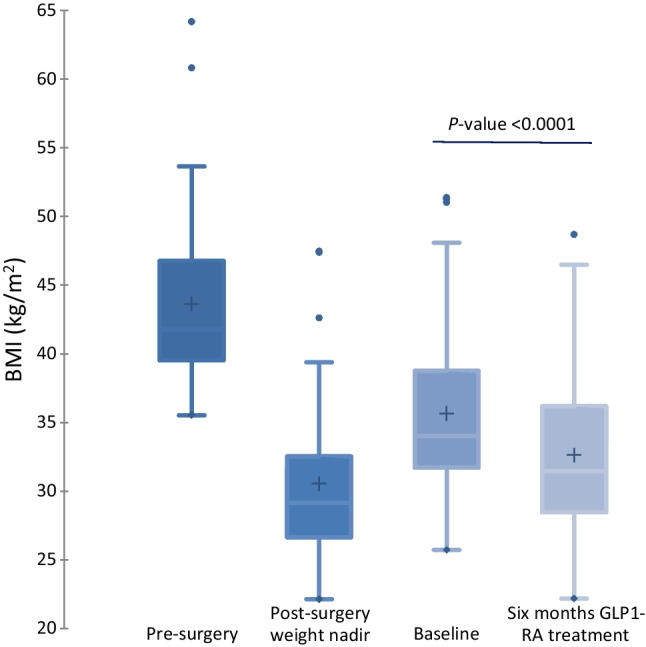
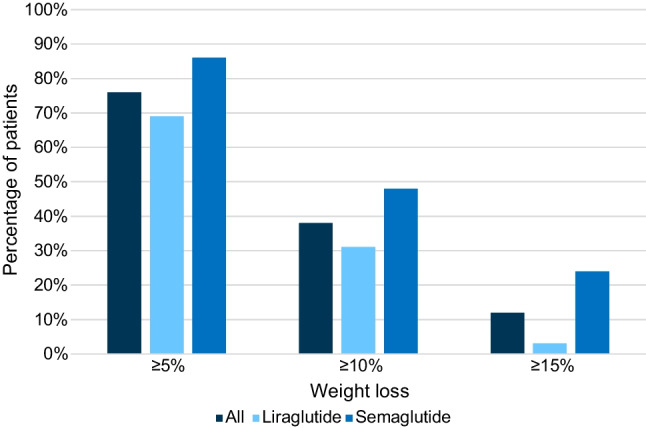
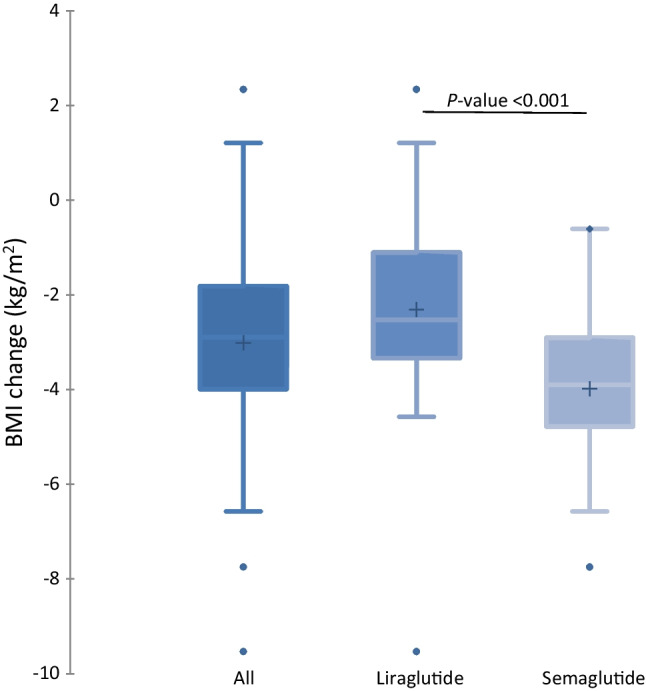
Results: Fifty patients (82% female) were included. Before GLP1-RA treatment (liraglutide, n=29; semaglutide, n=21), weight and BMI were 90.5 kg (83.4, 107.9) and 34.0 kg/m2 (31.7, 38.7), respectively, with a post-bariatric weight regain of 15.1% (10.6, 22.8) of total body weight and 4.6 kg/m2 (3.3, 6.2). After 6 months of GLP1-RA treatment, a reduction in weight and BMI of 8.8% (5.2, 11.4) of total body weight and 2.9 kg/m2 (1.8, 4.0) was observed (P value <0.0001), corresponding to 67.4% (40.4, 92.2) of the weight regain. No serious adverse events were reported.
Conclusion: For patients experiencing weight regain after bariatric surgery, two-thirds of the weight regain can be safely lost with GLP1-RA, providing clinicians with a therapeutic option for this clinical challenge, and highlights the need for a large-scale randomized clinical trial.
Keywords: Bariatric surgery; GLP-1 receptor agonist; Liraglutide; Obesity; Semaglutide; Weight regain.
© 2023. The Author(s), under exclusive licence to Springer Science+Business Media, LLC, part of Springer Nature.
Conflict of interest statement
Anders Boisen Jensen is a previous employee of Novo Nordisk (2008–2010) and has received speaker honoraria and financial support for attending congresses from Novo Nordisk.
Frida Renström has no conflict of interest to declare.
Stefan Aczél has received speaker honoraria and financial support for attending congresses from Novo Nordisk.
Patrick Folie and Magdalena Biraima-Steinemann have received speaker honoraria from Novo Nordisk.
Felix Beuschlein has received financial support for attending symposia and for educational programmes by Novo Nordisk.
Figures
References
-
- Syn NL, Cummings DE, Wang LZ, Lin DJ, Zhao JJ, Loh M, Koh ZJ, Chew CA, Loo YE, Tai BC, Kim G, So JBY, Kaplan LM, Dixon JB, Shabbir A. Association of metabolic–bariatric surgery with long-term survival in adults with and without diabetes: a one-stage meta-analysis of matched cohort and prospective controlled studies with 174 772 participants. The Lancet. 2021;397(10287):1830–41. doi: 10.1016/S0140-6736(21)00591-2. - DOI - PubMed
Publication types
MeSH terms
Substances
LinkOut - more resources
Full Text Sources
Medical
