


Ultrathin positively charged electrode skin for durable anion-intercalation battery chemistries
- PMID: 36765051
- PMCID: PMC9918723
- DOI: 10.1038/s41467-023-36384-5
Ultrathin positively charged electrode skin for durable anion-intercalation battery chemistries
Abstract
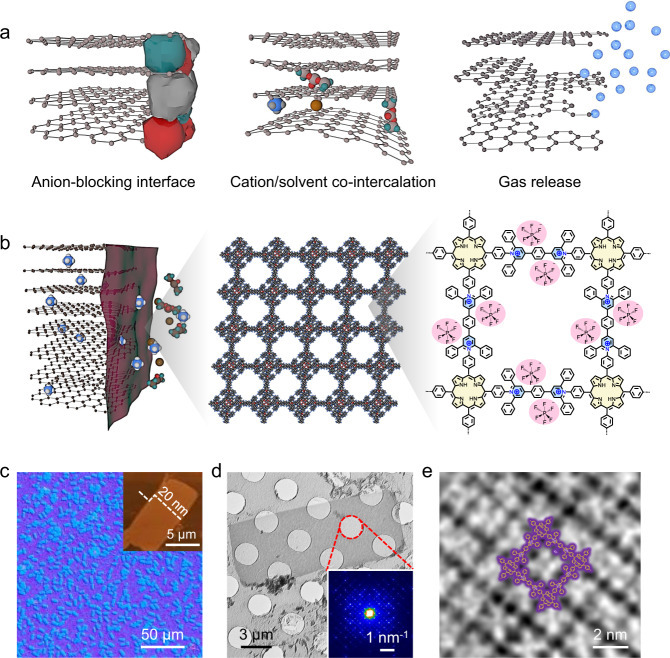
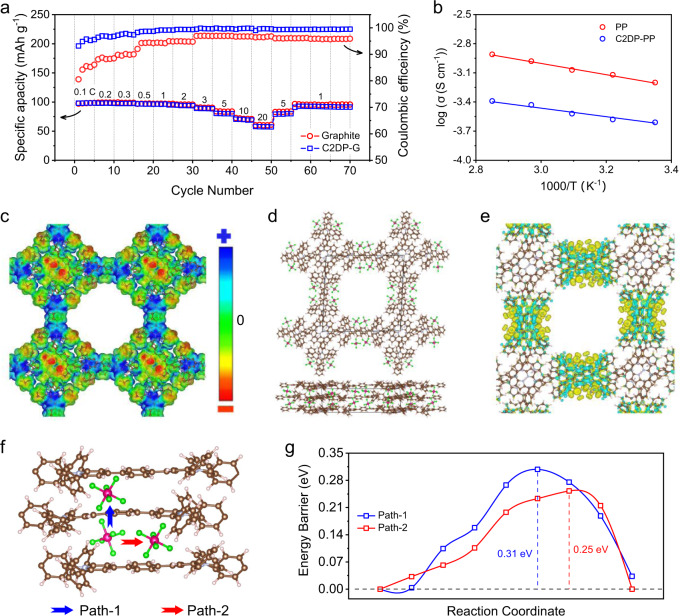
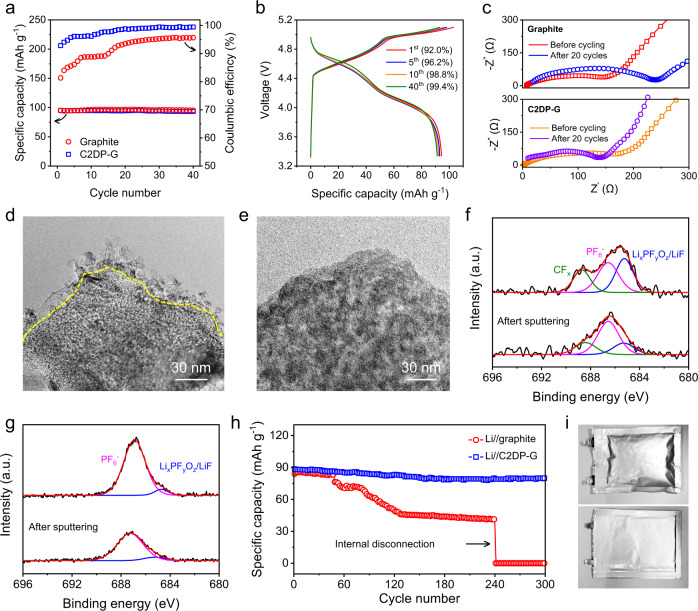
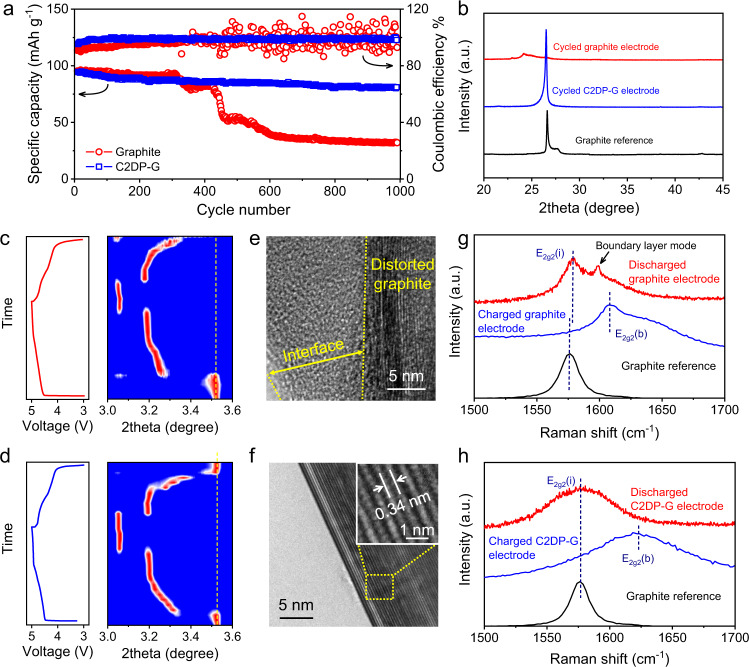
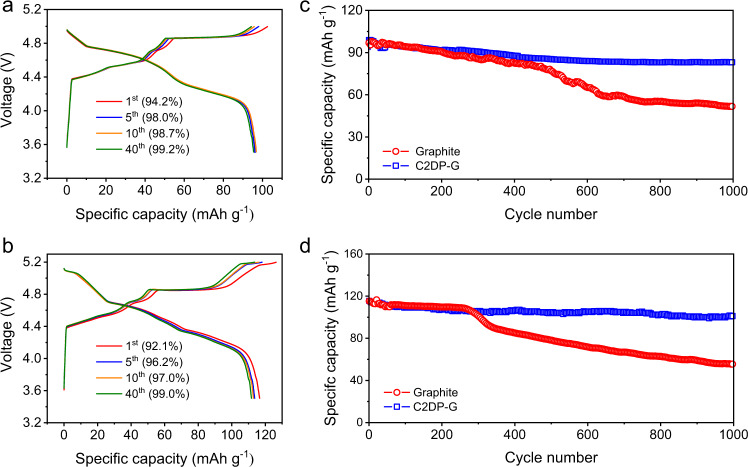
The anion-intercalation chemistries of graphite have the potential to construct batteries with promising energy and power breakthroughs. Here, we report the use of an ultrathin, positively charged two-dimensional poly(pyridinium salt) membrane (C2DP) as the graphite electrode skin to overcome the critical durability problem. Large-area C2DP enables the conformal coating on the graphite electrode, remarkably alleviating the electrolyte. Meanwhile, the dense face-on oriented single crystals with ultrathin thickness and cationic backbones allow C2DP with high anion-transport capability and selectivity. Such desirable anion-transport properties of C2DP prevent the cation/solvent co-intercalation into the graphite electrode and suppress the consequent structure collapse. An impressive PF6--intercalation durability is demonstrated for the C2DP-covered graphite electrode, with capacity retention of 92.8% after 1000 cycles at 1 C and Coulombic efficiencies of > 99%. The feasibility of constructing artificial ion-regulating electrode skins with precisely customized two-dimensional polymers offers viable means to promote problematic battery chemistries.
© 2023. The Author(s).
Conflict of interest statement
The authors declare no competing interests.
Figures
References
-
- Wang G, Yu M, Feng X. Carbon materials for ion-intercalation involved rechargeable battery technologies. Chem. Soc. Rev. 2021;50:2388–2443. - PubMed
-
- Wang G, et al. Self-activating, capacitive anion intercalation enables high-power graphite cathodes. Adv. Mater. 2018;30:1800533. - PubMed
-
- Yang C, et al. Aqueous Li-ion battery enabled by halogen conversion–intercalation chemistry in graphite. Nature. 2019;569:245–250. - PubMed
-
- Li Y, Lu Y, Adelhelm P, Titirici MM, Hu YS. Intercalation chemistry of graphite: Alkali metal ions and beyond. Chem. Soc. Rev. 2019;48:4655–4687. - PubMed
-
- Wang M, et al. Reversible calcium alloying enables a practical room-temperature rechargeable calcium-ion battery with a high discharge voltage. Nat. Chem. 2018;10:667–672. - PubMed
Grants and funding
- FC2DMOF, No. 852909/EC | Horizon 2020 Framework Programme (EU Framework Programme for Research and Innovation H2020)
- GrapheneCore3 881603/EC | Horizon 2020 Framework Programme (EU Framework Programme for Research and Innovation H2020)
- LIGHT-CAP 101017821/EC | Horizon 2020 Framework Programme (EU Framework Programme for Research and Innovation H2020)
- INST 275/357-1 FUGG/Deutsche Forschungsgemeinschaft (German Research Foundation)
- CRC 1415, 417590517/Deutsche Forschungsgemeinschaft (German Research Foundation)
- SPP 2248, RACOF-MMIS/Deutsche Forschungsgemeinschaft (German Research Foundation)
- LiNaKon 2018 FGR 0092/Thüringer Ministerium für Wirtschaft, Wissenschaft und Digitale Gesellschaft (Thuringian Ministry of Economics, Science and Digital Society)
- Sonderzuweisung zur Unterstützung profilbestimmender Struktureinheiten/Sächsisches Staatsministerium für Wissenschaft und Kunst (Saxon State Ministry for Science and Art)
- HYSUCAP 100478697/Sächsisches Staatsministerium für Wissenschaft und Kunst (Saxon State Ministry for Science and Art)
LinkOut - more resources
Full Text Sources
