Review
. 2023 Jan 19;13(3):350.
doi: 10.3390/ani13030350.

Effects of Heat Stress in Dairy Cows Raised in the Confined System: A Scientometric Review

Affiliations
Review

Effects of Heat Stress in Dairy Cows Raised in the Confined System: A Scientometric Review

Karen Dal' Magro Frigeri et al. Animals (Basel). .

Abstract

Due to climate change, heat stress is a growing problem for the dairy industry. Based on this, annual economic losses in the dairy sector are verified mainly on a large scale. Despite several publications on thermal stress in lactating dairy cows in confinement systems, there need to be published reviews addressing this issue systematically. Our objective was to scientometrically analyze the effects of heat stress in dairy cows managed in a confinement system. Based on PRISMA guidelines, research articles were identified, screened, and summarized based on inclusion criteria for heat stress in a confinement system. Data was obtained from the Web of Science. A total of 604 scientific articles published between 2000 and April 2022 were considered. Data was then analyzed using Microsoft Excel and CiteSpace. The results pointed to a significant increase in studies on heat stress in lactating cows housed in confinement systems. The main research areas were Agriculture, Dairy Animal Science and Veterinary Sciences. The USA showed the highest concentration of studies (31.12%), followed by China (14.90%). Emerging themes included heat stress and behavior. The most influential journals were the Journal of Dairy Science and the Journal of Animal Science. The top authors were L. H. Baumgard and R. J. Collier. The leading institutions were the Chinese Academy of Agricultural Sciences, followed by the State University System of Florida and the University of Florida. The study maps the significant research domains on heat stress of lactating cows in confinement systems, discusses implications and explanations and highlights emerging trends.

Keywords: CiteSpace; biometeorology; cattle; compost barn; free-stall; systematic review; tie-stall.


Conflict of interest statement

The authors declare no conflict of interest.

Figures
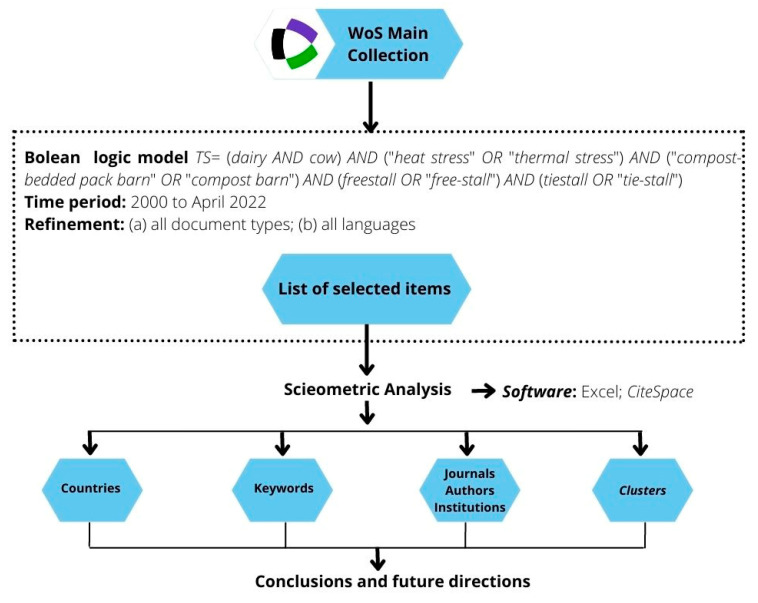
Figure 1
Figure 1
Research design.
Figure 2
Figure 2
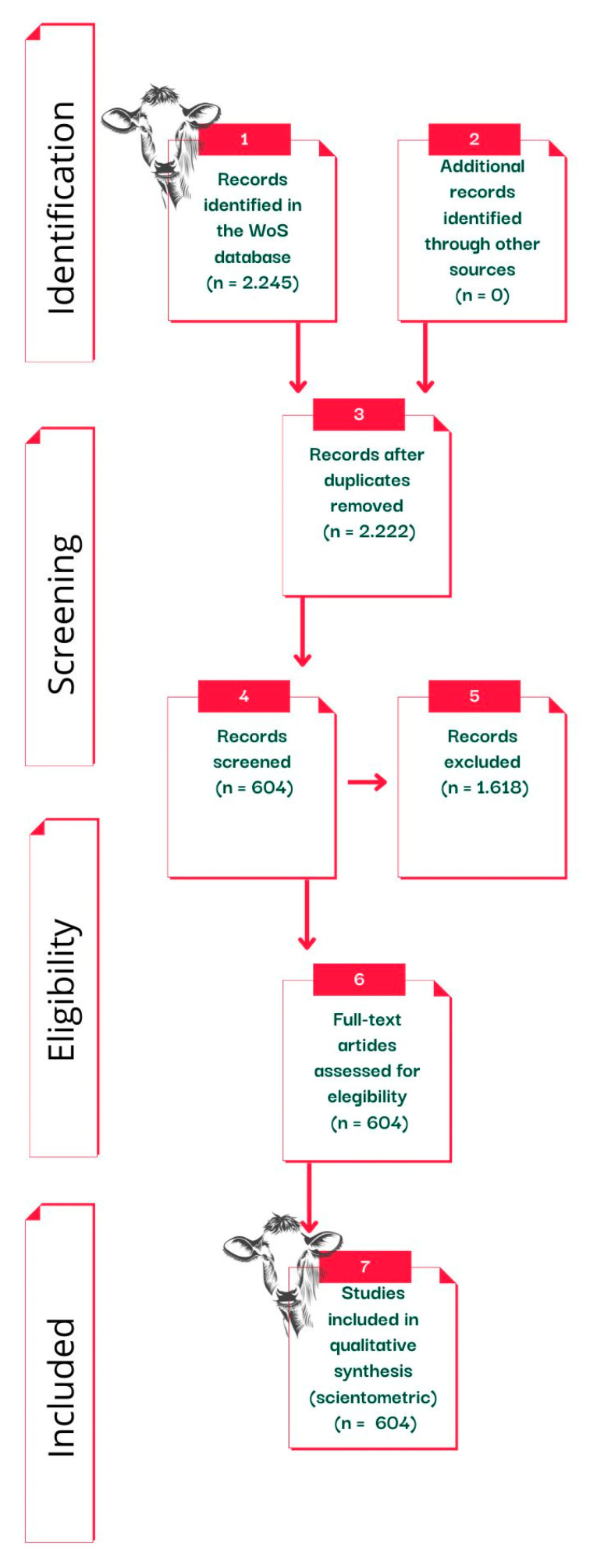
Flowchart following PRISMA guidelines (Moher et al. [32]), showing the total number of publications identified and the number of publications filtered at each stage of the selection process from the systematic review.
Figure 3
Figure 3
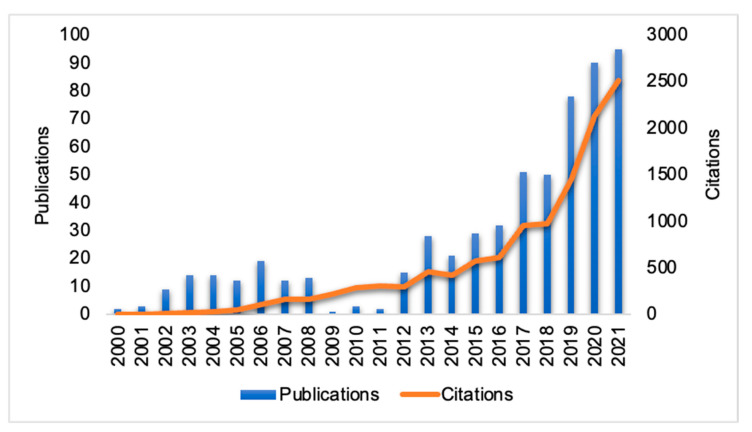
Relationship between the number of publications and citations per year of publications related to heat stress in dairy cows in a confinement system.
Figure 4
Figure 4
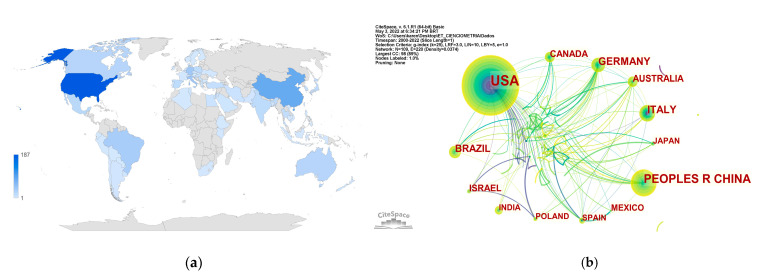
Geolocation of the 604 studies included in the review. (a) The geographic distribution of the studies is related to the color of each country, proportional to the number of publications (for interpretation purposes, the scale range from light blue which presents countries with the lowest number of publications to dark blue which presents countries with the highest number of publications, and gray which presents countries no publication). (b) The co-occurrence network of the nations is related by the node’s size, determined by the number of times that word was used and the links in the relationship between the countries.
Figure 5
Figure 5
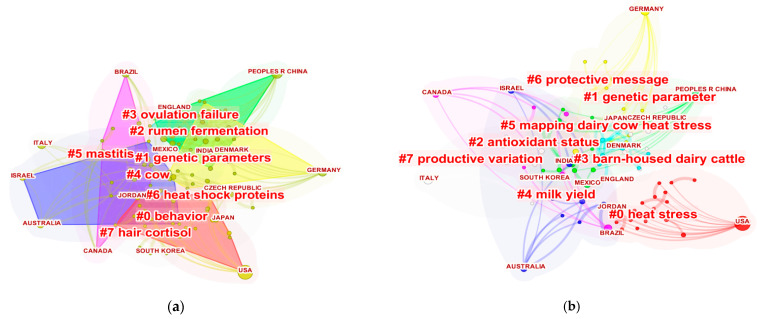
(a) Country grouping with keywords and (b) titles of the 604 studies included in the review. Identification #0 represents the grouping with the highest weight and most current area.
Figure 6
Figure 6
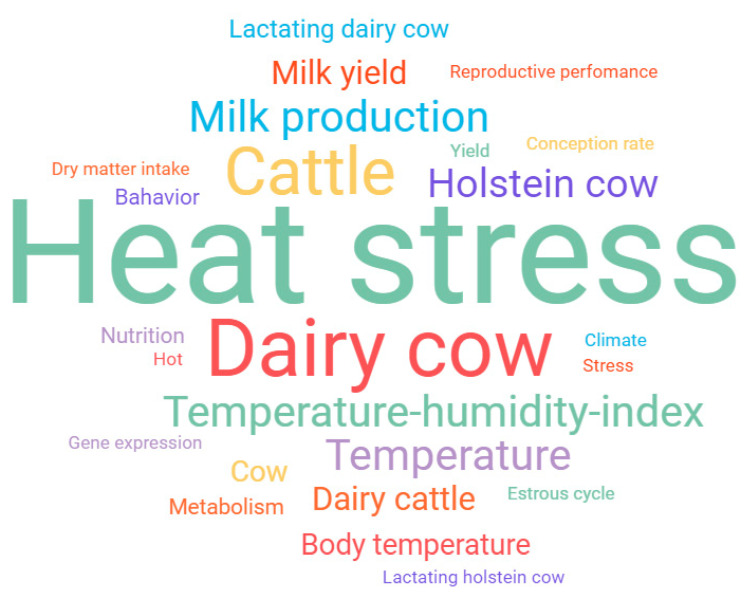
Word cloud was generated using the 25 most frequently used keywords from the 604 studies included in the review. Words appearing in more significant types were used more regularly.
Figure 7
Figure 7
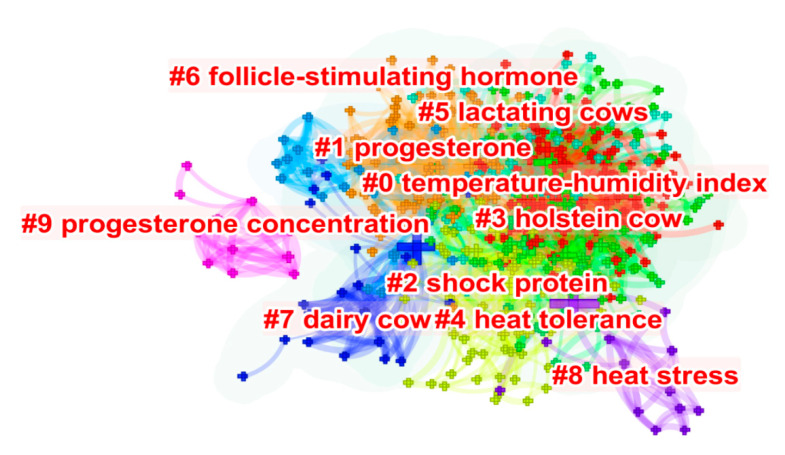
Clustering of the keywords of the 604 studies included in the review. Identification #0 represents the grouping with the highest weight and most current area.
Figure 8
Figure 8
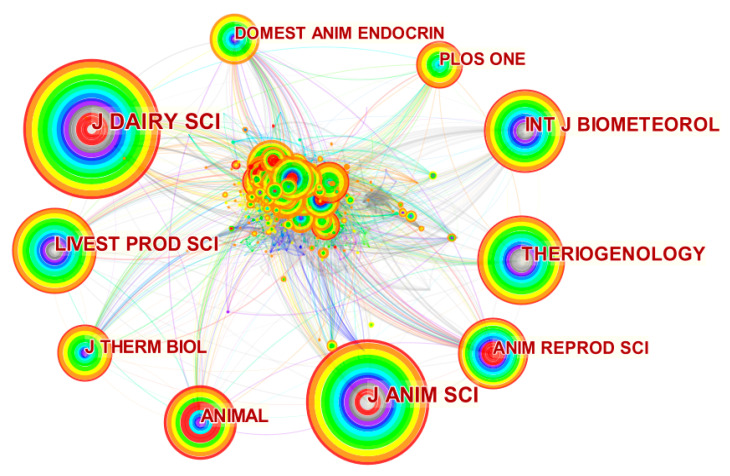
Co-occurrence network of the journals of the 604 studies included in the review. The node size is determined by the number of times this word was used and the links in the relationship between the journals. Warm colors (red, yellow, and green) represent the most current studies, while cold colors (gray, dark blue and light blue) represent the oldest studies.

References

    1. Lees A.M., Sejian V., Wallage A.L., Steel C.C., Mader T.L., Lees J.C., Gaughan J.B. The impact of heat load on cattle. Animals. 2019;9:322. doi: 10.3390/ani9060322. - DOI - PMC - PubMed
    1. Mota-Rojas D., Titto C.G., Orihuela A., Martínez-Burnes J., Gómez-Prado J., Torres-Bernal F., Flores-Padilla K., Carvajal-De la Fuente V., Wang D. Physiological and behavioral mechanisms of thermoregulation in mammals. Animals. 2021;11:1733. doi: 10.3390/ani11061733. - DOI - PMC - PubMed
    1. Liu J., Li L., Chen X., Lu Y., Wang D. Effects of heat stress on body temperature, milk production, and reproduction in dairy cows: A novel idea for monitoring and evaluation of heat stress—A review. Asian-Australas. J. Anim. Sci. 2019;32:1332–1339. doi: 10.5713/ajas.18.0743. - DOI - PMC - PubMed
    1. Kumar G., Devi P., Sharma N., Somagond Y.M. Impact of thermal stress on milk production, composition and fatty acid profile in dairy cows: A review. J. Entomol. Zool. Stud. 2020;8:1278–1283.
    1. Kim S.H., Ramos S.C., Valencia R.A., Cho Y.I., Lee S.S. Heat Stress: Effects on Rumen Microbes and Host Physiology, and Strategies to Alleviate the Negative Impacts on Lactating Dairy Cows. Front. Microbiol. 2022;13:804562. doi: 10.3389/fmicb.2022.804562. - DOI - PMC - PubMed

LinkOut - more resources