


Accuracy of a Prehospital Triage Protocol in Predicting In-Hospital Mortality and Severe Trauma Cases among Older Adults
- PMID: 36767343
- PMCID: PMC9916137
- DOI: 10.3390/ijerph20031975
Accuracy of a Prehospital Triage Protocol in Predicting In-Hospital Mortality and Severe Trauma Cases among Older Adults
Abstract
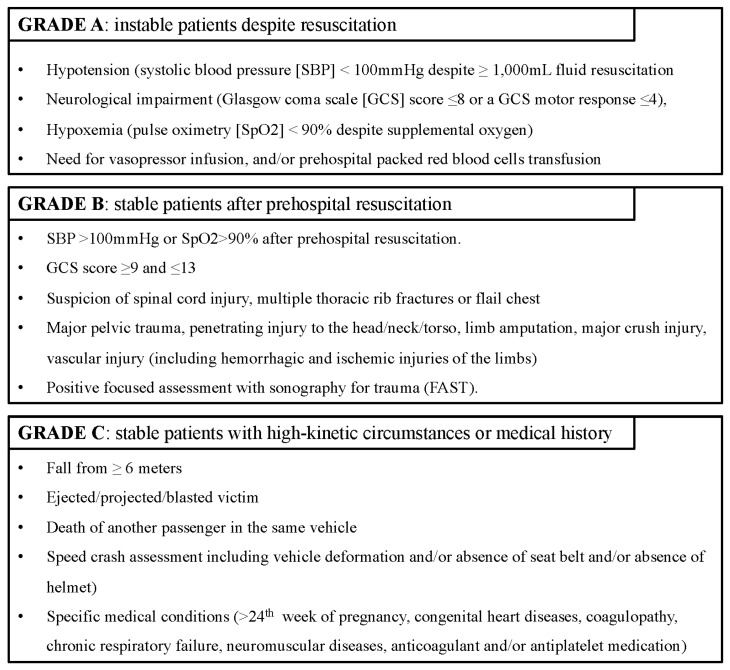
Background: Prehospital trauma triage tools are not tailored to identify severely injured older adults. Our trauma triage protocol based on a three-tier trauma severity grading system (A, B, and C) has never been studied in this population. The objective was to assess its accuracy in predicting in-hospital mortality among older adults (≥65 years) and to compare it to younger patients. Methods: A retrospective multicenter cohort study, from 2011 to 2021. Consecutive adult trauma patients managed by a mobile medical team were prospectively graded A, B, or C according to the initial seriousness of their injuries. Accuracy was evaluated using sensitivity, specificity, positive and negative predictive values, and positive and negative likelihood ratios. Results: 8888 patients were included (14.1% were ≥65 years). Overall, 10.1% were labeled Grade A (15.2% vs. 9.3% among older and younger adults, respectively), 21.9% Grade B (27.9% vs. 20.9%), and 68.0% Grade C (56.9% vs. 69.8%). In-hospital mortality was 7.1% and was significantly higher among older adults regardless of severity grade. Grade A showed lower sensitivity (50.5 (43.7; 57.2) vs. 74.6 (69.8; 79.1), p < 0.0001) for predicting mortality among older adults compared to their younger counterparts. Similarly, Grade B was associated with lower sensitivity (89.5 (84.7; 93.3) vs. 97.2 (94.8; 98.60), p = 0.0003) and specificity (69.4 (66.3; 72.4) vs. 74.6 (73.6; 75.7], p = 0.001) among older adults. Conclusions: Our prehospital trauma triage protocol offers high sensitivity for predicting in-hospital mortality including older adults.
Keywords: emergency medical services; older adults; trauma; triage.
Conflict of interest statement
All authors declare no conflict of interest.
References
-
- Kalbas Y., Lempert M., Ziegenhain F., Scherer J., Neuhaus V., Lefering R., Teuben M., Sprengel K., Pape H.C., Jensen K.O., et al. A retrospective cohort study of 27,049 polytraumatized patients age 60 and above: Identifying changes over 16 years. Eur. Geriatr. Med. 2021;13:233–241. doi: 10.1007/s41999-021-00546-9. - DOI - PMC - PubMed
Publication types
MeSH terms
LinkOut - more resources
Full Text Sources
Medical
