


Leaders' Role in Shaping Followers' Well-Being: Crossover in a Sample of Nurses
- PMID: 36767751
- PMCID: PMC9916091
- DOI: 10.3390/ijerph20032386
Leaders' Role in Shaping Followers' Well-Being: Crossover in a Sample of Nurses
Abstract
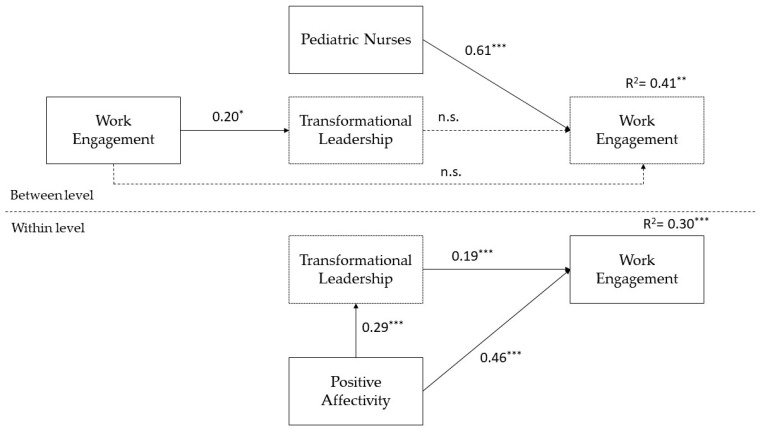
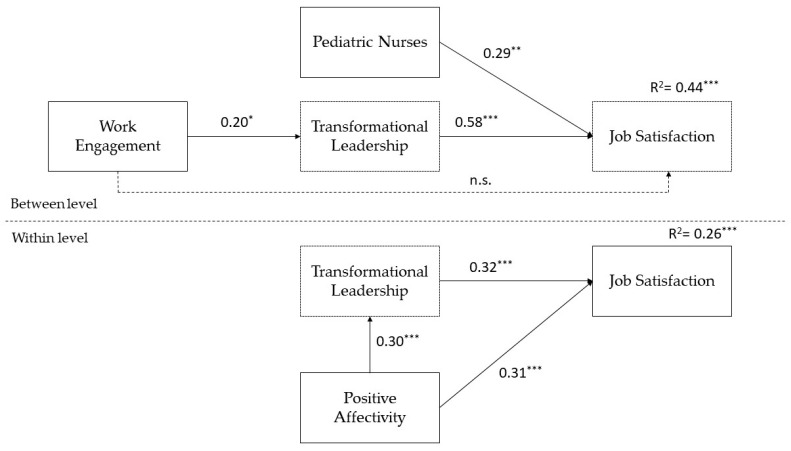
The link between well-being at work and leadership has received considerable attention. Leaders have the power to influence followers not only due to formal position, but also their positive behaviors could reinforce the followers' positive working experience. Following the crossover model (Westman, 2001), this study investigates whether leaders' work-related positive psychological states (i.e., work engagement) cross over to those of the followers (i.e., work engagement and job satisfaction) through the mediation of the latter's perception of transformational leadership. We used MPlus 8 to test two multilevel mediations in a sample of 1505 nurses nested in 143 groups led by as many leaders (87.19% of nurses and 56.50% of head nurses of the entire population). Results show that while there is not a crossover of leader work engagement to nurse work engagement, manager work engagement can cross over to nurse job satisfaction, enhancing their well-being through transformational leadership behaviors. This study adds further insights both on crossover theory and on the importance of leaders in expanding and transferring resources to followers at work. Fostering work engagement at a managerial level in the healthcare sector could be the driver to facilitate the well-being of nurses at work, address negative outcomes, and promote positive ones.
Keywords: conservation of resources; crossover; job satisfaction; multilevel mediation; nurse managers; nurses; transformational leadership; work engagement.
Conflict of interest statement
The authors declare no conflict of interest.
Figures
References
Publication types
MeSH terms
LinkOut - more resources
Full Text Sources
