Review
. 2023 Jan 23;24(3):2264.
doi: 10.3390/ijms24032264.

Convergent Evolution in SARS-CoV-2 Spike Creates a Variant Soup from Which New COVID-19 Waves Emerge

Affiliations
Review

Convergent Evolution in SARS-CoV-2 Spike Creates a Variant Soup from Which New COVID-19 Waves Emerge

Daniele Focosi et al. Int J Mol Sci. .

Abstract

The first 2 years of the COVID-19 pandemic were mainly characterized by recurrent mutations of SARS-CoV-2 Spike protein at residues K417, L452, E484, N501 and P681 emerging independently across different variants of concern (Alpha, Beta, Gamma, and Delta). Such homoplasy is a marker of convergent evolution. Since Spring 2022 and the third year of the pandemic, with the advent of Omicron and its sublineages, convergent evolution has led to the observation of different lineages acquiring an additional group of mutations at different amino acid residues, namely R346, K444, N450, N460, F486, F490, Q493, and S494. Mutations at these residues have become increasingly prevalent during Summer and Autumn 2022, with combinations showing increased fitness. The most likely reason for this convergence is the selective pressure exerted by previous infection- or vaccine-elicited immunity. Such accelerated evolution has caused failure of all anti-Spike monoclonal antibodies, including bebtelovimab and cilgavimab. While we are learning how fast coronaviruses can mutate and recombine, we should reconsider opportunities for economically sustainable escape-proof combination therapies, and refocus antibody-mediated therapeutic efforts on polyclonal preparations that are less likely to allow for viral immune escape.

Keywords: BQ.1.1; Evusheld™; K444; R346; SARS-CoV-2; Spike; XBB; bebtelovimab; cilgavimab; convergent evolution; omicron; tixagevimab.


Conflict of interest statement

The authors declare no conflict of interest.

Figures
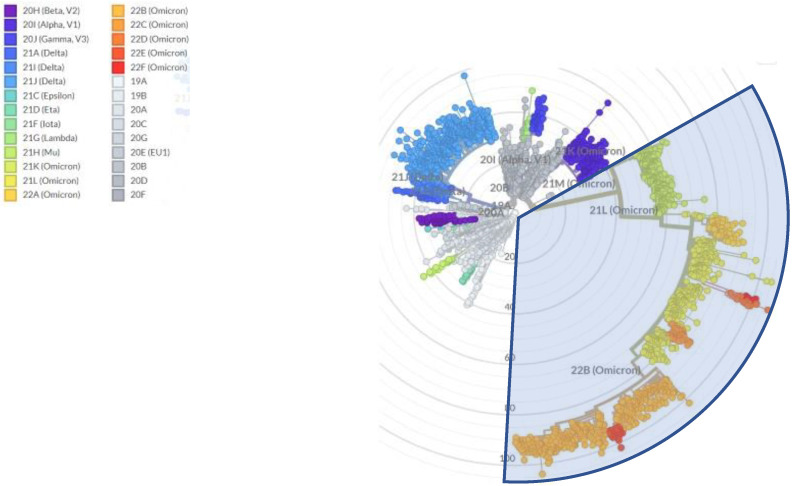
Figure 1
Figure 1
Radial tree of SARS-CoV-2 evolution, with branch length approximating divergence, showing that Omicron (light blue shadow) currently includes more than 45% or variations across 3193 genomes sampled between December 2019 and December 2022. Accessed online at https://nextstrain.org/ncov/gisaid/global/all-time?l=radial&m=div (accessed on 26 December 2022).
Figure 2
Figure 2
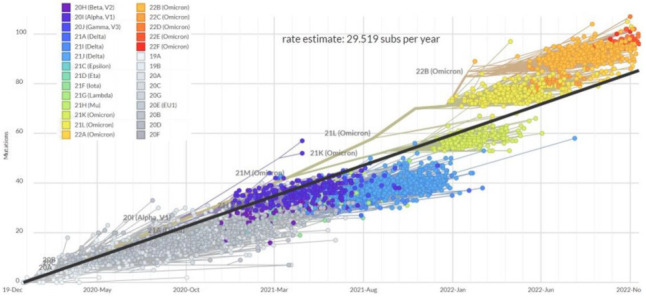
Clock tree of SARS-CoV-2 evolution, with regression line showing an increase in the estimate rate of substitutions per year across 3045 genomes sampled between December 2019 and November 2022. Accessed online at https://nextstrain.org/ncov/gisaid/global/all-time?l=clock&m=div (accessed on 26 November 2022).
Figure 3
Figure 3
Diagram representing all SARS-CoV-2 Omicron sublineages designated by PANGOLIN as of 26 December 2022 for which at least one of the Spike RBD immune escaping mutations (R346X, K444X, L452X, N460X, F486X, or R493Q) represents a branching event. Mythological names introduced by T Ryan Gregory and used colloquially are also reported. Convergence towards combos of this mutations is noted, with different background colors representing different combinations. Resistance of each combination to clinically authorized anti-Spike mAbs is reported in the squared box. For visualization purposes, the upper panel shows BA.1 and BA.2 evolution, while the lower panel shows BA.4/5 evolution.
Figure 4
Figure 4
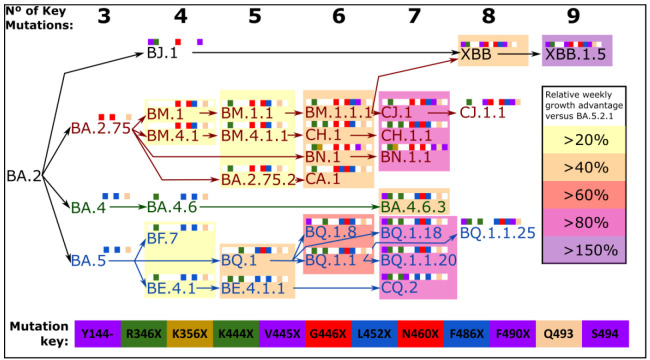
Step-wise accumulation of key Spike mutations involved in immune escape within SARS-CoV-2 Omicron sublineages increase the relative growth rate. Lineage name text is color coded, where BA.5 descendants are in blue text, BA.4 descendants in green text and BA.2.75 descendants are in red text. Each mutation is color coded as shown in the mutation key, and depicted as colored squares when present or white squares if absent. Number of key mutations of each lineage is summarized at the top. The F486P mutation is counted as two mutations due to the inherent increased fitness displayed by variants that carry this mutation relative to variants with F486S or F486V. Relative growth rates were calculated using BA.5 lineage as baseline, for groups of BA.4, BA.5, BA.2.75 and XBB descendant lineages with each exact total number of key mutations. Relative growth rates were calculated using global data, using CoV-Spectrum [30]. As of 26 December 2022.
Figure 5
Figure 5
Evolutionary steps at the basis of the major Omicron branches (CZ.1, XBB.* and CH.1.1.1, and other BA.2.75.* descendants), showing progressive increases in RBD immune escape score (as calculated here: https://jbloomlab.github.io/SARS2_RBD_Ab_escape_maps/escape-calc/ (accessed on)). Chart created on NextStrain [31] (https://next.nextstrain.org/staging/nextclade/sars-cov-2/21L?gmin=15&l=scatter&scatterX=ace2_binding&scatterY=immune_escape&showBranchLabels=all (accessed on 26 December 2022).
Figure 6
Figure 6
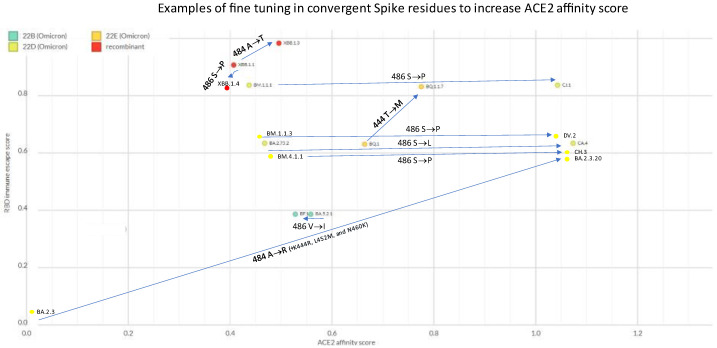
Sequential mutational events at the same Spike amino acid residues and change in ACE2 affinity score (as calculated here: https://github.com/jbloomlab/SARS-CoV-2-RBD_DMS_Omicron/blob/main/results/final_variant_scores/final_variant_scores.csv (accessed on 26 December 2022)). Chart created on NextStrain [31] (https://next.nextstrain.org/staging/nextclade/sars-cov-2/21L?gmin=15&l=scatter&scatterX=ace2_binding&scatterY=immune_escape&showBranchLabels=all (accessed on 26 December 2022)).
Figure 7
Figure 7
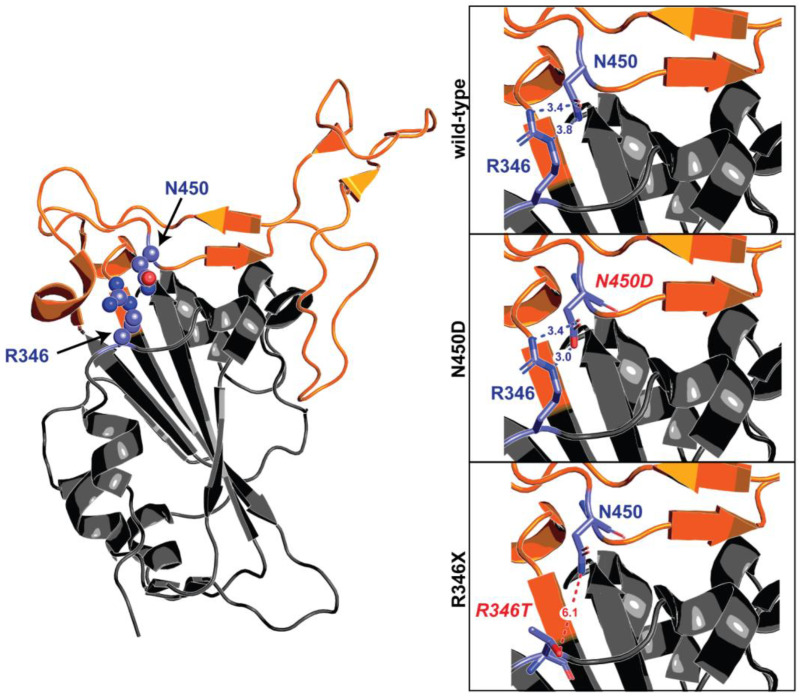
Mutually exclusive mutations at R346 and N450. The receptor binding domain of S is depicted in grey cartoon representation, with the receptor binding module (ACE2 interaction interface) highlighted in orange. Amino acids at the 346 and 450 positions are displayed as purple sticks. A zoomed-in view of the R346-N450 interaction in the ancestral domain, as well as the computationally modelled amino acid substitutions at those two positions, are portrayed in boxes to the right. In the wild-type sequence, the basic R346 sidechain interacts with the N450 residue through a pair of hydrogen bond interactions. N450D results in a similarly sized sidechain, but altered electrostatics. One hydrogen bond is maintained between the neutral oxygen of Asp and Nε of Arg, and a new salt bridge is formed between the anionic deprotonated oxygen of Asp and the cationic center of the guanidino group of Arg. In the case of R346X, any substitution except lysine would result in a side chain that is significantly shorter and non-cationic, thus dissolving the interactions between N450 or other common substitutions at that position.
Figure 8
Figure 8
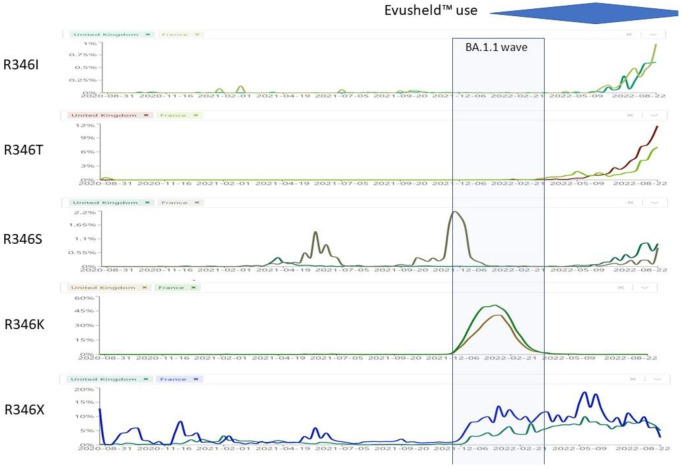
Prevalence of S:R346X mutations in the period 27 August 2022–13 September 2022 in UK versus France. Sourced from https://cov-spectrum.org (accessed on 26 November 2022). The blue area represents trends in Evusheld™ prescriptions in France and many other countries (but not UK).

References

    1. Rubin R. The COVID-19 Pandemic Rages on for People Who Are Immunocompromised. JAMA. 2022;327:1853–1855. doi: 10.1001/jama.2022.7281. - DOI - PubMed
    1. Dioverti V., Salto-Alejandre S., Haidar G. Immunocompromised Patients with Protracted COVID-19: A Review of “Long Persisters”. Curr. Transplant. Rep. 2022;9:209–218. doi: 10.1007/s40472-022-00385-y. - DOI - PMC - PubMed
    1. Wallace B.I., Kenney B., Malani P.N., Clauw D.J., Nallamothu B.K., Waljee A.K. Prevalence of Immunosuppressive Drug Use among Commercially Insured US Adults, 2018–2019. JAMA Netw. Open. 2021;4:e214920. doi: 10.1001/jamanetworkopen.2021.4920. - DOI - PMC - PubMed
    1. Daily New Confirmed COVID-19 Deaths Per Million People Our World in Data. [(accessed on 1 December 2022)]. Available online: https://ourworldindata.org/explorers/coronavirus-data-explorer?zoomToSel....
    1. Viana R., Moyo S., Amoako D.G., Tegally H., Scheepers C., Althaus C.L., Anyaneji U.J., Bester P.A., Boni M.F., Chand M., et al. Rapid epidemic expansion of the SARS-CoV-2 Omicron variant in southern Africa. Nature. 2022;603:679–686. doi: 10.1038/s41586-022-04411-y. - DOI - PMC - PubMed

Substances