Review
. 2023 Jan 31;24(3):2696.
doi: 10.3390/ijms24032696.

CD4 T-Cell Subsets and the Pathophysiology of Inflammatory Bowel Disease

Affiliations
Review

CD4 T-Cell Subsets and the Pathophysiology of Inflammatory Bowel Disease

Raquel Gomez-Bris et al. Int J Mol Sci. .

Abstract

Inflammatory bowel disease (IBD) is an umbrella term for the chronic immune-mediated idiopathic inflammation of the gastrointestinal tract, manifesting as Crohn's disease (CD) or ulcerative colitis (UC). IBD is characterized by exacerbated innate and adaptive immunity in the gut in association with microbiota dysbiosis and the disruption of the intestinal barrier, resulting in increased bacterial exposure. In response to signals from microorganisms and damaged tissue, innate immune cells produce inflammatory cytokines and factors that stimulate T and B cells of the adaptive immune system, and a prominent characteristic of IBD patients is the accumulation of inflammatory T-cells and their proinflammatory-associated cytokines in intestinal tissue. Upon antigen recognition and activation, CD4 T-cells differentiate towards a range of distinct phenotypes: T helper(h)1, Th2, Th9, Th17, Th22, T follicular helper (Tfh), and several types of T-regulatory cells (Treg). T-cells are generated according to and adapt to microenvironmental conditions and participate in a complex network of interactions among other immune cells that modulate the further progression of IBD. This review examines the role of the CD4 T-cells most relevant to IBD, highlighting how these cells adapt to the environment and interact with other cell populations to promote or inhibit the development of IBD.

Keywords: Crohn’s disease; Th1; Th17; Th19; Th2; Th22; Treg; adaptive immune system; inflammatory bowel disease; regulatory T-cell; ulcerative colitis.


Conflict of interest statement

The authors declare no conflict of interest.

Figures

Figure 1
Figure 1
T-cell differentiation, subsets, and main functions. Naive CD4 T-cells can undergo differentiation into distinct effector subsets (e.g., Th1, Th2, Th9, Th17, and Th22 cells), follicular helper T (Tfh) cells, and regulatory phenotypes (Treg), each producing a characteristic set of cytokines (unfilled boxes next to cells). This differentiation process is mediated in part by the local cytokine microenvironment (arrows), which activates specific transcription factors and signaling molecules (text inside cells). Color-filled boxes next to cells list functions in homeostasis and in IBD (bold text). IBD is associated with changes in T-cell populations.
Figure 2
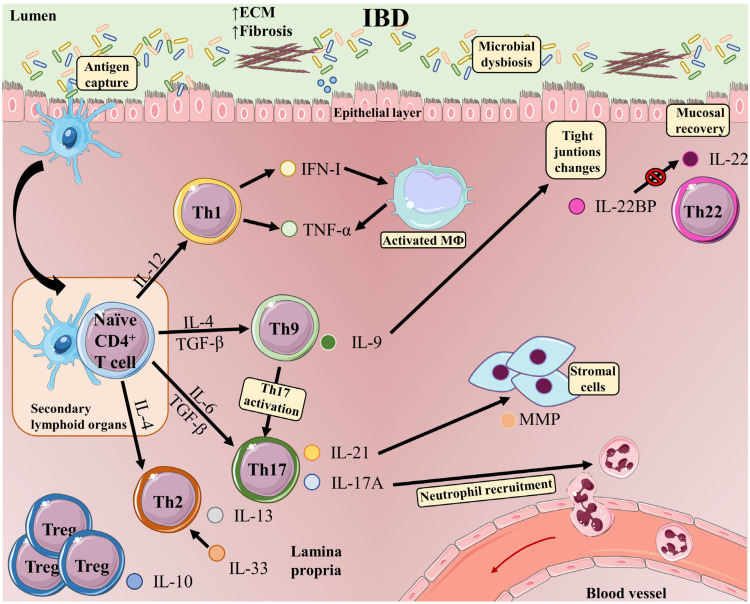
Figure 2
T-cell subsets and functions in the intestinal mucosa in inflammatory bowel disease. The development of IBD is induced by multiple phenomena occurring in the gastrointestinal tract: microbial dysbiosis, disruption of the mucus layer, dysregulation of epithelial tight junctions, defects in the number and function of Paneth cells, and increased intestinal permeability. These events massively increase bacterial exposure. In this context, antigen-bearing DCs capture antigens and migrate to secondary lymphoid organs, where they present antigens to naive T-cells. Once activated, CD4 T-cells undergo proliferation and differentiation into different effector T-cell subsets (Th1, Th9, Th17, and Th2 cells). Differentiated Th cells migrate back to the gut, where they carry out inflammatory functions, such as production of IFN-γ in the case of Th1 cells or IL-17A (which plays an important role in recruiting neutrophils to sites of active inflammation) and IL-21 (which induces MMP production by stromal cells) in the case of Th17 cells. Cytokines released by Th1 cells favor activation of macrophages, which release TNF-α and trigger epithelial-cell apoptosis. Th9 cells produce IL-9, which can act as a proinflammatory cytokine, activating Th17 cells. The presence of IL-9 is associated with alterations in the expression of tight junctions, and intestinal overproduction of IL-9 is likely to impair epithelial-barrier integrity and compromise tolerance to commensal bacteria, eventually progressing to inflammation. IL-33 is upregulated in UC patients and drives a Th2-like cytokine response. Elevated IL-33 production Th2 cells have also been reported in UC patients. Proinflammatory signals in IBD are counterbalanced by IL-10 produced by Tregs. IL-22 released by Th22 cells maintains intestinal epithelial barrier function. In inflamed intestinal tissue, CD4 T-cells are a major source of IL-22BP, which blocks IL-22 signaling.

References

    1. Herrero-Fernandez B., Gomez-Bris R., Somovilla-Crespo B., Gonzalez-Granado J.M. Immunobiology of Atherosclerosis: A Complex Net of Interactions. Int. J. Mol. Sci. 2019;20:5293. doi: 10.3390/ijms20215293. - DOI - PMC - PubMed
    1. Yao H., Tang G. Macrophages in intestinal fibrosis and regression. Cell. Immunol. 2022;381:104614. doi: 10.1016/j.cellimm.2022.104614. - DOI - PubMed
    1. Katsandegwaza B., Horsnell W., Smith K. Inflammatory Bowel Disease: A Review of Pre-Clinical Murine Models of Human Disease. Int. J. Mol. Sci. 2022;23:9344. doi: 10.3390/ijms23169344. - DOI - PMC - PubMed
    1. Kang L., Fang X., Song Y.H., He Z.X., Wang Z.J., Wang S.L., Li Z.S., Bai Y. Neutrophil-Epithelial Crosstalk During Intestinal Inflammation. Cell. Mol. Gastroenterol. Hepatol. 2022;14:1257–1267. doi: 10.1016/j.jcmgh.2022.09.002. - DOI - PMC - PubMed
    1. Kaluzna A., Olczyk P., Komosinska-Vassev K. The Role of Innate and Adaptive Immune Cells in the Pathogenesis and Development of the Inflammatory Response in Ulcerative Colitis. J. Clin. Med. 2022;11:400. doi: 10.3390/jcm11020400. - DOI - PMC - PubMed