Review
. 2023 Feb 1;24(3):2801.
doi: 10.3390/ijms24032801.

Therapeutic Use and Molecular Aspects of Ivabradine in Cardiac Remodeling: A Review

Affiliations
Review

Therapeutic Use and Molecular Aspects of Ivabradine in Cardiac Remodeling: A Review

Yusof Kamisah et al. Int J Mol Sci. .

Abstract

Cardiac remodeling can cause ventricular dysfunction and progress to heart failure, a cardiovascular disease that claims many lives globally. Ivabradine, a funny channel (If) inhibitor, is used in patients with chronic heart failure as an adjunct to other heart failure medications. This review aims to gather updated information regarding the therapeutic use and mechanism of action of ivabradine in heart failure. The drug reduces elevated resting heart rate, which is linked to increased morbidity and mortality in patients with heart failure. Its use is associated with improved cardiac function, structure, and quality of life in the patients. Ivabradine exerts several pleiotropic effects, including an antiremodeling property, which are independent of its principal heart-rate-reducing effects. Its suppressive effects on cardiac remodeling have been demonstrated in animal models of cardiac remodeling and heart failure. It reduces myocardial fibrosis, apoptosis, inflammation, and oxidative stress as well as increases autophagy in the animals. It also modulates myocardial calcium homeostasis, neurohumoral systems, and energy metabolism. However, its role in improving heart failure remains unclear. Therefore, elucidating its molecular mechanisms is imperative and would aid in the design of future studies.

Keywords: cardiac function; cardiac structure; heart failure; left ventricular dysfunction; myocardial fibrosis.


Conflict of interest statement

The authors declare no conflict of interest.

Figures
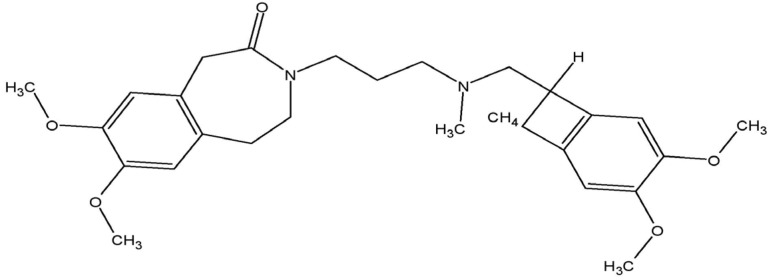
Figure 1
Figure 1
Molecular structure of ivabradine.
Figure 2
Figure 2
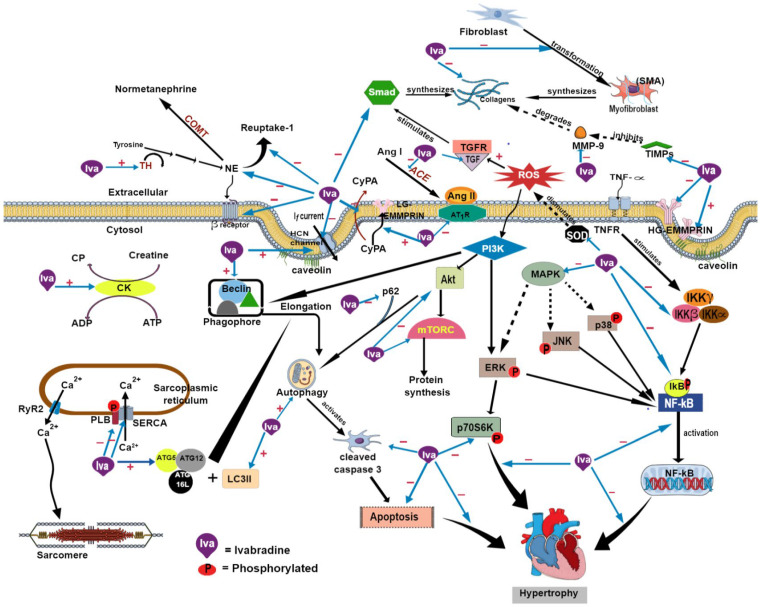
Possible molecular sites of action of ivabradine on cardiac remodeling. ACE, angiotensin-converting enzyme; ADP, adenosine diphosphate; Akt, protein kinase; Ang, angiotensin; ATG, autophagy-related; AT1R, angiotensin II type 1 receptor; ATP, adenosine triphosphate; COMT, catechol-O-methyltransferase; CK, creatine kinase; CP, creatine phosphate; CyPA, cyclophilin A; ERK, extracellular signal-regulated kinase; HCN, hyperpolarization-activated cyclic nucleotide-gated; IKB; nuclear factor of kappa light polypeptide gene enhancer in B-cells inhibitor; HG-EMMPRIN, high-glycosylated extracellular matrix metalloproteinase inducer; IKKγ, inhibitor of nuclear factor kappa-B kinase subunit γ; IKKβ, inhibitor of nuclear factor kappa-B kinase subunit β; IKKBα, inhibitor of nuclear factor kappa-B kinase subunit α; IκBα, nuclear factor of kappa light polypeptide gene enhancer in B-cells inhibitor α; t-IκBα, total inhibitor of nuclear factor kappa-B kinase subunit α/β and IκBα; nuclear factor of kappa light polypeptide gene enhancer in B-cells inhibitor α; p-IKKα/β, inhibitor of nuclear factor kappa-B kinase subunit α/β; JNK, c-Jun N-terminal kinase; LG-EMMPRIN, low-glycosylated extracellular matrix metalloproteinase inducer; LC3II, microtubule-associated protein light chain 3 II; MAPK, mitogen-activated protein kinase; MMP, matrix metalloproteinase; mTORC, mammalian target of rapamycin complex; NE, norepinephrine; NF-κB, nuclear factor-kappa B; PLB, phospholambam; ROS, reactive oxygen species; p-70S6K, phosphorylated protein S6 kinase beta-1; PI3K, phosphatidylinositol 3-kinase; RyR2, ryanodine receptor 2; SERCA2a, Sarcoplasmic/Endoplasmic reticulum calcium ATPase 2a; SMA, α-smooth muscle actin; Smad, the small mothers against decapentaplegic; SOD, superoxide dismutase; TGF, transforming growth factor; TGFR, transforming growth factor receptor; TH, tyrosine hydroxylase; TIMPs, tissue inhibitor of metalloproteinase; TNF-α, tumor necrosis factor α; TNFR, tumor necrosis factor receptor; −, inhibits; +, promotes/increase. Figure created in the Mind the Graph Platform, available at www.mindthegraph.com.

References

    1. Afzal M. Recent updates on novel therapeutic targets of cardiovascular diseases. Mol. Cell. Biochem. 2021;476:145–155. doi: 10.1007/s11010-020-03891-8. - DOI - PubMed
    1. Groenewegen A., Rutten F.H., Mosterd A., Hoes A.W. Epidemiology of heart failure. Eur. J. Heart Fail. 2020;22:1342–1356. doi: 10.1002/ejhf.1858. - DOI - PMC - PubMed
    1. WHO WHO Reveals Leading Causes of Death and Disability Worldwide: 2000–2019. 2020. [(accessed on 8 October 2022)]. Available online: https://www.who.int/news/item/09-12-2020-who-reveals-leading-causes-of-d....
    1. Van De Bruaene A., Meier L., Droogne W., De Meester P., Troost E., Gewillig M., Budts W. Management of acute heart failure in adult patients with congenital heart disease. Hear. Fail. Rev. 2018;23:1–14. doi: 10.1007/s10741-017-9664-x. - DOI - PubMed
    1. Maron B.J., Rowin E.J., Udelson J.E., Maron M.S. Clinical Spectrum and Management of Heart Failure in Hypertrophic Cardiomyopathy. JACC: Hear. Fail. 2018;6:353–363. doi: 10.1016/j.jchf.2017.09.011. - DOI - PubMed