Review
. 2023 Feb 2;24(3):2918.
doi: 10.3390/ijms24032918.

Genetics and Molecular Basis of Congenital Heart Defects in Down Syndrome: Role of Extracellular Matrix Regulation

Affiliations
Review

Genetics and Molecular Basis of Congenital Heart Defects in Down Syndrome: Role of Extracellular Matrix Regulation

Nunzia Mollo et al. Int J Mol Sci. .

Abstract

Down syndrome (DS), a complex disorder that is caused by the trisomy of chromosome 21 (Hsa21), is a major cause of congenital heart defects (CHD). Interestingly, only about 50% of individuals with Hsa21 trisomy manifest CHD. Here we review the genetic basis of CHD in DS, focusing on genes that regulate extracellular matrix (ECM) organization. The overexpression of Hsa21 genes likely underlies the molecular mechanisms that contribute to CHD, even though the genes responsible for CHD could only be located in a critical region of Hsa21. A role in causing CHD has been attributed not only to protein-coding Hsa21 genes, but also to genes on other chromosomes, as well as miRNAs and lncRNAs. It is likely that the contribution of more than one gene is required, and that the overexpression of Hsa21 genes acts in combination with other genetic events, such as specific mutations or polymorphisms, amplifying their effect. Moreover, a key function in determining alterations in cardiac morphogenesis might be played by ECM. A large number of genes encoding ECM proteins are overexpressed in trisomic human fetal hearts, and many of them appear to be under the control of a Hsa21 gene, the RUNX1 transcription factor.

Keywords: Down syndrome; RUNX1; chromosome 21; congenital heart defects; extracellular matrix.


Conflict of interest statement

The authors declare that the research was conducted in the absence of any commercial or financial relationships that could be construed as a potential conflict of interest.

Figures
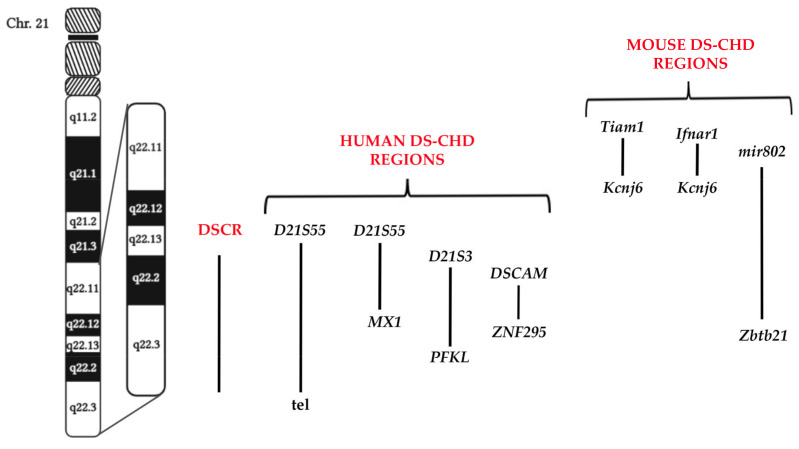
Figure 1
Figure 1
Schematic representation of DS phenotype critical regions. The ‘Down Syndrome Critical Region’ (DSCR) [8,9,10] and human [11,12,13,14,15] and mouse [19,20,21] DS–CHD regions with corresponding boundaries have been defined using the GRCh38/hg38 UCSC assembly.
Figure 2
Figure 2
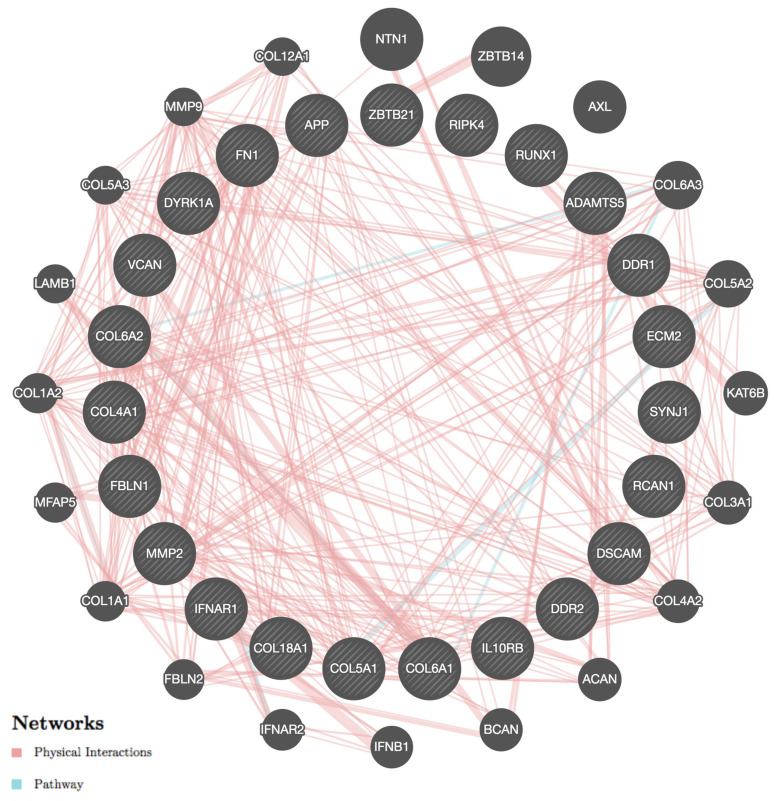
Interactions among genes involved in CHD. The figure illustrates the physical interactions and participation in the same pathway of genes involved in CHD generation, obtained using the GeneMANIA software (version 3.6.0) [174,175] (available at: https://genemania.org/ (accessed on 27 January 2023)). The genes discussed in this review are represented by the striped circles depicted in the inner ring. They are connected to each other by lines of different colors, each indicating a specific type of interaction: pink for physical interactions and light blue for pathways. The outer ring shows genes closely related to those in the inner ring (according to the GeneMANIA software). These genes are represented as circles of different sizes according to their ranking, which is achieved by scoring them using label propagation. By inputting the names of the genes in GeneMANIA, it is possible to generate an image featuring active links that provide additional information about all interactions and relevant literature references.

References

    1. Van Der Linde D., Konings E.E.M., Slager M.A., Witsenburg M., Helbing W.A., Takkenberg J.J.M., Roos-Hesselink J.W. Birth Prevalence of Congenital Heart Disease Worldwide: A Systematic Review and Meta-Analysis. J. Am. Coll. Cardiol. 2011;58:2241–2247. doi: 10.1016/j.jacc.2011.08.025. - DOI - PubMed
    1. Fahed A.C., Gelb B.D., Seidman J.G., Seidman C.E. Genetics of Congenital Heart Disease: The Glass Half Empty. Circ. Res. 2013;112:707–720. doi: 10.1161/CIRCRESAHA.112.300853. - DOI - PMC - PubMed
    1. Urbano R. Health Issues in Persons with Down Syndrome. Volume 39. Academic Press; Cambridge, MA, USA: 2012.
    1. Stoll C., Dott B., Alembik Y., Roth M.-P. Associated congenital anomalies among cases with Down syndrome. Eur. J. Med. Genet. 2015;58:674–680. doi: 10.1016/j.ejmg.2015.11.003. - DOI - PubMed
    1. Maslen C.L., Babcock D., Robinson S.W., Bean L.J.H., Dooley K.J., Willour V.L., Sherman S.L. CRELD1 mutations contribute to the occurrence of cardiac atrioventricular septal defects in Down syndrome. Am. J. Med. Genet. Part A. 2006;140:2501–2505. doi: 10.1002/ajmg.a.31494. - DOI - PubMed