


Gender Difference in the Effects of COVID-19 Pandemic on Mechanical Reperfusion and 30-Day Mortality for STEMI: Results of the ISACS-STEMI COVID-19 Registry
- PMID: 36769546
- PMCID: PMC9918240
- DOI: 10.3390/jcm12030896
Gender Difference in the Effects of COVID-19 Pandemic on Mechanical Reperfusion and 30-Day Mortality for STEMI: Results of the ISACS-STEMI COVID-19 Registry
Abstract
Background: Several reports have demonstrated the impact of the COVID-19 pandemic on the management and outcome of patients with ST-segment elevation myocardial infarction (STEMI). The aim of the current analysis is to investigate the potential gender difference in the effects of the COVID-19 pandemic on mechanical reperfusion and 30-day mortality for STEMI patients within the ISACS-STEMI COVID-19 Registry.
Methods: This retrospective multicenter registry was performed in high-volume primary percutaneous coronary intervention (PPCI) centers on four continents and included STEMI patients undergoing PPCIs in March-June 2019 and 2020. Patients were divided according to gender. The main outcomes were the incidence and timing of the PPCI, (ischemia time ≥ 12 h and door-to-balloon ≥ 30 min) and in-hospital or 30-day mortality.
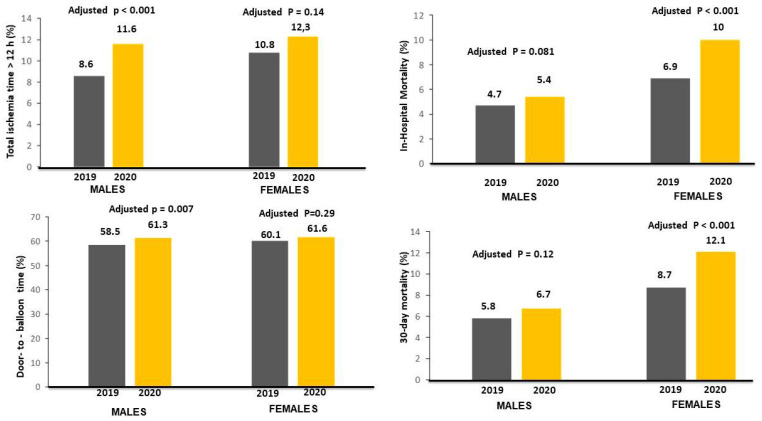
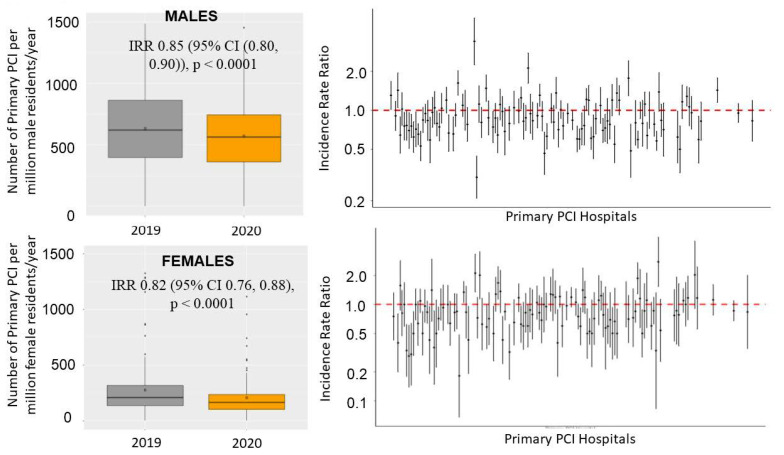
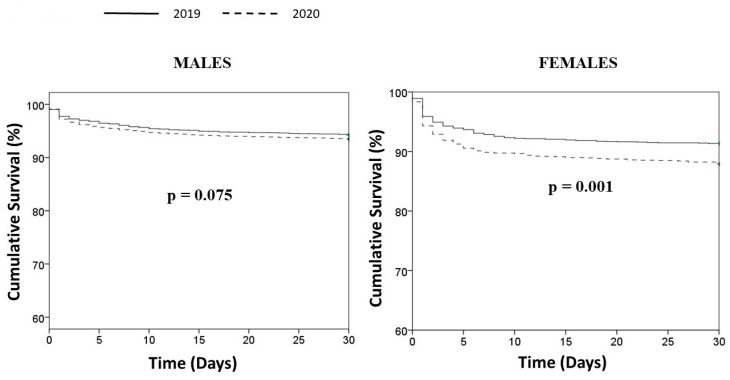
Results: We included 16683 STEMI patients undergoing PPCIs in 109 centers. In 2020 during the pandemic, there was a significant reduction in PPCIs compared to 2019 (IRR 0.843 (95% CI: 0.825-0.861, p < 0.0001). We did not find a significant gender difference in the effects of the COVID-19 pandemic on the numbers of STEMI patients, which were similarly reduced from 2019 to 2020 in both groups, or in the mortality rates. Compared to prepandemia, 30-day mortality was significantly higher during the pandemic period among female (12.1% vs. 8.7%; adjusted HR [95% CI] = 1.66 [1.31-2.11], p < 0.001) but not male patients (5.8% vs. 6.7%; adjusted HR [95% CI] = 1.14 [0.96-1.34], p = 0.12).
Conclusions: The COVID-19 pandemic had a significant impact on the treatment of patients with STEMI, with a 16% reduction in PPCI procedures similarly observed in both genders. Furthermore, we observed significantly increased in-hospital and 30-day mortality rates during the pandemic only among females. Trial registration number: NCT 04412655.
Keywords: COVID-19; ST-segment elevation myocardial infarction; gender; percutaneous coronary intervention.
Conflict of interest statement
The authors declare no conflict of interest concerning the submitted study.
Figures
References
-
- Coronavirus (COVID-19) Deaths. [(accessed on 31 January 2022)]. Available online: https://ourworldindata.org/covid-deaths.
-
- Garcia S., Albaghdadi M.S., Meraj P.M., Schmidt C., Garberich R., Jaffer F.A., Dixon S., Rade J.J., Tannenbaum M., Chambers J., et al. Reduction in ST-Segment Elevation Cardiac Catheterization Laboratory Activations in the United States during COVID-19 Pandemic. J. Am. Coll. Cardiol. 2020;75:2871–2872. doi: 10.1016/j.jacc.2020.04.011. - DOI - PMC - PubMed
-
- Tam C.F., Cheung K.S., Lam S., Wong A., Yung A., Sze M., Lam Y.M., Chan C., Tsang T.C., Tsui M., et al. Impact of Coronavirus Disease 2019 (COVID-19) Outbreak on ST-Segment-Elevation Myocardial Infarction Care in Hong Kong, China. Circ. Cardiovasc Qual. Outcomes. 2020;13:e006631. doi: 10.1161/CIRCOUTCOMES.120.006631. - DOI - PMC - PubMed
-
- Piccolo R., Bruzzese D., Mauro C., Aloia A., Baldi C., Boccalatte M., Bottiglieri G., Briguori C., Caiazzo G., Calabrò P., et al. Population Trends in Rates of Percutaneous Coronary Revascularization for Acute Coronary Syndromes Associated with the COVID-19. Outbreak Circ. 2020;141:2035–2037. doi: 10.1161/CIRCULATIONAHA.120.047457. - DOI - PMC - PubMed
