. 2023 Jan 30;12(3):1068.
doi: 10.3390/jcm12031068.

Primary Stereotactic Radiosurgery Provides Favorable Tumor Control for Intraventricular Meningioma: A Retrospective Analysis

Affiliations

Primary Stereotactic Radiosurgery Provides Favorable Tumor Control for Intraventricular Meningioma: A Retrospective Analysis

Motoyuki Umekawa et al. J Clin Med. .

Abstract

The surgical resection of intraventricular meningiomas (IVMs) remains challenging because of their anatomically deep locations and proximity to vital structures, resulting in non-negligible morbidity and mortality rates. Stereotactic radiosurgery (SRS) is a safe and effective treatment option, providing durable tumor control for benign brain tumors, but its outcomes for IVMs have rarely been reported. Therefore, the goal of the present study was to evaluate the SRS outcomes for IVMs at our institution. This retrospective observational study included 11 patients with 12 IVMs with a median follow-up period of 52 months (range, 3-353 months) treated with SRS using the Leksell Gamma Knife. Nine (75%) tumors were located in the trigone of the lateral ventricle, two (17%) in the body of the lateral ventricle, and one (8%) in the third ventricle. Tumor control was achieved in all cases, and seven (55%) decreased in size. Post-SRS perifocal edema was observed in four (37%; three asymptomatic and one symptomatic but transient) patients, all of which were resolved by the last follow-up. SRS appears to provide safe and excellent tumor control for IVMs. A longer follow-up with a larger number of cases is desired for a more solid conclusion.

Keywords: intraventricular meningioma; long-term outcomes; stereotactic radiosurgery.


Conflict of interest statement

The authors declare no conflict of interest.

Figures
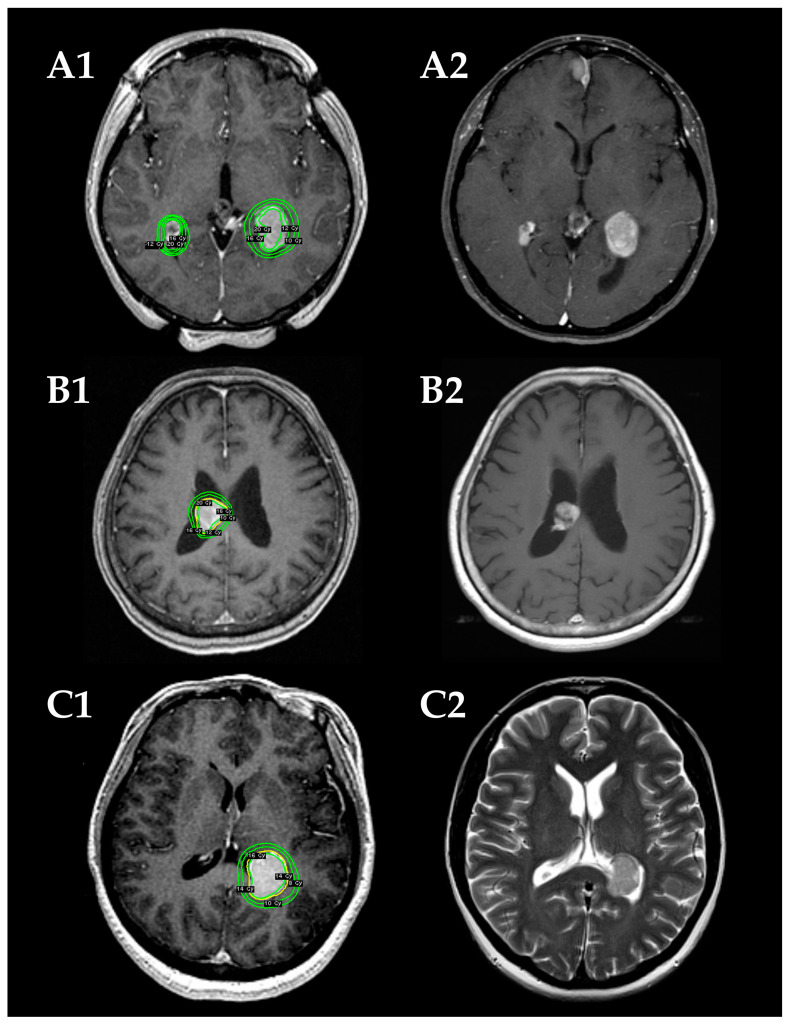
Figure 1
Figure 1
Radiosurgical plans (A1C1) and follow-up magnetic resonance images (MRIs) (A2C2) in three demonstrative patients. (A) A 31-year-old woman with NF2-related bilateral intraventricular meningiomas (IVMs) in the trigones of the lateral ventricles (cases 7 and 8). The tumors are stable in size on a follow-up MRI at 21 months after the stereotactic radiosurgery (SRS). (B) An 80-year-old woman with a sporadic IVM in the body of the right lateral ventricle (case 9). Tumor shrinkage is confirmed on a follow-up MRI at 109 months after the SRS. (C) A 50-year-old woman with a sporadic IVM in left trigone (case 11). Tumor shrinkage is confirmed on a follow-up MRI at 35 months after the SRS.
Figure 2
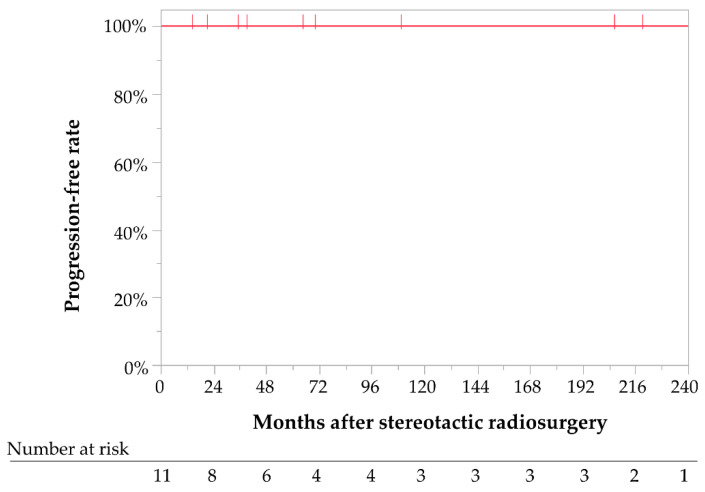
Figure 2
Kaplan–Meier curve for progression-free rates for all patients with intraventricular meningiomas treated with stereotactic radiosurgery.
Figure 3
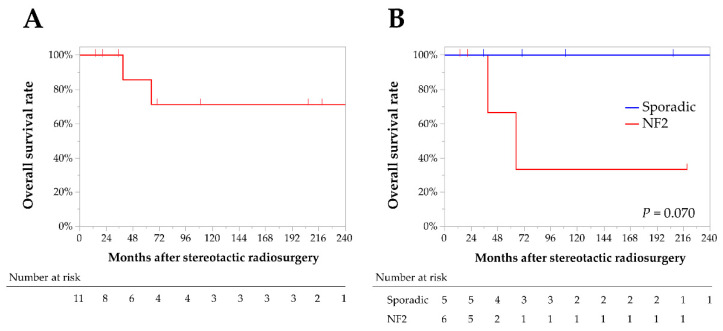
Figure 3
Kaplan–Meier curves for the overall survival rates in all patients (A), and a comparison between sporadic and neurofibromatosis-type-2-related intraventricular meningiomas (B).
Figure 4
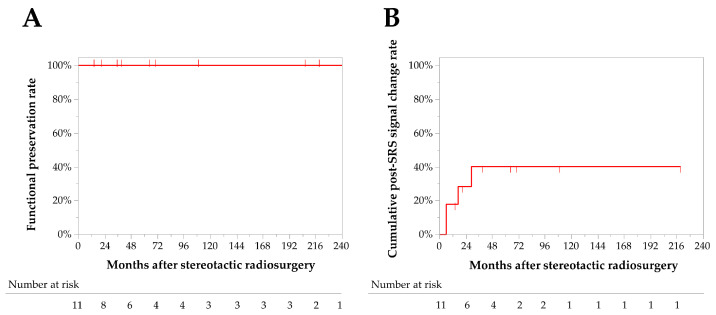
Figure 4
Kaplan–Meier curves for functional preservation rates (A) and cumulative post-stereotacitic radiosurgery T2 signal change rates (B).

References

    1. Ragel B.T., Jensen R.L., Couldwell W.T. Inflammatory response and meningioma tumorigenesis and the effect of cyclooxygenase-2 inhibitors. Neurosurg. Focus. 2007;23:E7. doi: 10.3171/FOC-07/10/E7. - DOI - PubMed
    1. Riemenschneider M.J., Perry A., Reifenberger G. Histological classification and molecular genetics of meningiomas. Lancet Neurol. 2006;5:1045–1054. doi: 10.1016/S1474-4422(06)70625-1. - DOI - PubMed
    1. Nakamura M., Roser F., Bundschuh O., Vorkapic P., Samii M. Intraventricular meningiomas: A review of 16 cases with reference to the literature. Surg. Neurol. 2003;59:490–503. doi: 10.1016/S0090-3019(03)00082-X. - DOI - PubMed
    1. Pereira B.J.A., de Almeida A.N., Paiva W.S., de Aguiar P.H.P., Teixeira M.J., Marie S.K.N. Natural history of intraventricular meningiomas: Systematic review. Neurosurg. Rev. 2020;43:513–523. doi: 10.1007/s10143-018-1019-0. - DOI - PubMed
    1. Bhatoe H.S., Singh P., Dutta V. Intraventricular meningiomas: A clinicopathological study and review. Neurosurg. Focus. 2006;20:E9. doi: 10.3171/foc.2006.20.3.10. - DOI - PubMed

LinkOut - more resources