. 2023 Feb 3;12(3):1228.
doi: 10.3390/jcm12031228.

Retinopathy of Prematurity in the 21st Century and the Complex Impact of Supplemental Oxygen

Affiliations

Retinopathy of Prematurity in the 21st Century and the Complex Impact of Supplemental Oxygen

Sarah H Rodriguez et al. J Clin Med. .

Abstract

Retinopathy of prematurity (ROP) is a leading cause of childhood blindness. Not only do the epidemiologic determinants and distributions of patients with ROP vary worldwide, but clinical differences have also been described. The Third Edition of the International Classification of ROP (ICROP3) acknowledges that aggressive ROP (AROP) can occur in larger preterm infants and involve areas of the more anterior retina, particularly in low-resource settings with unmonitored oxygen supplementation. As sub-specialty training programs are underway to address an epidemic of ROP in sub-Saharan Africa, recognizing characteristic retinal pathology in preterm infants exposed to unmonitored supplemental oxygen is important to proper diagnosis and treatment. This paper describes specific features associated with various ROP presentations: oxygen-induced retinopathy in animal models, traditional ROP seen in high-income countries with modern oxygen management, and ROP related to excessive oxygen supplementation in low- and middle-income countries: oxygen-associated ROP (OA-ROP).

Keywords: childhood blindness; global health; global ophthalmology; ophthalmology; oxygen; oxygen-associated retinopathy of prematurity; oxygen-induced retinopathy; pediatric blindness; retinopathy of prematurity; retrolental fibroplasia.


Conflict of interest statement

The authors declare no conflict of interest.

Figures
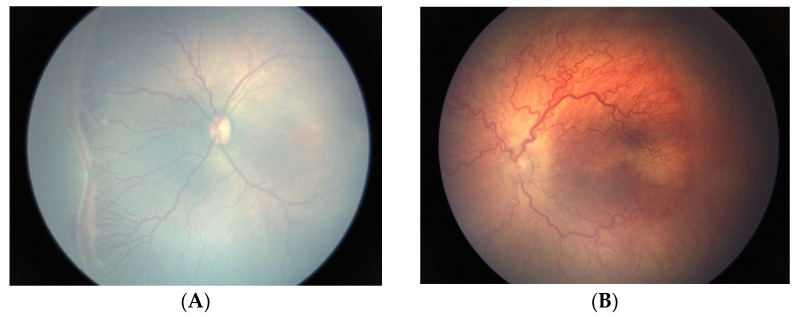
Figure 1
Figure 1
Patients with typical retinopathy of prematurity (ROP) requiring treatment (Type 1 ROP) in a neonatal intensive care unit with modern strict oxygen regulation. (A) Preterm infant with gestational age of 26 weeks and birthweight of 600 g, who developed stage 3 ROP in zone I (Type 1 ROP) at 38 weeks’ post-menstrual age. Notice the traditional stage 3 ROP, characterized by extraretinal neovascular proliferation. (B) Fundus photograph of a baby born at 24 weeks and a birthweight of 710 g with very severe bronchopulmonary dysplasia. As pictured at 34 weeks’ post-menstrual age, note the deceptively featureless networks of flat neovascularization in the setting of severe plus disease and aggressive ROP (A-ROP).
Figure 2
Figure 2
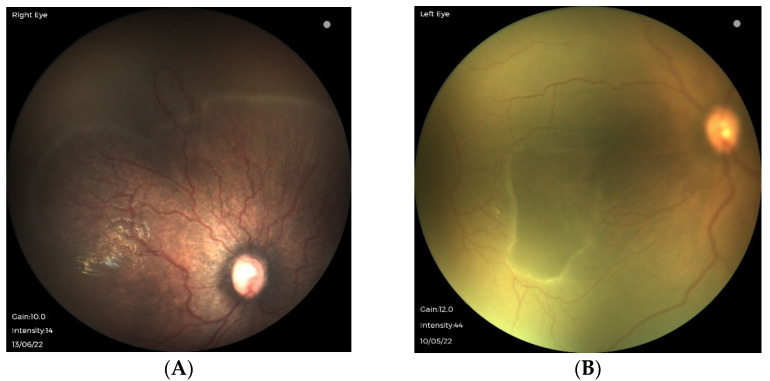
Retinal pathology photographed at 36 weeks’ post-menstrual age in a preterm infant born at 32 weeks and 1500 g, exposed to 100% oxygen. (A) The right eye has shunt vessels extending beyond the vascular–avascular junction superiorly. (B) The left eye has an island of avascular retina within otherwise vascularized retina nasally.
Figure 3
Figure 3
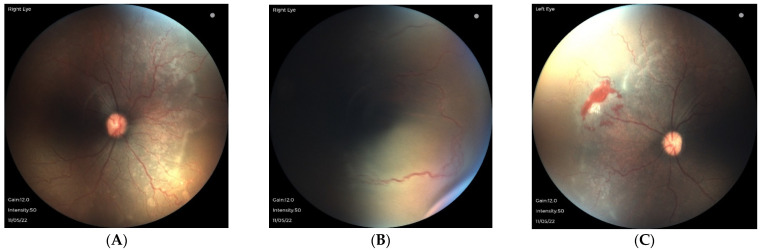
Fundus photograph at 36 3/7 weeks’ post-menstrual age in a larger infant (gestational age 32 weeks, birthweight 1600 g), exposed to 100% oxygen. (A,B) Notice the posterior vessel changes with areas of fibrosis and large looping vessels with capillary dropout. Although the avascular retina extends into zone I, large looping vessels can be seen extending more anteriorly into the nasal periphery surrounding areas of capillary dropout. (C) Similar findings are seen in the left eye with fibrosis and shunt vessels extending peripherally. Note the flat neovascularization and fibrosis, which are distinct from the traditional stage 3 retinopathy of prematurity of extraretinal neovascularization shown in Figure 1A.

References

    1. Terry T.L. Fibroblastic overgrowth of persistent tunica vasculosa lentis in infants born prematurely: II. Report of clinical aspects. Trans. Am. Ophthalmol. Soc. 1942;40:262–284. - PMC - PubMed
    1. Gilbert C. Retinopathy of prematurity: A global perspective of the epidemics, population of babies at risk and implications for control. Early Hum. Dev. 2008;84:77–82. doi: 10.1016/j.earlhumdev.2007.11.009. - DOI - PubMed
    1. Campbell K. Intensive oxygen therapy as a possible cause of retrolental fibroplasia; a clinical approach. Med. J. Aust. 1951;2:48–50. doi: 10.5694/j.1326-5377.1951.tb109040.x. - DOI - PubMed
    1. Patz A.H.L., De La Cruz E. Studies on the effect of high oxygen administration in retrolental fibroplasia. I. Nursery observations. Am. J. Ophthalmol. 1952;35:1248–1253. doi: 10.1016/0002-9394(52)91140-9. - DOI - PubMed
    1. Kinsey V.E. Retrolental fibroplasia: Cooperative study of retrolental fibroplasia and the use of oxygen. AMA Arch. Ophthalmol. 1956;56:481–543. doi: 10.1001/archopht.1956.00930040489001. - DOI - PubMed