


Current Therapeutic Strategies for Patients with Hypopharyngeal Carcinoma: Oncologic and Functional Outcomes
- PMID: 36769885
- PMCID: PMC9918098
- DOI: 10.3390/jcm12031237
Current Therapeutic Strategies for Patients with Hypopharyngeal Carcinoma: Oncologic and Functional Outcomes
Abstract
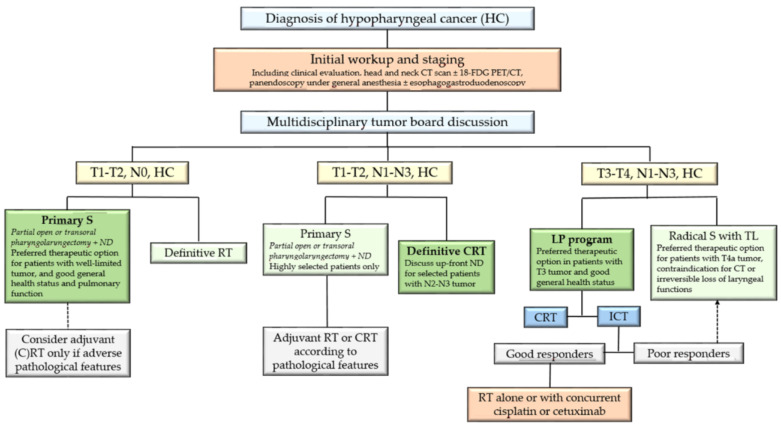
Hypopharyngeal cancer is usually diagnosed at an advanced stage and is associated with a high risk of recurrence and poor survival rates. Although they differ greatly in terms of prognosis, hypopharyngeal cancers are usually treated together with laryngeal cancers in clinical trials. Therefore, there are very few studies that focus specifically on patients with hypopharyngeal carcinoma. As a result, the therapeutic management of these patients is highly debated, and their clinical outcomes are poorly reported. The aim of this review is therefore to discuss the current therapeutic options in patients with hypopharyngeal carcinoma and their oncologic and functional outcomes. Patients with early-stage tumors can be treated either by conservative surgery (including transoral robot-assisted surgery) or by RT alone. However, most patients are diagnosed with locally advanced tumors that cannot be treated surgically without total laryngectomy. In this situation, the critical issue is to select the patients eligible for a larynx preservation therapeutic program. However, radical surgery with total laryngectomy still plays an important role in the management of patients with hypopharyngeal carcinoma, either as the primary treatment modality (T4 resectable primary tumor, contraindication to larynx preservation therapies) or, more commonly, as salvage treatment.
Keywords: functional outcomes; hypopharynx; larynx preservation; squamous cell carcinoma; survival; total laryngectomy.
Conflict of interest statement
The authors declare no conflict of interest.
Figures
References
-
- Global Burden of Disease Cancer Collaboration Global, regional, and national cancer incidence, mortality, years of life lost, years lived with disability, and disability-adjusted life-years for 29 Cancer Groups, 1990 to 2017: A systematic analysis for the global burden of disease study. JAMA Oncol. 2019;5:1749–1768. doi: 10.1001/jamaoncol.2019.2996. - DOI - PMC - PubMed
-
- Tseng C.M., Wang H.H., Le C.T., Tai C.M., Tseng C.H., Chen C.C., Tsai Y.N., Chen T.H., Hsu M.H., Wang C.C., et al. A nationwide population-based study to access the risk of metachronous esophageal cancers in head and neck cancer survivors. Sci. Rep. 2020;10:884. doi: 10.1038/s41598-020-57630-6. - DOI - PMC - PubMed
Publication types
LinkOut - more resources
Full Text Sources
Research Materials
