Review
. 2023 Jan 29;13(3):546.
doi: 10.3390/nano13030546.

Semiconductor Nanomaterial Photocatalysts for Water-Splitting Hydrogen Production: The Holy Grail of Converting Solar Energy to Fuel

Affiliations
Review

Semiconductor Nanomaterial Photocatalysts for Water-Splitting Hydrogen Production: The Holy Grail of Converting Solar Energy to Fuel

Muhammad Mohsin et al. Nanomaterials (Basel). .

Abstract

Nanomaterials have attracted attention for application in photocatalytic hydrogen production because of their beneficial properties such as high specific surface area, attractive morphology, and high light absorption. Furthermore, hydrogen is a clean and green source of energy that may help to resolve the existing energy crisis and increasing environmental pollution caused by the consumption of fossil fuels. Among various hydrogen production methods, photocatalytic water splitting is most significant because it utilizes solar light, a freely available energy source throughout the world, activated via semiconductor nanomaterial catalysts. Various types of photocatalysts are developed for this purpose, including carbon-based and transition-metal-based photocatalysts, and each has its advantages and disadvantages. The present review highlights the basic principle of water splitting and various techniques such as the thermochemical process, electrocatalytic process, and direct solar water splitting to enhance hydrogen production. Moreover, modification strategies such as band gap engineering, semiconductor alloys, and multiphoton photocatalysts have been reviewed. Furthermore, the Z- and S-schemes of heterojunction photocatalysts for water splitting were also reviewed. Ultimately, the strategies for developing efficient, practical, highly efficient, and novel visible-light-harvesting photocatalysts will be discussed, in addition to the challenges that are involved. This review can provide researchers with a reference for the current state of affairs, and may motivate them to develop new materials for hydrogen generation.

Keywords: green source; hydrogen production; nanomaterial; photocatalysis; semiconductor materials; water splitting.


Conflict of interest statement

There are no conflict of interest to declare.

Figures

Figure 3
Figure 3
Shows a schematic diagram of hydrogen production from a particulate photocatalytic system. Printed with permission from the Royal Chemical Society [43].
Figure 6
Figure 6
Representing the band gap of material obtained via a solid solution of wide and narrow-band-gap materials. Printed with permission from Wiley Online Library [62].
Figure 1
Figure 1
The basic principle of water splitting on the photocatalyst surface. Printed with permission from the Royal Chemical Society [21].
Figure 2
Figure 2
Hydrogen production using (a) semiconductor photocatalysts (b) photo electrolytic process and (c) particular photocatalytic system. Printed with permission from the Royal Chemical Society [42].
Figure 4
Figure 4
Band gap structure of a cation-doped wide band gap semiconductor. Printed with permission from Wiley Online Library [57].
Figure 5
Figure 5
Anion-doped wide band gap semiconductor with visible-light activity. Printed with permission from Wiley Online Library [46].
Figure 7
Figure 7
Semiconductor catalyst with co-catalyst. Printed with permission from Frontiers [63].
Figure 8
Figure 8
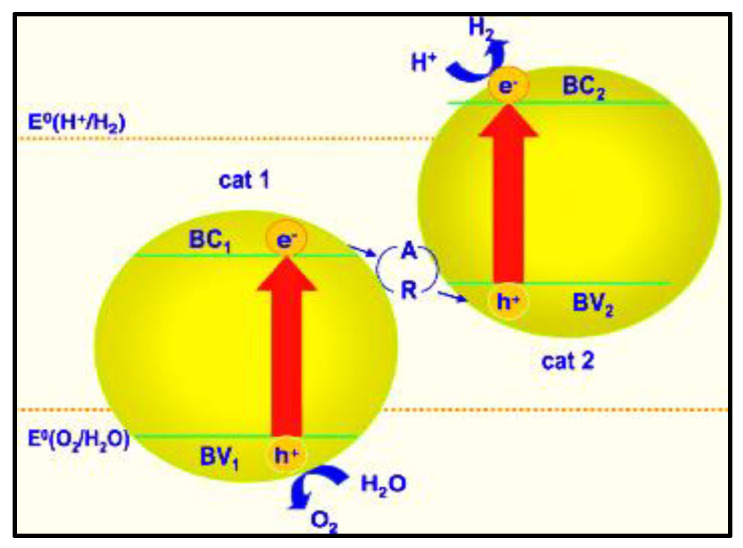
Dual photocatalysts system employing a redox shuttle. Printed with permission from Wiley Online Library [46].
Figure 9
Figure 9
Z-scheme mechanism for photocatalytic water splitting. Printed with permission from Elsevier [80].
Figure 10
Figure 10
S-scheme pathway for photocatalytic water splitting. Printed with permission from Elsevier [81].
Figure 11
Figure 11
Dual-functionalized mixed Keggin- and Lindqvist-type [CuI243-Cl)8 µ4-Cl]6] based POM@MOFs as H2 and O2 evolution photocatalysts. Printed with permission from the American Chemical Society [86].
Figure 12
Figure 12
Diagram of an instance of type-II MIL-167 and MIL-125- NH2 heterojunctions. Printed with permission from American Chemical Society [87].
Figure 13
Figure 13
UV/visible diffuse reflectance spectra of Sm2Ti2O7 and Sm2Ti2S2O5. Printed with permission from American Chemical Society [120].
Figure 14
Figure 14
UV–visible diffuse reflectance spectra of Ta2O5, TaON, Ta2N3, and MtaO2N (M: Ca, Sr, Ba). Printed with permission from Elsevier [125].
Figure 15
Figure 15
(A) Powder X-ray diffraction patterns and (B) UV/visible diffuse reflectance spectra of (a) GaN, (b) GaN:ZnO, (c) GaN:ZnO, (d) GaN:ZnO, and (e) ZnO. Printed with permission from American Chemical Society [132].
Figure 16
Figure 16
Hydrogen production rate from an aqueous solution of Na2S and Na2SO3 in visible light over solid solutions of Cd1-xZnxS with different zinc concentrations (0.2, 0.25, 0.30, and 0.35) in 150 mL of reactant solution with a 0.1 M concentration of Na2S and 0.04 M concentration of Na2SO3. Printed with permission from Elsevier [145].
Figure 17
Figure 17
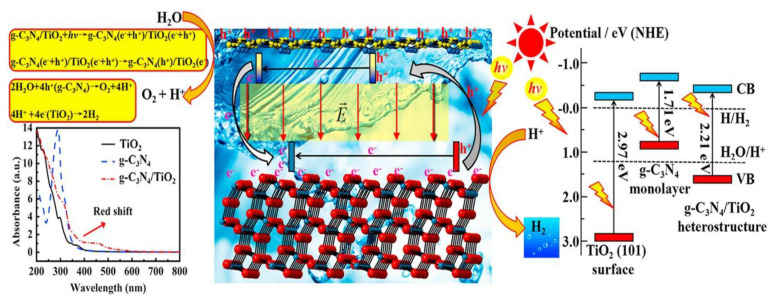
Schematic diagram of g-C3N4TiO2 band gap reduction and working efficiency. Printed with permission from Elsevier [148].

References

    1. Abdi J., Sisi A.J., Hadipoor M., Khataee A. State of the art on the ultrasonic-assisted removal of environmental pollutants using metal-organic frameworks. J. Hazard. Mater. 2022;424:127558. doi: 10.1016/j.jhazmat.2021.127558. - DOI - PubMed
    1. Mohsin M., Bhatti I.A., Ashar A., Khan M.W., Farooq M.U., Khan H., Hussain M.T., Loomba S., Mohiuddin M., Zavabeti A. Iron-doped zinc oxide for photocatalyzed degradation of humic acid from municipal wastewater. Appl. Mater. Today. 2021;23:101047. doi: 10.1016/j.apmt.2021.101047. - DOI
    1. Hisatomi T., Domen K. Reaction systems for solar hydrogen production via water splitting with particulate semiconductor photocatalysts. Nat. Catal. 2019;2:387–399. doi: 10.1038/s41929-019-0242-6. - DOI
    1. Tobaldi D., Kočí K., Edelmannová M., Lajaunie L., Figueiredo B., Calvino J., Seabra M., Labrincha J. CuxO and carbon–modified TiO2–based hybrid materials for photocatalytically assisted H2 generation. Mater. Today Energy. 2021;19:100607. doi: 10.1016/j.mtener.2020.100607. - DOI
    1. Wang H., Wang H., Wang Z., Tang L., Zeng G., Xu P., Chen M., Xiong T., Zhou C., Li X. Covalent organic framework photocatalysts: Structures and applications. Chem. Soc. Rev. 2020;49:4135–4165. doi: 10.1039/D0CS00278J. - DOI - PubMed

LinkOut - more resources