


A Comprehensive Review on Adsorption, Photocatalytic and Chemical Degradation of Dyes and Nitro-Compounds over Different Kinds of Porous and Composite Materials
- PMID: 36770748
- PMCID: PMC9918932
- DOI: 10.3390/molecules28031081
A Comprehensive Review on Adsorption, Photocatalytic and Chemical Degradation of Dyes and Nitro-Compounds over Different Kinds of Porous and Composite Materials
Abstract
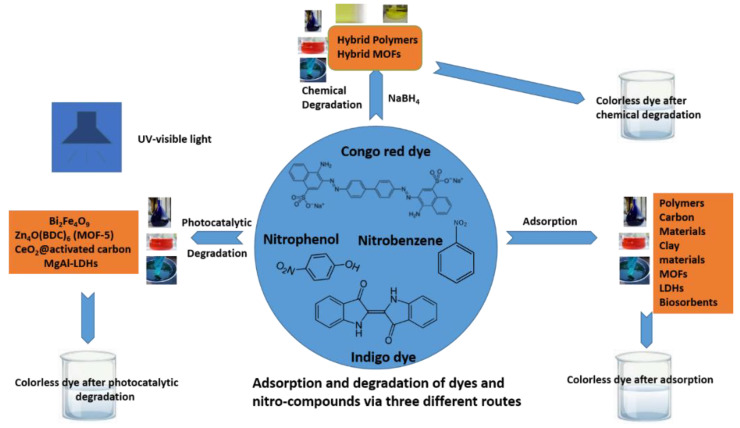
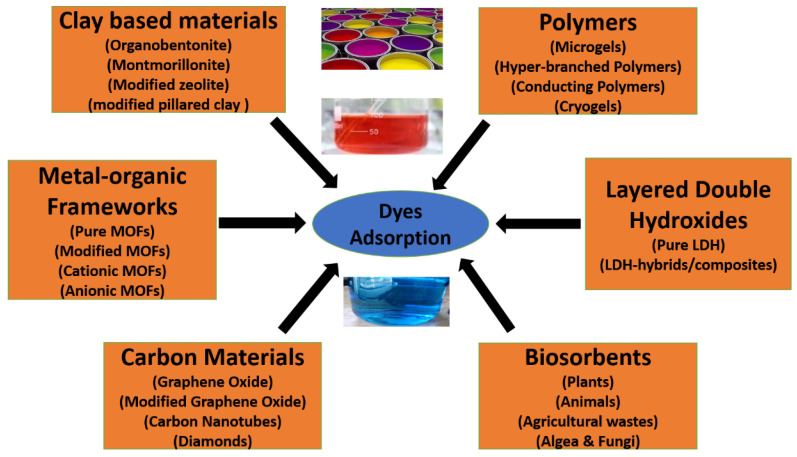
Dye and nitro-compound pollution has become a significant issue worldwide. The adsorption and degradation of dyes and nitro-compounds have recently become important areas of study. Different methods, such as precipitation, flocculation, ultra-filtration, ion exchange, coagulation, and electro-catalytic degradation have been adopted for the adsorption and degradation of these organic pollutants. Apart from these methods, adsorption, photocatalytic degradation, and chemical degradation are considered the most economical and efficient to control water pollution from dyes and nitro-compounds. In this review, different kinds of dyes and nitro-compounds, and their adverse effects on aquatic organisms and human beings, were summarized in depth. This review article covers the comprehensive analysis of the adsorption of dyes over different materials (porous polymer, carbon-based materials, clay-based materials, layer double hydroxides, metal-organic frameworks, and biosorbents). The mechanism and kinetics of dye adsorption were the central parts of this study. The structures of all the materials mentioned above were discussed, along with their main functional groups responsible for dye adsorption. Removal and degradation methods, such as adsorption, photocatalytic degradation, and chemical degradation of dyes and nitro-compounds were also the main aim of this review article, as well as the materials used for such degradation. The mechanisms of photocatalytic and chemical degradation were also explained comprehensively. Different factors responsible for adsorption, photocatalytic degradation, and chemical degradation were also highlighted. Advantages and disadvantages, as well as economic cost, were also discussed briefly. This review will be beneficial for the reader as it covers all aspects of dye adsorption and the degradation of dyes and nitro-compounds. Future aspects and shortcomings were also part of this review article. There are several review articles on all these topics, but such a comprehensive study has not been performed so far in the literature.
Keywords: biosorbents; carbon materials; composite; layered double hydroxides; metal–organic frameworks; organic pollutants; polymeric materials; porosity.
Conflict of interest statement
The authors declare no conflict of interest.
Figures

References
-
- Elgarahy A., Elwakeel K., Mohammad S., Elshoubaky G.A. A critical review of biosorption of dyes, heavy metals and metalloids from wastewater as an efficient and green process. Clean. Eng. Technol. 2021;4:100209. doi: 10.1016/j.clet.2021.100209. - DOI
-
- Zafar A., Ullah S., Majeed M.T., Yasmeen R. Environmental pollution in Asian economies: Does the industrialisation matter? OPEC Energy Rev. 2020;44:227–248. doi: 10.1111/opec.12181. - DOI
-
- Islam A., Teo S.H., Taufiq-Yap Y.H., Ng C.H., Vo DV N., Ibrahim M.L., Munjur H.M., Khan MA R., Nur A.S.M., Awual M.R. Step towards the sustainable toxic dyes removal and recycling from aqueous solution-A comprehensive review. Resour. Conserv. Recycl. 2021;175:105849. doi: 10.1016/j.resconrec.2021.105849. - DOI
-
- Valentin L., Nousiainen A., Mikkonen A. Emerging Organic Contaminants in Sludges. Springer; Berlin/Heidelberg, Germany: 2013. Introduction to organic contaminants in soil: Concepts and risks; pp. 1–29.
Publication types
LinkOut - more resources
Full Text Sources
