Review
. 2023 Feb 2;28(3):1421.
doi: 10.3390/molecules28031421.

Towards Antibiotic Synthesis in Continuous-Flow Processes

Affiliations
Review

Towards Antibiotic Synthesis in Continuous-Flow Processes

Marziale Comito et al. Molecules. .

Abstract

Continuous-flow chemistry has become a mainstream process and a notable trend among emerging technologies for drug synthesis. It is routinely used in academic and industrial laboratories to generate a wide variety of molecules and building blocks. The advantages it provides, in terms of safety, speed, cost efficiency and small-equipment footprint compared to analog batch processes, have been known for some time. What has become even more important in recent years is its compliance with the quality objectives that are required by drug-development protocols that integrate inline analysis and purification tools. There can be no doubt that worldwide government agencies have strongly encouraged the study and implementation of this innovative, sustainable and environmentally friendly technology. In this brief review, we list and evaluate the development and applications of continuous-flow processes for antibiotic synthesis. This work spans the period of 2012-2022 and highlights the main cases in which either active ingredients or their intermediates were produced under continuous flow. We hope that this manuscript will provide an overview of the field and a starting point for a deeper understanding of the impact of flow chemistry on the broad panorama of antibiotic synthesis.

Keywords: antibiotics; continuous process; drug synthesis; flow chemistry; industrial application; miniaturization; process control.


Conflict of interest statement

The authors declare no conflict of interest.

Figures

Figure 1
Figure 1
End-to-end continuous manufacturing compared to batch-manufacturing process.
Figure 2
Figure 2
The advantages of flow chemistry for the pharmaceutical industry.
Scheme 1
Scheme 1
Cefotaxime (1) flow synthesis inspired by Ref. [82].
Figure 3
Figure 3
Scheme (a) and photo (b) of a cephalexin (2) flow system with enzyme recycling. Reprinted with permission from ref. [83], Copyright 2020 Elsevier B.V.
Scheme 2
Scheme 2
Enzymatic cephalexin (2) synthesis reaction scheme.
Scheme 3
Scheme 3
Continuous total synthesis of ciprofloxacin hydrochloride (3) by Lin [84].
Scheme 4
Scheme 4
Continuous total synthesis of ciprofloxacin hydrochloride (3) by Armstrong [85].
Figure 4
Figure 4
Two gravity separators used in the CLLE step. (a) Separatory funnel with pumping out of the organic layer into a different vessel. (b) Custom gravity separator with an organic overflow egress to different vessel. Reprinted with permission from ref. [85]. Copyright 2021, American Chemical Society.
Scheme 5
Scheme 5
Seven-step linezolid (4) flow synthesis. I.D., inner diameter.
Scheme 6
Scheme 6
Tazobactam (5) synthesis under combined flow and batch conditions.
Scheme 7
Scheme 7
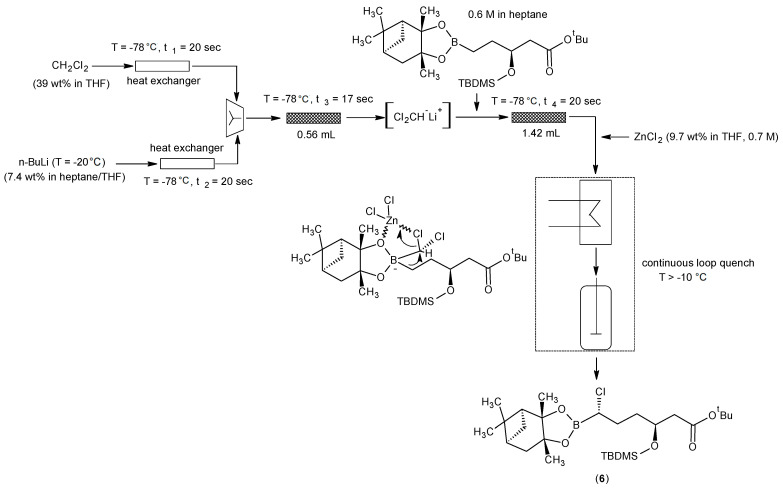
Flow process for the Matteson reaction to manufacture the key vaborbactam intermediate (6).
Scheme 8
Scheme 8
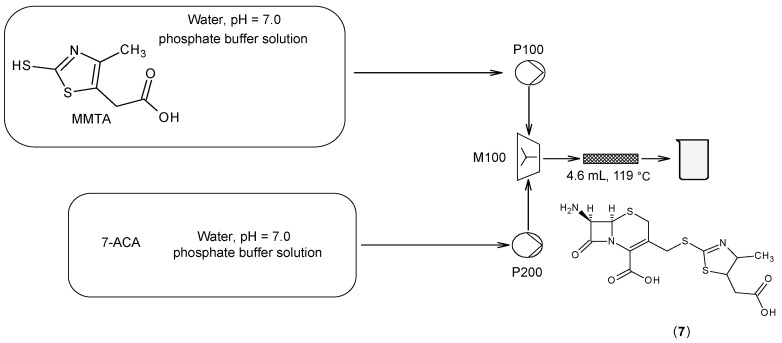
Flow synthesis of 7-TACA (7).
Scheme 9
Scheme 9
Flow synthesis of MAP (8).
Scheme 10
Scheme 10
Integrated microfluidic reactor-separator for 6-APA production.

References

    1. Hutchings M., Truman A., Wilkinson B. Antibiotics: Past, present and future. Curr. Opin. Microbiol. 2019;51:72–80. doi: 10.1016/j.mib.2019.10.008. - DOI - PubMed
    1. Hanna E., Remuzat C., Auquier P., Toumi M. Advanced therapy medicinal products: Current and future perspectives. J. Mark. Access Health Policy. 2016;4:31036. doi: 10.3402/jmahp.v4.31036. - DOI - PMC - PubMed
    1. Ginn S.L., Alexander I.E., Edelstein M.L., Abedi M.R., Wixon J. Gene therapy clinical trials worldwide to 2012—An update. J. Gene Med. 2013;15:65–77. doi: 10.1002/jgm.2698. - DOI - PubMed
    1. Bisson I., green E., Sharpe M., Herbert C., Hyllner J., Mount N. Landscape of current and emerging cell therapy clinical trials in the UK: Current status, comparison to global trends and future perspectives. Regen. Med. 2015;10:169–179. doi: 10.2217/rme.14.71. - DOI - PubMed
    1. Baraldi P.T., Hessel V. Micro reactor and flow chemistry for industrial applications in drug discovery and development. Green Process. Synth. 2012;1:149–167. doi: 10.1515/gps-2012-0008. - DOI

Substances

LinkOut - more resources