


Advanced Polymeric Nanocomposite Membranes for Water and Wastewater Treatment: A Comprehensive Review
- PMID: 36771842
- PMCID: PMC9920371
- DOI: 10.3390/polym15030540
Advanced Polymeric Nanocomposite Membranes for Water and Wastewater Treatment: A Comprehensive Review
Abstract
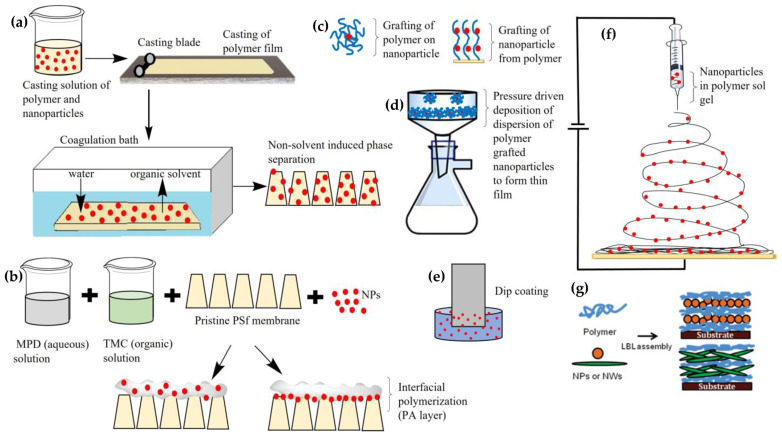
Nanomaterials have been extensively used in polymer nanocomposite membranes due to the inclusion of unique features that enhance water and wastewater treatment performance. Compared to the pristine membranes, the incorporation of nanomodifiers not only improves membrane performance (water permeability, salt rejection, contaminant removal, selectivity), but also the intrinsic properties (hydrophilicity, porosity, antifouling properties, antimicrobial properties, mechanical, thermal, and chemical stability) of these membranes. This review focuses on applications of different types of nanomaterials: zero-dimensional (metal/metal oxide nanoparticles), one-dimensional (carbon nanotubes), two-dimensional (graphene and associated structures), and three-dimensional (zeolites and associated frameworks) nanomaterials combined with polymers towards novel polymeric nanocomposites for water and wastewater treatment applications. This review will show that combinations of nanomaterials and polymers impart enhanced features into the pristine membrane; however, the underlying issues associated with the modification processes and environmental impact of these membranes are less obvious. This review also highlights the utility of computational methods toward understanding the structural and functional properties of the membranes. Here, we highlight the fabrication methods, advantages, challenges, environmental impact, and future scope of these advanced polymeric nanocomposite membrane based systems for water and wastewater treatment applications.
Keywords: biopolymers; computational studies; desalination; inorganic nanoparticles; polymer nanocomposites; water treatment.
Conflict of interest statement
The authors declare no conflict of interest.
Figures
Similar articles
-
State-of-the-Art of Polymer/Fullerene C60 Nanocomposite Membranes for Water Treatment: Conceptions, Structural Diversity and Topographies.Membranes (Basel). 2022 Dec 25;13(1):27. doi: 10.3390/membranes13010027. Membranes (Basel). 2022. PMID: 36676834 Free PMC article. Review.
-
Development of a Polymeric Carbon Nanocomposite Hollow-Fiber Membrane for Wastewater Treatment.J Nanosci Nanotechnol. 2021 Jul 1;21(7):3711-3715. doi: 10.1166/jnn.2021.19208. J Nanosci Nanotechnol. 2021. PMID: 33715679
-
Nanometals-Containing Polymeric Membranes for Purification Processes.Materials (Basel). 2021 Jan 21;14(3):513. doi: 10.3390/ma14030513. Materials (Basel). 2021. PMID: 33494485 Free PMC article. Review.
-
Classification of Nanomaterials and the Effect of Graphene Oxide (GO) and Recently Developed Nanoparticles on the Ultrafiltration Membrane and Their Applications: A Review.Membranes (Basel). 2022 Oct 26;12(11):1043. doi: 10.3390/membranes12111043. Membranes (Basel). 2022. PMID: 36363598 Free PMC article. Review.
-
Synthesis of Graphene-Based Nanocomposites for Environmental Remediation Applications: A Review.Molecules. 2022 Sep 29;27(19):6433. doi: 10.3390/molecules27196433. Molecules. 2022. PMID: 36234970 Free PMC article. Review.
Cited by
-
Recent Developments in Nanocomposite Membranes Based on Carbon Dots.Polymers (Basel). 2024 May 23;16(11):1481. doi: 10.3390/polym16111481. Polymers (Basel). 2024. PMID: 38891428 Free PMC article. Review.
-
Synergistic effects of polyvinylpyrrolidone and graphene oxide in thin film nanocomposite membranes for oily wastewater treatment via forward osmosis process.Sci Rep. 2025 Jul 28;15(1):27372. doi: 10.1038/s41598-025-11383-2. Sci Rep. 2025. PMID: 40721621 Free PMC article.
-
Simulation-Guided Engineering of Mg-Doped Silica Membranes via DFT and MATLAB: Toward High-Efficiency Desalination and Antibacterial Protection.ACS Omega. 2025 Jul 2;10(27):29768-29780. doi: 10.1021/acsomega.5c04165. eCollection 2025 Jul 15. ACS Omega. 2025. PMID: 40687046 Free PMC article.
-
State-of-the-Art Advances and Current Applications of Gel-Based Membranes.Gels. 2024 Jan 1;10(1):39. doi: 10.3390/gels10010039. Gels. 2024. PMID: 38247761 Free PMC article. Review.
-
Review of Additively Manufactured Polymeric Metamaterials: Design, Fabrication, Testing and Modeling.Polymers (Basel). 2023 Sep 22;15(19):3858. doi: 10.3390/polym15193858. Polymers (Basel). 2023. PMID: 37835907 Free PMC article. Review.
References
-
- Goh P.S., Ismail A.F. A review on inorganic membranes for desalination and wastewater treatment. Desalination. 2018;434:60–80. doi: 10.1016/j.desal.2017.07.023. - DOI
-
- Elimelech M. The global challenge for adequate and safe water. J. Water Supply Res. Technol. 2006;55:3–10. doi: 10.2166/aqua.2005.064. - DOI
-
- Esfahani M.R., Aktij S.A., Dabaghian Z., Firouzjaei M.D., Rahimpour A., Eke J., Escobar I.C., Abolhassani M., Greenlee L.F., Esfahani A.R., et al. Nanocomposite membranes for water separation and purification: Fabrication, modification, and applications. Sep. Purif. Technol. 2019;213:465–499. doi: 10.1016/j.seppur.2018.12.050. - DOI
-
- Agboola O., Fayomi O.S.I., Ayodeji A., Ayeni A.O., Alagbe E.E., Sanni S.E., Okoro E.E., Moropeng L., Sadiku R., Kupolati K.W., et al. A review on polymer nanocomposites and their effective applications in membranes and adsorbents for water treatment and gas separation. Membranes. 2021;11:139. doi: 10.3390/membranes11020139. - DOI - PMC - PubMed
-
- Beyene H.D., Ambaye T.G. Sustainable Polymer Composites and Nanocomposites. Springer International Publishing; Berlin/Heidelberg, Germany: 2019. Application of sustainable nanocomposites for water purification process; pp. 387–412.
Publication types
Grants and funding
LinkOut - more resources
Full Text Sources
Molecular Biology Databases
